Section
People & Life
Everyday life, work and school. The voices of people connected with Ukraine.
-
Ukraine Grades on a 12-Point Scale — Except Grades 1–2, Which Get No Numbers at All
Ukrainian school grades run from 1 to 12 points, with 12 the highest. The 12 points are divided into four bands of three points each — "initial," "medium," "sufficient" and "high." The scale switched in 2000 from a 4-point scale (2 to 5); in 2026, a new evaluation system was set that assesses grades 1–2 in words only.
-
Caps on Salt and Sugar, One Free Meal for Every Grade: Ukraine’s School Lunches
A 2021 Cabinet resolution revised the standards for Ukraine's school lunches, setting rules such as a cap of 5 grams of added sugar per 100 grams of a finished dish, and a ban on serving carbonated drinks or coffee. A free meal was extended to all primary school students in 2024, and, from September 2026, to every grade at public schools (as of September 2026).
-
Kalyna Is Not Gamazumi: Rendering Ukrainian Plant and Animal Names in Japanese
Kalyna, leleka, kashtan, soloveiko. Dictionary translations of Ukrainian plant and bird names often do not match the species that go by the same Japanese name. This article covers the method of using scientific names as a bridge to find the correct Japanese common name, 11 easily confused names, the 2021 Red Book list, and whether Ukraine has a legally designated "national flower."
-
The 220,000-Hectare Reserve Created Inside Chornobyl’s Exclusion Zone
In 2016, Ukraine's largest nature reserve was established around Chornobyl, which residents left after the 1986 accident. This article traces, through legislation and announcements from the reserve and the IAEA, the goals stated in the presidential decree, the reserve's four zones, the animals and plants recorded there, and the fires and land mines that remained after Russian forces occupied it in 2022.
-
IDP Housing Allowance: The Extension Cap Rises From Two Six-Month Periods to Six
Since March 2022, Ukraine has paid internally displaced persons a housing allowance of 2,000 hryvnias a month (3,000 hryvnias for people with disabilities and children). The monthly form of payment for the duration of martial law changed to a payment made every six months in August 2023, and the cap on the number of extensions has been raised from two in August 2024 to six in September 2026. There is also a rule under which payment stops if a person leaves the country for more than 30 days.
-
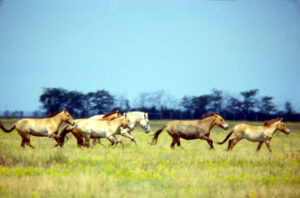
In Ukraine’s Protected Areas: Steppe That Was Never Plowed, and 28 Lakes
In southern Ukraine, steppe that has never been plowed survives; at the western edge, in the Carpathians, old-growth beech forest remains; and in the northwest, in Polissia, lakes and peat wetlands endure. The nature reserves at the heart of these areas were established not as tourist sites but as places of research. Drawing on the records of biosphere reserves and Ramsar wetland sites, this article traces what is being protected, and what is studied there.
-
Birch in March, Falling Leaves in November ── Ukrainian Months, Dates, and Numbers
Many Ukrainian month names come from nature and farm work — birch (March), sickle (August), falling leaves (November). This article draws on Ukrainian dictionaries, the 2019 orthography, and cabinet regulations to set out the origins of the twelve months and the days of the week, how dates are written and read in the day.month.year order, and how numbers combine with nouns.
-
Type лютого and You’ll Get “a Lutheran” ── How to Use a Ukrainian Dictionary
Ukrainian dictionaries list words under their "base form" as headwords, and the online dictionaries do not correct an inflected form for you. Type in лютого and you land on an unrelated word. This article sets out the steps for getting back to the headword, how to read the abbreviations and stress marks on a headword line, and which free public dictionaries and Japanese-language dictionaries are available.
-
Not Noodles but Porridge ── Ukraine’s Hrechka, the World’s Third-Largest Buckwheat Producer
The buckwheat groat called "hrechka" in Ukrainian is eaten as porridge, not made into noodles. This article lines up the ways of eating it that the encyclopedias give, the origin of a name linked to "Greek," and the production figures, year by year, that put Ukraine third in the world for four years running from 2021, according to FAO statistics.
-
Ukraine’s 12-Year School System: The Final Three Years Begin in 2027
Ukrainian schooling runs 12 years — four years of primary education, five years of basic secondary education, and three years of profile-oriented secondary education — and all 12 years are compulsory. Children start school at age 6 in principle, and no later than age 7. However, the final three-year stage is scheduled to begin only in September 2027, so students graduating now finish school after 11 years. University entrance exams have also, since 2022, used the NMT in place of the ZNO required by law.