
Features of Ukraine’s Education System | From Kindergarten to University, and Underground Schools
Ukraine has a reputation for producing many talented people, so you might wonder what kind of education makes that possible.
This time, we explain the features of Ukraine’s education system. There are many differences from Japan, such as music schools for children and continuous education, so if you’re interested in education, please read to the end.
Education at Ukrainian Kindergartens
Kindergarten education in Ukraine places emphasis on early childhood education. Ukraine has a distinctive kind of educational institution not found in Japan: music schools (art schools) for children.
Music Schools for Children
In Ukraine, separate from kindergarten and regular school, children can attend a music school (art school).
These music schools are an important educational institution for nurturing children’s creativity and expressiveness. This is because music education does more than teach instrumental technique — it also improves rhythm, pitch sense, and concentration.
These art schools include national, municipal, and private ones, and children learn to play instruments, sing, and study music theory. This deepens their understanding of music and lays the groundwork for a future career as a musician.
What differs from Japan is that, through music education, children also polish their expressiveness and learn to express themselves with confidence.
Tuition is around 800 hryvnias a month (roughly ¥3,000, at 1 hryvnia = ¥3.75), with a system where top students study for free. Especially high-achieving children can go on to a national music school for advanced musical education.
Kenta Igarashi, the saxophonist who won first place at the 37th Japan Wind and Percussion Competition, is a graduate of Ukraine’s Lysenko National Music School.
This competition helped bring attention to Ukraine’s national music schools.
Preparation for Compulsory Education, Starting at Age 5
In Ukraine, preparation for compulsory schooling begins at age 5. Alongside building the basics of literacy and arithmetic, education is also provided to develop sociability and cooperation.
Literacy and arithmetic are taught through fun, play-based methods, designed to make it easy for children to learn.
Specifically, children become familiar with letters and numbers through picture-book reading and number games.
They also develop sociability through group activities and collaborative work.
By playing with friends and working together to solve tasks, children learn how to relate to others and communicate.
The aim is to help them adapt more easily to group life once compulsory education begins.
Underground Classrooms, to Protect Children from Attacks
Under Russia’s full-scale invasion, in places such as Kharkiv Oblast, classrooms have been set up in the underground shelters of schools and kindergartens to protect children from shelling and missile attacks, and classes are held there.
In above-ground school buildings, classes are interrupted every time an air-raid siren sounds. Underground classrooms are an emergency measure to keep in-person classes going while attacks continue.
Children are not learning underground as a matter of normal educational policy.
These underground classrooms were originally built to serve as shelters.
The Basics of Ukraine’s School Education
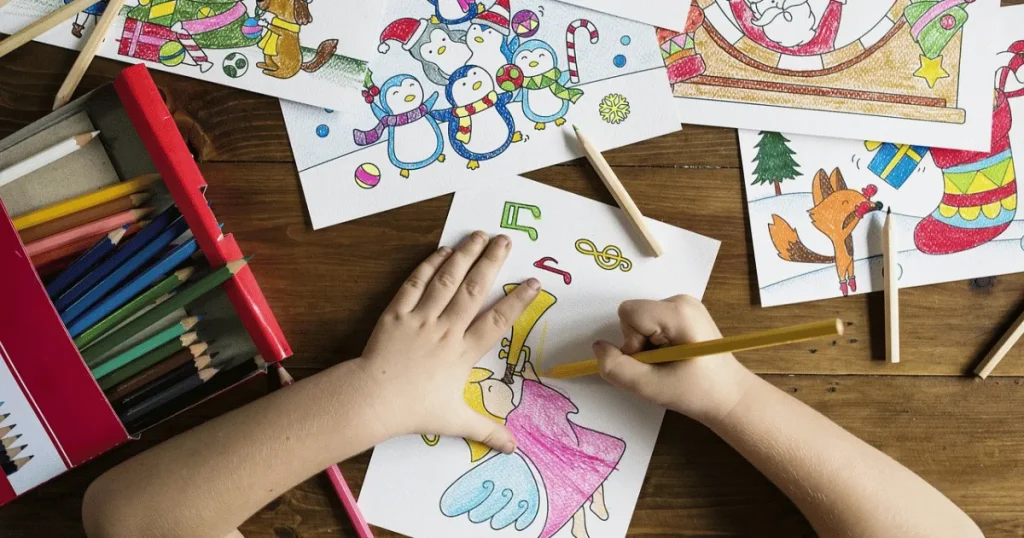
Compulsory education in Ukraine generally begins at age 6, and by law everything from primary education through the completion of full general secondary education is compulsory.
Ukraine’s education system, which differs from Japan’s, allows flexible responses tailored to each child’s stage of development.
The Entry Age for Compulsory Education Is Generally 6
Under the education law, primary education generally begins at age 6, and a child who turns 7 by the start of the school year must enroll that year. Children with special educational needs may start at a different age.
Because the entry age ranges between 6 and 7, some children want to start learning early, while others start a little later.
In particular, because individual differences in early childhood development can be large, this gives children a chance to move on to school without added stress.
A child who isn’t yet ready at age 6 can wait to enroll until the following school year, when they turn 7.
This lets children start school life more smoothly and maintain a positive attitude toward learning.
Compulsory Education Runs Through Full General Secondary Education
Ukraine’s compulsory education is longer than Japan’s nine years — by law it covers primary education (4 years), basic secondary education (5 years), and profile secondary education (3 years) in full. During compulsory education, students study the Ukrainian language, Ukrainian history, mathematics, English, and other subjects.
After completing grade 9, students receive a certificate of basic secondary education. The state final assessment at the end of this stage was waived, under transitional provisions of the law, for the 2021/22 through 2025/26 school years. This basic secondary certificate is required to advance to upper secondary education.
How Ukrainian School Education Differs from Japan’s
There are many ways Ukrainian schools differ from Japanese ones.
In Japan, compulsory education runs from age 6 to 15 (six years of elementary school and three years of junior high), whereas in Ukraine, compulsory education runs from primary education through the completion of full general secondary education.
Ukrainian schools are also known for their strong focus on math education. Advanced math is taught, and children learn complex mathematical concepts and problem-solving skills.
This is part of an education aimed at future success in science and technology fields.
Furthermore, Ukrainian school education places emphasis on STEM (science, technology, engineering, and mathematics) education.
Because Ukrainian children acquire practical skills and theoretical knowledge at the same time, they’re well positioned to become globally competitive talent.
Ukraine’s Compulsory Education Is High-Level
Some of you may be curious about the environment in which Ukrainian children receive compulsory education. Here’s a look at that environment.
Ukraine’s Advanced Math Education
Ukrainian school education places importance on advanced math education. Specialist teachers provide instruction, and by tackling complex math problems, children build logical thinking and problem-solving skills.
Math education is considered one of the strengths of Ukrainian education, with a high level of content taught from an early stage.
Math education begins in primary school, and even more advanced content is added once students move into secondary education. Students get the opportunity to study various fields of mathematics in depth, including algebra, geometry, statistics, and probability theory.
Ukraine’s math education has also focused on building problem-solving ability. Classes take up problems related to everyday life and science and technology, developing children’s ability to think for themselves and find solutions.
This approach differs from Japanese math education, which focuses on simply memorizing formulas, and instead aims to build skills that can be applied to real-world problems.
Ukraine’s National Math Olympiad
Ukraine holds a national math olympiad every year. This olympiad is a place where children with outstanding mathematical talent gather to compete.
Participants tackle advanced math problems, getting a chance to showcase their ability. The national math olympiad poses complex problems, and participants are required to solve them within a limited time.
At the 2018 International Mathematical Olympiad, held in Romania, Ukraine placed 4th. Japan placed 13th that same year, proving Ukraine’s strength in mathematics.
Ukraine has continued to take part in the International Mathematical Olympiad even after the full-scale invasion began, placing 31st in the national rankings in 2023, 38th in 2024, and 24th in 2025.
School Lunches in Ukraine
The UN World Food Programme provides school meals to more than 700 schools in Ukraine. This is to support children within Ukraine, where securing food has become difficult under Russia’s full-scale invasion.
Also, the WFP sources 79% of the food it supports from within Ukraine, while also providing support to the country at the same time. In Ukraine, where more and more families are struggling financially, school meals are important for keeping children’s nutrition balanced.
In Japan too, more school lunches now feature Ukrainian dishes, as a way to help students understand Ukrainian culture.
As more people evacuate to Japan fleeing Russia’s invasion, this is likely also meant as a consideration for children from Ukraine.
Food education matters in schooling too. Support from the UN and various countries will likely continue so that Ukraine’s children can keep enjoying good school meals.
Paths After Basic Secondary Education in Ukraine

In Ukraine, after finishing basic secondary education (grade 9), students can choose from the following paths.
- Upper secondary school
- Vocational/technical school
In Japan, going on to high school is the common path; here’s an explanation of the options available in Ukraine.
Upper Secondary School
Ukraine’s upper secondary schools are mainly for students aiming to go on to university. This track involves studying general academic subjects in depth, preparing for university entrance exams.
Because university entrance exams demand a high level of academic ability, the curriculum covers a wide range of subjects, including the following.
- National language
- Mathematics
- Science
- History
- Foreign languages, and more
This lets students build comprehensive knowledge in preparation for specialized study at university. Ukraine’s upper secondary schools suit students with a specific academic interest or a clear career goal in mind.
Students who choose upper secondary school can go on to deepen their studies in a specialized field at university, and pursue a career as a researcher or professional.
Vocational/Technical Schools
Ukraine’s vocational/technical schools, which train skilled workers, are aimed at students acquiring specific technical skills and knowledge.
At vocational/technical schools, students learn practical skills, preparing to be immediately useful at a company right after graduation. These schools suit students aiming to become a specific type of technician or tradesperson.
The curriculum at vocational/technical schools emphasizes a balance between theory and practice. Students apply the knowledge gained in class through actual work and projects, building practical skills such as the following.
- Engineering
- Architecture/construction
- Computer science, and more
Graduates of vocational/technical schools are valued as highly skilled workers who can contribute immediately at companies and in industry.
Ukraine’s Top 3 Popular Universities

Ukraine has many excellent universities; here are three especially popular ones.
The universities introduced here have earned high academic reputations, have abundant educational resources, and have produced many talented graduates.
Taras Shevchenko National University of Kyiv
Taras Shevchenko National University of Kyiv is one of Ukraine’s most prestigious national universities.
Founded in 1834, it has built a high academic reputation based on its long history and tradition. Its 14 faculties cover a wide range of academic fields.
The university has produced many outstanding graduates recognized both within Ukraine and abroad, active in politics, business, culture, and other fields.
Among its famous graduates is Daria Bilodid, who won bronze in the women’s 48kg judo event at the Tokyo Olympics.
The university is also highly active in research, with numerous international academic exchanges and joint research projects. This gives students exposure to the latest research and technology and helps them develop a global perspective.
Kharkiv Polytechnic Institute
Kharkiv Polytechnic Institute is one of Ukraine’s leading technical universities. Founded in 1885, it has established itself as an institution specializing in engineering and technical fields.
It’s an attractive option for many students, since they can study technology and advanced expertise such as the following.
- Educational and Scientific Institute of Power Engineering, Electronics and Electromechanics
- Faculty of Computer Science and Information Technology
- Faculty of Economics
- Faculty of Business Administration, and more
Kharkiv Polytechnic Institute offers excellent programs in fields such as engineering, physics, information technology, and mechanical engineering, letting students build practical skills.
It’s also appealing that Kharkiv Polytechnic Institute has numerous international partnerships, letting students take advantage of overseas training or study-abroad opportunities.
Ivan Franko National University of Lviv
Ivan Franko National University of Lviv is one of Ukraine’s highly regarded national universities. Founded in 1661, it offers a wide range of academic fields, including literature, the humanities, and the natural sciences.
Ivan Franko National University of Lviv is known for its high academic reputation, and has been highly regarded in academic circles both at home and abroad.
It also partners with the Institute for Asian and African Studies and the International Center for Japanese Studies, so students can aim to become globally active professionals.
Ivan Franko National University of Lviv is highly active in research, with many research projects carried out jointly with institutions at home and abroad.
Ukraine’s Education Is Advanced, and Produces Talented Students

In Ukraine, literacy and music education are pursued rigorously even before compulsory education begins, creating an environment where children can develop artistic talent as well as basic academic skills.
Given how many times Ukraine has placed at the International Mathematical Olympiad, its remarkable growth in the IT industry in recent years makes sense.
More schools and facilities in Japan are also accepting children from Ukraine, so please use the local education system as a reference.
Sources and article record
Sources and references
- Закон України «Про освіту» № 2145-VIIIArticle 12
Published by Верховна Рада України · Checked: 2026-09-23 - Закон України «Про повну загальну середню освіту» № 463-IXChapter X, Section 3, Clause 14
Published by Верховна Рада України · Checked: 2026-09-23 - Положення про мистецьку школуMinistry of Culture Order No. 686
Published by Міністерство культури України / Верховна Рада України · Checked: 2026-09-23 - A real desk, a real blackboard, and real joy
Published by UNICEF Ukraine · Checked: 2026-09-23 - Renovations open classroom doors and get Ukraine’s children back into school safely
Published by UNICEF Ukraine · Checked: 2026-09-23 - IMO Team Results 2018, 2023, 2024, 2025
Published by International Mathematical Olympiad · Checked: 2026-09-23 - Білодід Дар'я Геннадіївна
Published by Енциклопедія Сучасної України (National Academy of Sciences of Ukraine) · Checked: 2026-09-23 - NTU "Kharkiv Polytechnic Institute"
Published by Same university · Checked: 2026-09-23
Corrections and updates
- The school-lunch section had described “political instability”; this has been rewritten as the situation under Russia's full-scale invasion, and “conflict” in the underground-kindergarten section has been changed to “war.” An unsupported explanation in the math-olympiad section attributing results to “political instability” has been removed.
- This article had described compulsory education as “nine years” with “free choice of enrollment age from 6 to 8,” but under the education law, full general secondary education (4 years primary + 5 years basic secondary + 3 years profile secondary) is compulsory in its entirety, enrollment is generally at age 6, and a child turning 7 by the start of the school year has a duty to enroll. The state final assessment at the end of grade 9 was waived for the 2021/22 through 2025/26 school years. Also corrected as errors: references to a “national music academy” and “instructors being civil servants,” an unsupported claim of “more than 700 underground kindergartens” and its supposed benefits, a claim that Ukraine had “not placed in the International Mathematical Olympiad rankings in recent years,” and a reference to a “Faculty of Home Appliances and Construction” at Kharkiv Polytechnic Institute.
If you find an error in this article, please tell us via Corrections. Once we have checked it, we will record in the article what was corrected and why.