
What Do Ukraine’s President, Verkhovna Rada, and Cabinet of Ministers Each Decide?
Ukraine's Constitution sets the Verkhovna Rada, the parliament, at 450 seats, and provides that the prime minister is nominated by the parliamentary majority, proposed by the president, and appointed by parliament. This article lays out the powers of the three institutions along with their article numbers, and introduces the legal basis for why no elections have been held since 2022, together with the debate over how that basis should be read.
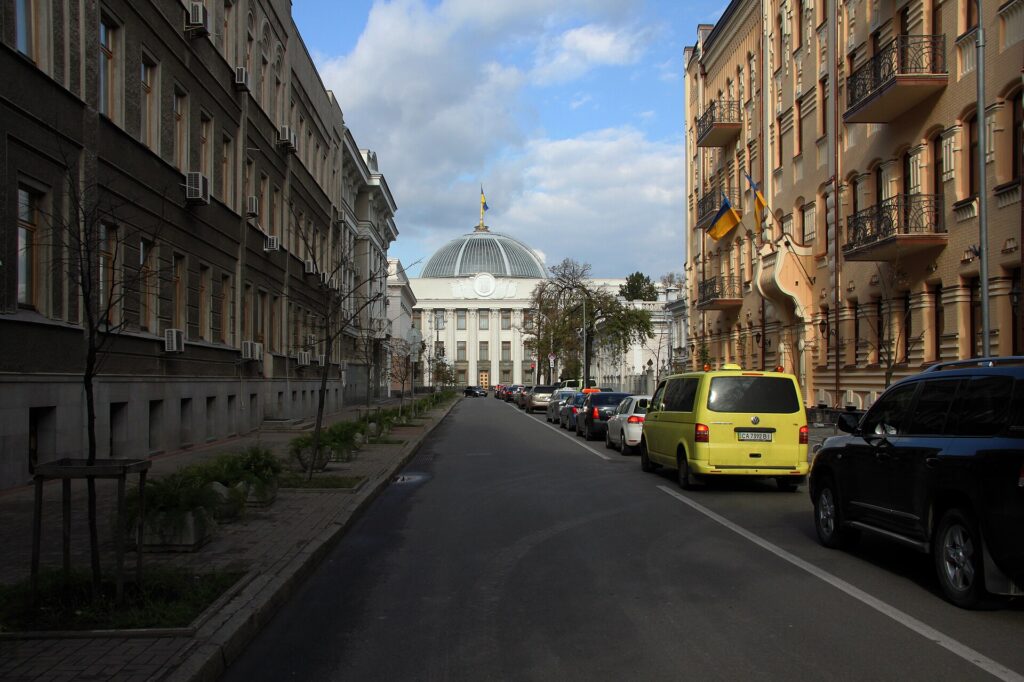

Article 76 of Ukraine’s Constitution sets the membership of the Verkhovna Rada — the parliament — at 450 seats, with a term of 5 years. The president’s term is also 5 years (Article 103). The prime minister is nominated by the parliamentary majority, proposed by the president to parliament, and appointed by parliament (Article 114). Both the president and parliament are chosen by election, and the Cabinet of Ministers is accountable to both. This structure is the starting point for reading Ukrainian politics.
Since martial law was introduced on the day of Russia’s full-scale invasion of Ukraine, February 24, 2022, neither a presidential election nor a parliamentary election has been held in Ukraine. Later in this article, we look at which articles this rests on.
The Standing of the Three Institutions
Article 6 of the Constitution provides that state power is exercised through a division into legislative, executive, and judicial branches. The Verkhovna Rada alone holds legislative power (Article 75), and the highest body of executive power is the Cabinet of Ministers (Кабінет Міністрів України) (Article 113). The president is the head of state and represents the country (Article 102). The Constitution does not describe the president as the head of the executive branch.
| Verkhovna Rada (Parliament) | President | Cabinet of Ministers | |
|---|---|---|---|
| Constitutional status | Sole legislative body (Article 75) | Head of state. Guarantor of sovereignty, territorial integrity, and the Constitution (Article 102) | Highest body of executive power (Article 113) |
| How chosen | Direct popular election. 450 seats (Article 76) | Direct popular election (Article 103) | Prime minister and ministers appointed by the Verkhovna Rada (Articles 85 and 114) |
| Term | 5 years (Article 76) | 5 years. Maximum of two consecutive terms (Article 103) | Resigns as a body before a newly elected Verkhovna Rada (Article 115) |
| Main powers | Enacting laws, approving the state budget, appointing and dismissing the prime minister and ministers, declaring a state of war (Article 85) | Directing foreign policy, serving as commander-in-chief of the armed forces, chairing the National Security and Defense Council, vetoing laws (Article 106) | Drafting and executing the budget, directing ministries, implementing domestic and foreign policy (Article 116) |
The Verkhovna Rada: 450 Members, Laws, the Budget, and Appointments
Members of the Verkhovna Rada are elected from among citizens aged 21 or older who have lived in Ukraine for the preceding 5 years (Article 76). Regular elections are held on the last Sunday of October in the fifth year of parliament’s term (Article 77).
Article 85 lists more than 30 powers of the Verkhovna Rada. These include enacting laws, approving the state budget and overseeing its execution, declaring a state of war and concluding peace on the president’s proposal, impeaching the president, and appointing the prime minister, the defense minister, and the foreign minister on the president’s proposal, with the other ministers appointed on the prime minister’s proposal. It is also the Verkhovna Rada that approves a presidential decree introducing martial law within 2 days (Article 85, clause 31).
The chair of the Verkhovna Rada signs a law and sends it to the president, who must sign it within 15 days or return it with reasons attached (Article 94). If the Verkhovna Rada then re-adopts the returned law by at least two-thirds of its full membership, the president must sign it within 10 days. In other words, the president’s veto is a mechanism that can be overridden by a two-thirds vote of parliament.
The President: Head of State Leading Foreign Affairs and the Armed Forces
To run for president, a citizen must be at least 35 years old, must have lived in Ukraine for the 10 years before the election, and must have command of the state language, Ukrainian (Article 103). Article 106 lists the president’s powers: directing foreign policy and concluding international treaties; serving as commander-in-chief of the armed forces; chairing the National Security and Defense Council; signing laws and holding a veto over them; and, in accordance with law, deciding on general mobilization and the introduction of martial law (Article 106, clause 20).
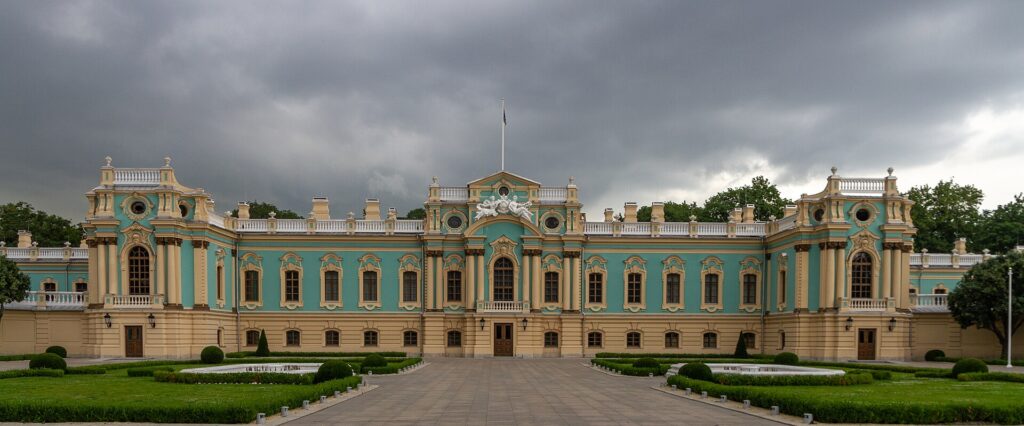

The National Security and Defense Council is a body under the president that coordinates national security and defense policy; the prime minister, the defense minister, the head of the Security Service, the interior minister, and the foreign minister serve as members by virtue of their office (Article 107). The Council’s decisions take effect through presidential decrees.
There is also a procedure for removing the president before the end of the term. On grounds such as treason or another crime, impeachment is initiated by a majority of the Verkhovna Rada’s full membership, the decision to bring charges is made by two-thirds, and, after obtaining rulings from the Constitutional Court and the Supreme Court, removal is decided by three-quarters (Article 111).
The Prime Minister and the Cabinet: Starting from a Parliamentary Majority
The Constitution sets out, step by step, the procedure for choosing a prime minister.
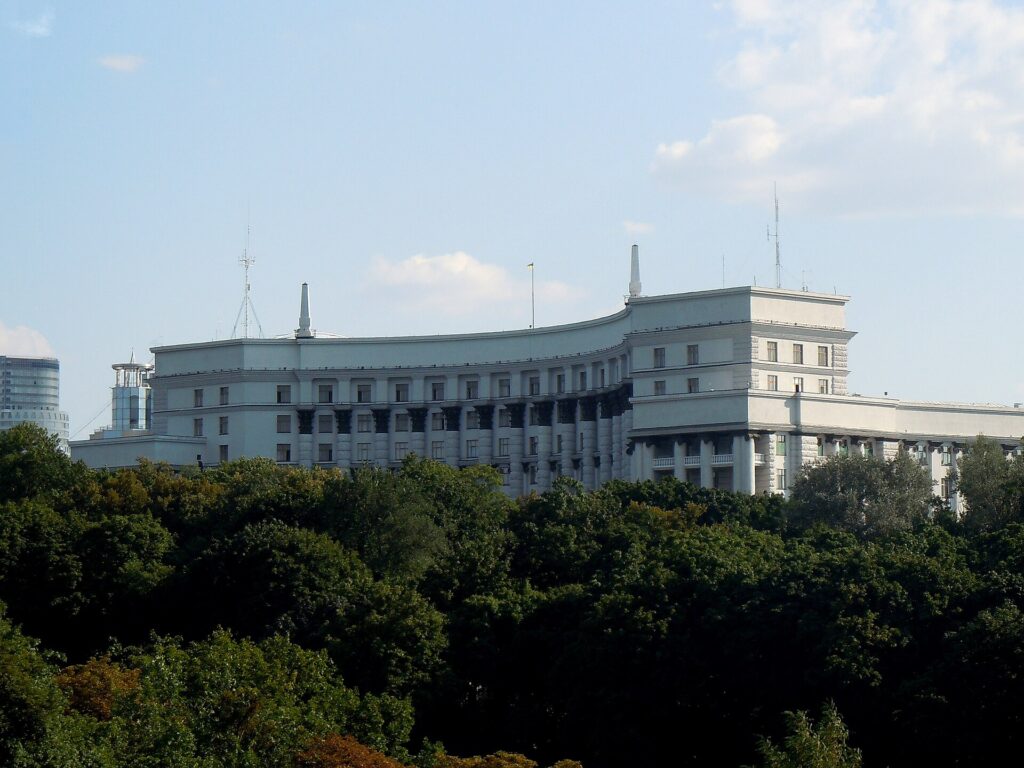

- After an election to the Verkhovna Rada, a coalition of factions holding a majority of seats is formed within one month of its first sitting (Article 83).
- That coalition proposes a candidate for prime minister to the president (Articles 83 and 114).
- Within 15 days of receiving the proposal, the president submits the nomination of the prime minister to the Verkhovna Rada (Article 106, clause 9).
- The Verkhovna Rada appoints the prime minister (Article 85, clause 12, and Article 114). The defense minister and the foreign minister are appointed on the president’s proposal, and the other ministers on the prime minister’s proposal, with the Verkhovna Rada making the appointment in each case.
The Constitution states that the Cabinet “is responsible to the President of Ukraine and the Verkhovna Rada of Ukraine, is under the control of the Verkhovna Rada of Ukraine, and is accountable to it” (Article 113). The Verkhovna Rada can pass a vote of no confidence in the Cabinet by a majority of its full membership (Article 87), and the Cabinet resigns as a body if the prime minister resigns or a vote of no confidence is passed (Article 115).
Conversely, the cases in which the president can dissolve the Verkhovna Rada before the end of its term are limited to three: a coalition is not formed within one month; a new Cabinet is not formed within 60 days of the Cabinet’s resignation as a body; or a regular session fails to open a plenary sitting within 30 days (Article 90). The Rada cannot be dissolved during the last six months of parliament’s or the president’s term.
“Semi-Presidential” Is Not a Term Found in the Constitution
Ukraine’s system of government is sometimes described in scholarship as “semi-presidential.” That term, however, does not appear in the text of the Constitution. The Constitution of Ukraine entry (written in 2023 by Bohdan Harasymiw) in the Internet Encyclopedia of Ukraine (IEU, published by the Canadian Institute of Ukrainian Studies — CIUS — at the University of Alberta) explains that the drafts leading up to the 1996 Constitution shifted “from a strong presidential system toward a semi-presidential system with a larger role for parliament and the prime minister.”
The balance of power between the president and parliament has shifted back and forth several times since then. According to the same entry, a constitutional amendment following the 2004 Orange Revolution strengthened parliament’s powers starting in January 2006. In 2010, the Constitutional Court found that amendment unconstitutional and restored the 1996 arrangement. In 2014, after the Euromaidan revolution, the post-2004 amended arrangement was reinstated. The current Constitution’s preamble notes both the Constitutional Court’s decision finding the 2004 amendment unconstitutional (No. 20-рп/2010, September 30, 2010) and the Verkhovna Rada’s decision restoring the effect of the amended provisions (No. 750-VII, February 22, 2014).
The text of the Constitution and how it is applied in practice need to be looked at separately. In the same entry, the author cites, among other things, President Zelensky’s dissolution of the Verkhovna Rada before the end of its term after taking office in 2019, and offers a critical assessment that this undermined the principle of the separation of powers. This is the author’s own assessment, not a power the Constitution itself grants the president.
Why No Elections Are Held Under Martial Law
On February 24, 2022, Presidential Decree No. 64/2022 introduced martial law across the whole of Ukraine, starting at 5:30 a.m. that same day, for a period of 30 days. The Verkhovna Rada approved it the same day by Law No. 2102-IX. Martial law has since been repeatedly extended by presidential decree, most recently by Decree No. 596/2026 of July 13, 2026, which extended it for 90 days from August 2, 2026.
The basis for not holding elections is not a single article, but a combination of several.
- Article 19(1) of the Law on Martial Law (Law No. 389-VIII, “On the Legal Regime of Martial Law,” May 12, 2015): prohibits holding presidential elections, Verkhovna Rada elections, local elections, or referendums during martial law.
- Article 10(1) of the Law on Martial Law: the powers of the president, the Verkhovna Rada, the Cabinet, and other bodies cannot be terminated during martial law.
- Article 83(4) of the Constitution: if the Verkhovna Rada’s term ends during martial law or a state of emergency, its powers are extended until the day the newly elected Verkhovna Rada, chosen after martial law is lifted, holds its first sitting.
- Article 108(1) of the Constitution: the president continues to exercise the office until a newly elected president takes office.
- Article 157(2) of the Constitution: the Constitution cannot be amended during martial law or a state of emergency.
For the Verkhovna Rada, the extension of its term is written directly into Article 83(4). For the president, there is no article providing for an extension of the term; the basis instead is the provision in Article 108(1) that the president continues in office until a successor takes office.
The Debate Over How to Read These Articles
This difference in treatment has been debated within Ukraine itself. Civil Network OPORA, an election-monitoring civic organization, wrote in a legal explainer published October 10, 2023 that, under the Constitution’s own terms, the next Verkhovna Rada election should have been held on October 29, 2023, and the next presidential election on March 31, 2024. OPORA then introduces the counter-argument that “there is no provision extending the president’s term comparable to Article 83(4),” but takes the position that holding elections under martial law would be unconstitutional, citing the facts that Article 108 lets the president continue in office until a successor takes office and that electing only a president while a parliamentary election cannot be held would put the two institutions’ methods of selection out of step with each other.
On February 25, 2025, the Verkhovna Rada adopted, by Decision No. 4252-IX, a “Statement on Support for Democracy in Ukraine under the Aggression of the Russian Federation.” The statement says that the martial law imposed under the full-scale invasion does not permit elections consistent with the Constitution, that elections should be held after the war ends, and that, under Article 108(1), the president should continue in office until a successor takes office. It states that a presidential election will be held, by decision of the Verkhovna Rada, once a comprehensive, just, and lasting peace has been secured.
Насправді заяви російської федерації щодо нібито нелегітимності української влади, і Президента України Володимира Зеленського зокрема, поширюються російською пропагандою з метою відволікання уваги від нелегітимності президента російської федерації владіміра путіна
Statement of the Verkhovna Rada (Decision No. 4252-IX, February 25, 2025). Translation: In fact, claims by the Russian Federation that Ukraine’s authorities, and President of Ukraine Volodymyr Zelensky in particular, are illegitimate are spread by Russian propaganda in order to divert attention from the illegitimacy of the president of the russian federation, vladimir putin.
Russia argues that Ukraine’s president is illegitimate because no election has been held, and the statement is framed as a response to that argument. In terms of the text of the law, it is Article 19 of the Law on Martial Law that prohibits elections, and Article 108(1) of the Constitution that provides the basis for the president to remain in office. What has been debated within Ukraine is which articles to combine and how to read them, not whether the presidency has become vacant. The statement expresses the Verkhovna Rada’s position on not holding elections in wartime; it is not a ruling by the Constitutional Court.
For President Zelensky’s career, see our article The Career of Ukraine’s President Volodymyr Zelensky.
Sources and references
- Конституція України № 254к/96-ВР [Constitution of Ukraine, No. 254к/96-ВР] (adopted June 28, 1996. Confirmed against the original text: Articles 5, 6, 64, 75–77, 83, 85, 87, 90, 94, 102–103, 106–108, 111, 113–116, and 157, and the amendment note at the head of the document)
Published by Verkhovna Rada of Ukraine (zakon.rada.gov.ua) · Checked: 2026-09-23 - Constitution of Ukraine (official English translation. Confirmed the English text of Article 108 and others)
Published by Verkhovna Rada of Ukraine (zakon.rada.gov.ua) · Checked: 2026-09-23 - Закон України «Про правовий режим воєнного стану» № 389-VIII [Law of Ukraine ‘On the Legal Regime of Martial Law,’ No. 389-VIII] (May 12, 2015. Confirmed Articles 1, 10(1), and 19)
Published by Verkhovna Rada of Ukraine · Checked: 2026-09-23 - Указ Президента України «Про введення воєнного стану в Україні» № 64/2022 [Presidential Decree ‘On the Introduction of Martial Law in Ukraine,’ No. 64/2022] (February 24, 2022. Confirmed the time and duration of introduction, the approving Law No. 2102-IX, the extension notes, and the latest extension, No. 596/2026)
Published by President of Ukraine (as published on zakon.rada.gov.ua) · Checked: 2026-09-23 - Постанова Верховної Ради України «Про Заяву Верховної Ради України про підтримку демократії в Україні в умовах агресії російської федерації» № 4252-IX [Decision of the Verkhovna Rada of Ukraine ‘On the Statement of the Verkhovna Rada of Ukraine on Support for Democracy in Ukraine under the Conditions of Aggression by the Russian Federation,’ No. 4252-IX] (February 25, 2025. Confirmed the full text of the statement)
Published by Verkhovna Rada of Ukraine · Checked: 2026-09-23 - Legal information on the impossibility of holding elections under conditions of martial law (October 10, 2023. Confirmed the scheduled election dates and the introduction of the debate over Articles 83 and 108)
Published by Civil Network OPORA · Checked: 2026-09-23 - Constitution of Ukraine (written in 2023 by Bohdan Harasymiw. Confirmed the shift toward semi-presidentialism, the changes in 2004, 2010, and 2014, and the assessment of how it has operated in practice)
Published by Internet Encyclopedia of Ukraine (Canadian Institute of Ukrainian Studies — CIUS — University of Alberta) · Checked: 2026-09-23
If you find an error in this article, please tell us via Corrections. Once we have checked it, we will record in the article what was corrected and why.