What Kind of Country Is Ukraine? A 3-Minute Refresher on Its Culture and History
How much do you know about Ukraine?
This article brings together basic facts about Ukraine along with its culture and history.
Let’s deepen our understanding of Ukraine.
What Kind of Country Is Ukraine?
Ukraine is a country in Eastern Europe with a rich culture and history.
Here we explain it in terms of the following three points.
- Ukraine’s land and population
- Ukraine’s culture
- Ukraine’s ethnic makeup
Ukraine’s Land and Population
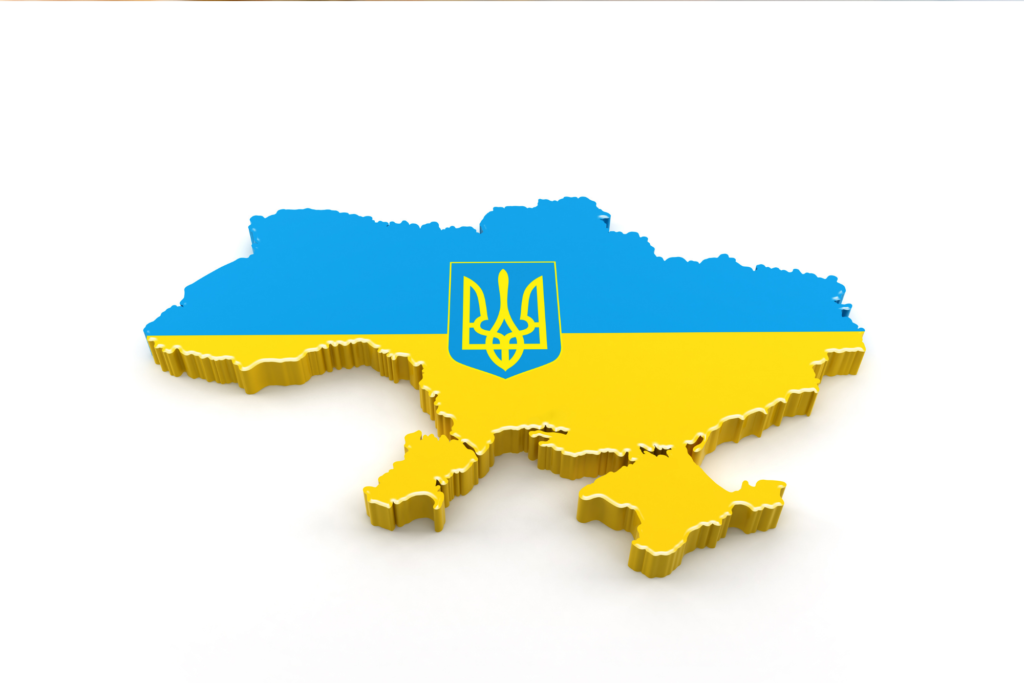
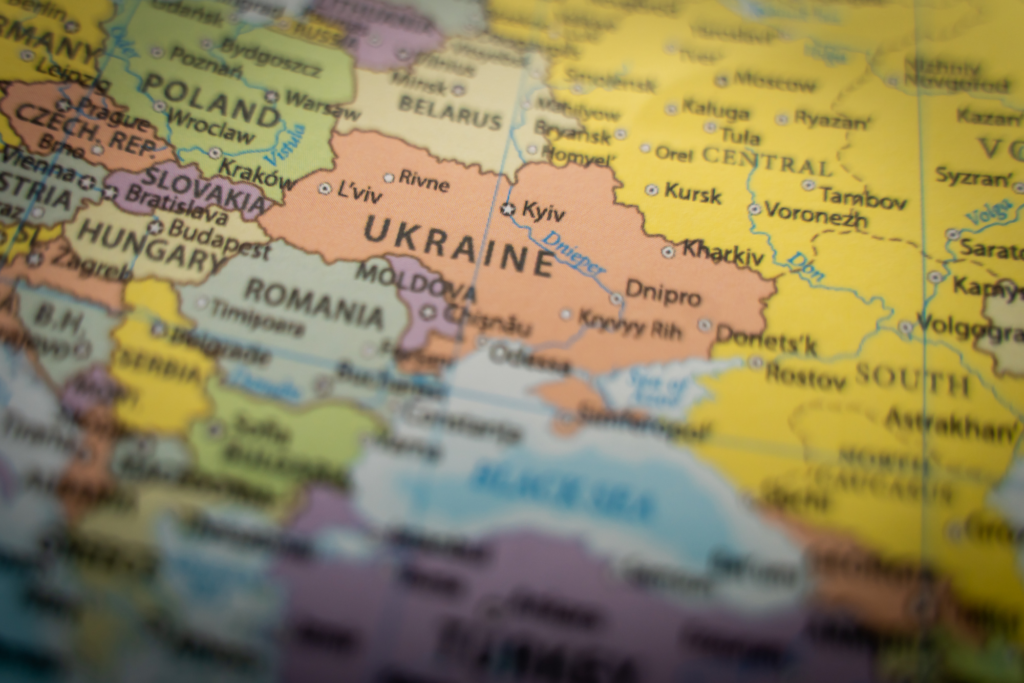
Ukraine is a country in Eastern Europe.
It borders Belarus, Russia, Poland, Slovakia, Hungary, Romania, and Moldova.
It’s one of the larger countries by land area, at about 600,000 square kilometers — roughly 1.6 times the size of Japan.
It has abundant natural resources and land well suited to growing crops.
Ukraine’s population is about 41.16 million (2022, excluding Crimea; a figure from the State Statistics Service of Ukraine, as listed in the Ministry of Foreign Affairs’ “Basic Data on Ukraine”), with a diverse mix of ethnic groups living together.
Its capital is Kyiv.
Ukraine also occupies an important geographic position, a point where many cultures intersect.
Ukraine’s Culture
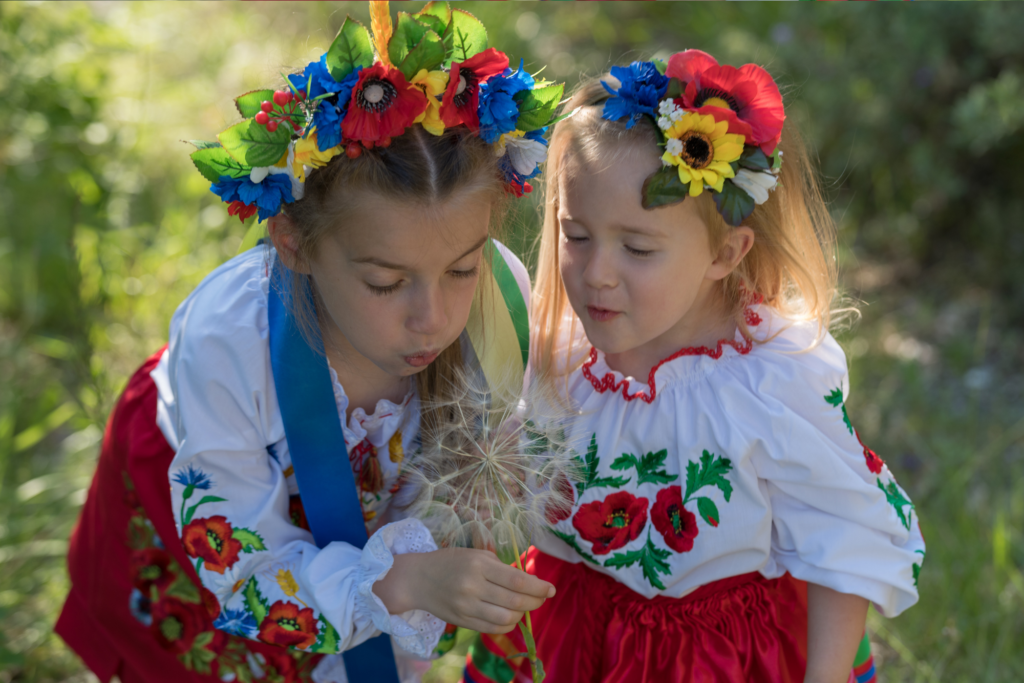
Ukraine’s culture spans many fields.
There is strong interest in the arts, and music, literature, and fine art all flourish.
The embroidered traditional shirt known as the “vyshyvanka,” and the folk instrument the “bandura,” are especially famous, loved by people around the world.
Ukrainian Easter also features “pysanka,” eggs decorated using a wax-resist dyeing technique.
These beautiful Easter eggs, painted with symbols of happiness like stars and animals, are popular enough that workshops on making them are even held in Japan.
Ukrainian cuisine is also known for its wide variety and distinctive flavors, with dishes such as borscht and varenyky among the most famous.
Ukraine’s Ethnic Makeup
Ukraine is a multi-ethnic country: ethnic Ukrainians make up a large majority at 77.8%, while Russians and other minorities also live there. The main ethnic group belongs to the East Slavic peoples of Eastern Europe.
This diversity is reflected in Ukraine’s culture and languages as well: the state language is Ukrainian, and Russian and other languages are also spoken.
Ukraine’s ethnic makeup is closely tied to its historical background, and diverse cultural backgrounds coexist there.
Source: Ministry of Foreign Affairs of Japan, 2001 census (https://www.mofa.go.jp/mofaj/area/ukraine/data.html)
Ukraine’s History
Ukraine’s history stretches back a long way, as a region where diverse peoples and cultures have crossed paths.
Understanding this history also helps deepen our understanding of the challenges present-day Ukraine faces and how its people’s identity has taken shape.
From the era of Kyivan Rus, through the Mongol invasion, the Polish-Lithuanian Commonwealth, the Russian Empire, and as part of the Soviet Union, Ukraine achieved independence in 1991.
Across this long history, Ukraine has gone through many trials and transformations.
The Era of Kyivan Rus
Kyivan Rus, formed in the 9th century, was the first significant state in Ukraine’s history, and it was here that East Slavic culture and the Orthodox faith took root.
The Polish-Lithuanian Era, and the Cossacks
When the Polish-Lithuanian Commonwealth was formed by the Union of Lublin in 1569, much of Ukraine’s territory came under Polish rule. During this period, peasants and townspeople burdened by heavy obligations fled south to the steppe and settled there, growing into a force known as the Ukrainian Cossacks.
The Cossacks were known as freedom-loving warriors, and became a symbol of Ukrainian national identity and self-determination.
The Soviet Era, and Independence
Entering the 20th century, Ukraine became a constituent republic of the Soviet Union, undergoing many political and social transformations.
However, the 1986 Chornobyl (Chernobyl) nuclear power plant accident and the collapse of the Soviet Union had a major impact on its people, and in 1991 Ukraine declared independence.
Ukraine’s history since independence has faced new challenges: efforts at democratization and nation-building, and, from 2014, Russia’s declared annexation of Crimea and fighting in the east.
This historical background is essential to understanding present-day Ukraine’s political and social issues.
The Situation in Ukraine Today
On February 24, 2022, Russia began its full-scale invasion of Ukraine.
Ukraine today continues to draw international attention. In this section, we take a closer look at the background and the events still unfolding.
Russia’s Declared Annexation of Crimea, and Fighting in the East (2014–)
In 2014, Russia unilaterally declared the annexation of the Crimean peninsula. Many countries, including Japan, do not recognize this annexation.
That same year, in the eastern oblasts of Donetsk and Luhansk, Russian-backed armed groups claimed control of the region, and fighting began.
Many Russian-speaking residents live in this region. However, the language someone speaks and their political stance are two different things. The views of these residents cannot be summed up as one.
This fighting has taken the lives of many civilians, and many residents have lost their livelihoods.
The Russia-Ukraine War
On February 24, 2022, Russia began its full-scale invasion of Ukraine.
Russia calls this a “special military operation,” explaining it as a response to NATO’s expansion and a matter of its own security.
However, this explanation has not been accepted by the international community. On March 2, 2022, the UN General Assembly adopted a resolution titled “Aggression against Ukraine” by a vote of 141 in favor, 5 against, and 35 abstentions, condemning Russia’s invasion and demanding the immediate withdrawal of its forces.
Here, we state separately the fact of what Russia has claimed, and the assessment of whether that claim holds up.
Russia has occupied several oblasts in the east and south and unilaterally declared their annexation, but this is not internationally recognized.
Many countries, including Japan, have condemned Russia, and the United States and Europe have imposed economic sanctions.
The invasion is still ongoing, with no end in sight.
The number of civilian casualties is tracked and published on an ongoing basis by the Office of the UN High Commissioner for Human Rights (OHCHR). The figures change depending on the method and point of counting, and do not include harm that could not be confirmed. When quoting them, always include the source and reference date.
The Economic Situation
Ukraine has suffered major economic damage from Russia’s invasion.
Its gross domestic product (GDP) fell 30.4% year over year in 2022.
However, in 2023 it grew 5.3%, its first growth in two years.
Growth is also forecast to continue in 2024, supported by flexible fiscal policy and international aid.
Reference: https://bank.gov.ua/en/news/all/komentar-natsionalnogo-banku-schodo-zmini-realnogo-vvp-u-2023-rotsi
Let’s Get to Know Ukraine Correctly
We’ve covered the basic facts and culture of Ukraine.
Ukraine continues to draw international attention.
Gaining an accurate understanding of this beautiful, rich country is the first step toward supporting it.
This outlet will keep reporting on Ukraine, together with voices from the ground.
Sources and article record
Sources and references
- ウクライナ基礎データas of September 3, Reiwa 8 [2026]. Population, ethnicity, and language fields
Published by Ministry of Foreign Affairs · Checked: 2026-09-23 - Lublin, Union of
Published by Internet Encyclopedia of Ukraine (Canadian Institute of Ukrainian Studies, University of Alberta) · Checked: 2026-09-23 - Cossacks
Published by Internet Encyclopedia of Ukraine (Canadian Institute of Ukrainian Studies, University of Alberta) · Checked: 2026-09-23 - Embroidery
Published by Internet Encyclopedia of Ukraine (Canadian Institute of Ukrainian Studies, University of Alberta) · Checked: 2026-09-23 - Varenyky
Published by Authentic Ukraine (a project of Ukraine's Ministry of Culture and Strategic Communications / youth and sports) · Checked: 2026-09-23
Corrections and updates
- Where this article had simply repeated Russia's own justification for the invasion as if it were established fact, this has been revised to separately state the fact that “Russia claims this” from the international community's assessment. Added the content of UN General Assembly resolution ES-11/1 (adopted March 2, 2022).
- Regarding the events of 2014, a passage that had described them, without mentioning Russia's involvement, as “growing momentum for independence,” has been revised to state explicitly the unilateral declared annexation of Crimea and the Russian-backed armed groups.
- Removed a civilian casualty figure that had no source or reference date, replacing it with a statement that the Office of the UN High Commissioner for Human Rights (OHCHR) publishes such counts.
- Place names revised to forms based on Ukrainian usage (Kyivan Rus, Chornobyl), and headings and body text that had described the fighting in the east since 2014 as a “dispute” have been changed to “fighting.”
- A population figure of “approximately 44 million,” given with no reference date, has been changed to the State Statistics Service of Ukraine's 2022 figure (approximately 41.16 million, excluding Crimea). Descriptions of the Polish-Lithuanian Commonwealth as existing “from the 14th century” and of the Cossacks as “mainly serfs who had fled Poland and Lithuania” were errors: the Commonwealth was formed in 1569, and the Cossacks mainly consisted of peasants and townspeople who had fled from within Ukraine itself. The dish name “pierogi” (Polish) has been changed to varenyky, the garment name “sorochka” (meaning “shirt”) has been changed to vyshyvanka, the heading “race” has been changed to “ethnic makeup,” and the wording on language and the events of 2014 has been revised.
If you find an error in this article, please tell us via Corrections. Once we have checked it, we will record in the article what was corrected and why.
Related articles
-
Pysanka: The Ukrainian Wax-Written Egg, and Its 2024 UNESCO Listing
In December 2024, what was added to UNESCO's Representative List was "Pysanka, Ukrainian tradition and art of decorating eggs," a joint submission by Ukraine and Estonia. How do dictionaries and museums distinguish between these eggs? What warnings do Ukrainian researchers give about decoding "this pattern means this"? And the oldest surviving clues are not eggs at all, but 12th-century pottery.
-
“-IX” Is the 9th Convocation of Parliament: A Clue to Reading Ukrainian Laws in the Original
In a Ukrainian law's number, such as “4223-IX,” the “IX” indicates the convocation of the Verkhovna Rada that adopted it. Cabinet resolution numbers restart from 1 every year, and a law has several dates: adoption, promulgation, entry into force, and the start of application. Using real legal acts as examples, this article explains how to read the numbers, dates, status labels, and amendment-consolidated “redactions” in the Verkhovna Rada's legal database.
-
Born in 1918 Under a Hetman’s Law: Ukraine’s Academy of Sciences
The National Academy of Sciences of Ukraine began with a law signed on November 14, 1918, by Hetman Pavlo Skoropadskyi. Thirteen days later, at its first general meeting, the geologist Volodymyr Vernadsky was elected president. The Academy's name has changed four times, and as of March 2026 it encompasses 159 research institutions. This article lays out how the founding date is counted, a timeline of names and presidents, and staff numbers.