
A Japan-Ukraine Timeline ── From the 1965 Sister-City Partnership to Yen Loans
From the 1965 sister-city partnership between the City of Yokohama and the City of Odesa, to the opening of diplomatic relations in 1992, to the yen loans and evacuee intake after 2022. This article puts Japan-Ukraine relations into a timeline made only of events whose date and announcing body can be identified. It also separates whether support figures are ceilings or amounts actually disbursed, and what an evacuee count is actually counting.

Ties between Japan and Ukraine began between cities, before they began between states. The City of Yokohama and the City of Odesa became sister cities in 1965; Kyoto City and the City of Kyiv, in 1971. This article puts into a timeline the events for which a date is given in the text of materials from the Japanese government, the Ukrainian government or its agencies, Japanese municipalities, and the Diet’s records, and for figures that are easy to misread — support amounts, the number of people who have come as evacuees — it attaches what, exactly, each figure is counting.
What This Timeline Includes
What is included here are events for which a date is written in the body of a document issued by the parties themselves — the Japanese government, the Ukrainian government or its agencies, Japanese municipalities, or Diet records. The dates of state recognition, the opening of diplomatic relations, the opening of embassies, bilateral treaties and arrangements, and visits by dignitaries follow the Ministry of Foreign Affairs’ “Ukraine: Basic Data” (dated September 3, Reiwa 8 / 2026).
Events whose date we could not confirm from a source are not included. Not being listed does not mean it did not happen. The main things left out are listed in the “What We Could Not Confirm” section at the end of this article.
Cities Were Connected Before States Were
Arranged from earliest, the top of the timeline is not diplomacy, but municipalities.
| Date | Event | Announcing body (source used to confirm) |
|---|---|---|
| July 1, 1965 | The City of Yokohama and the City of Odesa become sister cities | City of Yokohama |
| September 7, 1971 | Kyoto City and the City of Kyiv become sister cities | Kyoto City |
| November 27, 1986 | The Japan-Soviet Union tax treaty takes effect | Ministry of Finance |
| December 28, 1991 | Japan grants state recognition to Ukraine | Ministry of Foreign Affairs |
| January 26, 1992 | Japan and Ukraine open diplomatic relations | Ministry of Foreign Affairs / Prime Minister Kiichi Miyazawa’s Policy Speech (House of Representatives plenary session, January 28, 1992) |
| January 1993 | Japan’s embassy in Ukraine opens (Ukraine’s embassy in Tokyo opened in September 1994) | Ministry of Foreign Affairs |
| March 1995 | Succession of treaties concluded between Japan and the Soviet Union is confirmed | Ministry of Foreign Affairs |
| June 2004 | Technical cooperation and grant aid agreement | Ministry of Foreign Affairs |
| May 22, 2006 | JICA’s “Ukraine-Japan Center Project” begins (runs until May 21, 2011) | JICA |
| May 2012 | Agreement between the Government of Japan and the Government of Ukraine on cooperation to promote follow-up response to the accident at a nuclear power plant | Ministry of Foreign Affairs |
| February 5, 2015 | The Japan-Ukraine Investment Agreement (Agreement between Japan and Ukraine for the Promotion and Protection of Investment) is signed in Kyiv | Cabinet Legislation Bureau |
| June 2015 | Prime Minister Shinzo Abe visits Ukraine | Ministry of Foreign Affairs |
| November 26, 2015 | The same investment agreement takes effect | JETRO (the Ministry of Foreign Affairs’ list of treaties and arrangements gives “November 2015”) |
| 2017 | 25th anniversary of the establishment of diplomatic relations. Events held around the country as the “Year of Japan in Ukraine” | Ministry of Foreign Affairs |
| October 2019 | President Zelensky visits Japan to attend the Enthronement Ceremony | Ministry of Foreign Affairs |
| January 1, 2020 | The Multilateral Instrument to prevent BEPS begins to apply to the Japan-Soviet tax treaty as succeeded by Ukraine | Ministry of Finance |
Yokohama and Odesa in 1965; Kyoto and Kyiv in 1971 — both more than twenty years before Japan and Ukraine had diplomatic relations, when Ukraine was still part of the Soviet Union. According to Kyoto City’s own account, the idea for the partnership began in 1958, when the Soviet ambassador to Japan at the time raised it with the Mayor of Kyoto, and it was reached after roughly ten years of exchange leading up to the 1971 partnership. Kyoto City states that from April 1, 2022 it changed its documentary spelling to “Kyiv (Kiev).”
As for the date diplomatic relations were opened, the Ministry of Foreign Affairs’ basic data gives “January 26, 1992,” and the same date can also be confirmed independently from the Diet’s records of the time: the House of Representatives plenary session of January 28, 1992, in Prime Minister Kiichi Miyazawa’s policy speech.
On January 26th, we established diplomatic relations with Ukraine and four other republics.
Prime Minister Kiichi Miyazawa’s Policy Speech, House of Representatives plenary session, January 28, 1992 (National Diet Library, Minutes of the Diet Search System)
Both are, and only are, records that “the Japanese government stated this.” Still, the same date appears in two sources of different character — today’s Ministry of Foreign Affairs page and the minutes of the time — which is enough to anchor a single line of a timeline. State recognition came the year before, on December 28, 1991, confirmed only from the Ministry of Foreign Affairs’ basic data.
A 1986 Treaty Was Still Alive in 2025
Of everything on this timeline, the item with the most direct effect today on Japanese companies and individuals is the tax rules. The tax treaty between Japan and Ukraine was, for a long time, the “Japan-Soviet tax treaty.” The treaty between Japan and the Soviet Union that took effect on November 27, 1986 continued to be used, as it had been succeeded by Ukraine after the Soviet Union’s dissolution. In the Ministry of Finance’s list of tax treaties (as of June 26, 2026), Ukraine is still listed among the countries noted as “succeeding the treaty with the former Soviet Union.”
This has now been comprehensively revised. The new treaty was signed on February 19, 2024 and took effect on August 1, 2025. Its provisions on withholding tax apply to amounts payable on or after January 1, 2026. In other words, by the time you are reading this article, the new tax rates are already in effect.
| Type of income | Before revision (the 1986 Japan-Soviet tax treaty) | After revision (amounts payable on or after January 1, 2026) |
|---|---|---|
| Dividends | 15% | 5% (voting-share holding of 25% or more, held for 6 months or more) / 15% (other cases) |
| Interest | Exempt (government recipients, etc.) / 10% (other cases) | Exempt (government recipients, etc.) / 5% (financial institutions, pension funds, etc.) / 10% (other cases) |
| Royalties | Exempt (copyright) / 10% (other cases) | 5% |
The National Tax Agency’s pamphlet also lists changes beyond the maximum tax rates. The 183-day count for the short-term visitor exemption was revised to be based on “any 12-month period beginning or ending in the taxable year of the other Contracting State.” The exemption is now limited to remuneration from employment, with remuneration for independent personal services no longer covered. The two-year exemption for individuals teaching at universities and similar institutions has been abolished (with transitional relief for anyone entitled to the old treaty’s benefit as of the effective date). And a Ukrainian resident wishing to receive a reduced rate or exemption must submit an “Application Form for Income Tax Convention” through the withholding agent, by the day before the first payment received on or after January 1, 2026.
After February 24, 2022
After Russia’s full-scale invasion of Ukraine began on February 24, 2022, Japan’s actions began to be preserved as dated official announcements. From here on, primary sources become easier to find.

| Date | Event | Announcing body (source used to confirm) |
|---|---|---|
| February 24, 2022 | Russia’s full-scale invasion of Ukraine. The Prime Minister holds a press conference the same day | Prime Minister’s Office (English edition) |
| February 26, 2022 | Measures under the Foreign Exchange and Foreign Trade Act (the earliest among the series of measures listed by the Ministry of Finance) | Ministry of Finance |
| March 8, 2022 | Signing and exchange of letters concerning the provision of Self-Defense Force equipment | Prime Minister’s Office (English edition) |
| March 18, 2022 | 1st meeting of the Liaison and Coordination Meeting on Measures for Ukrainian Evacuees (2nd meeting: April 1) | Cabinet Secretariat |
| June 17, 2022 | JICA adds ¥65 billion to the Emergency Economic Recovery Development Policy Loan, bringing the total to ¥78 billion | JICA |
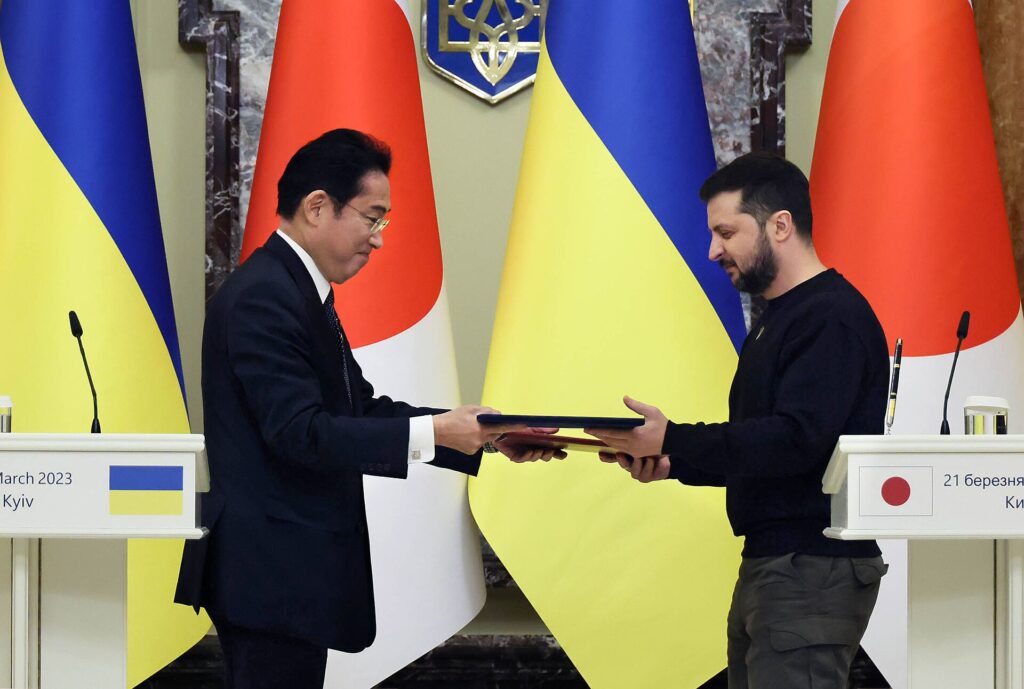
| March 21, 2023 | The Prime Minister visits Kyiv. A summit meeting and the signing ceremony for the “Japan-Ukraine Joint Statement on Special Global Partnership” | Prime Minister’s Office (English edition) |
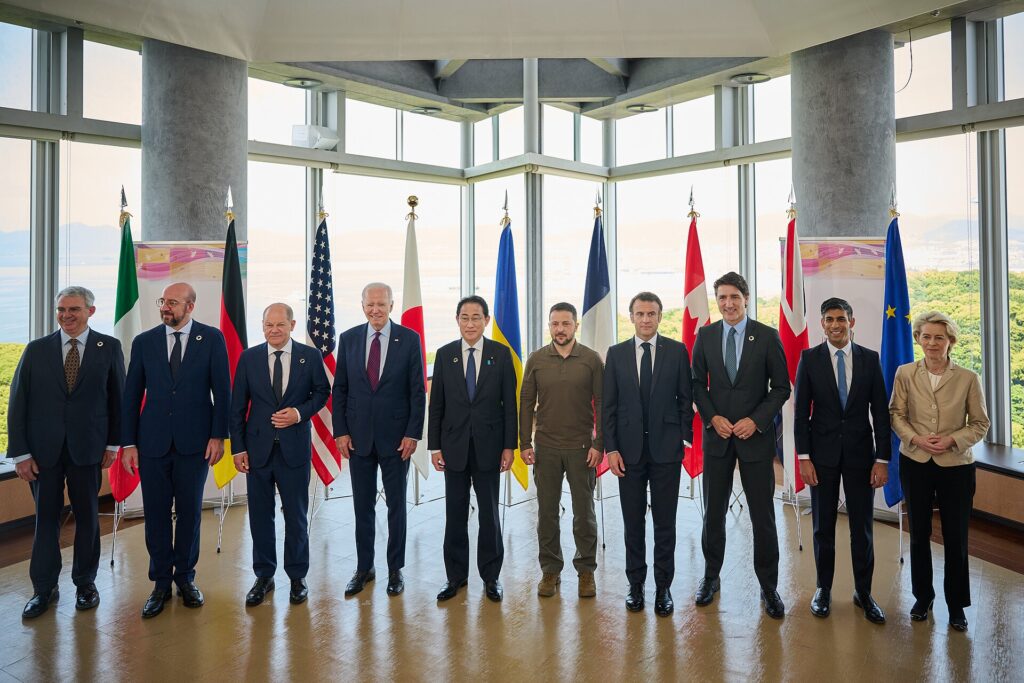
| May 2023 | President Zelensky visits Japan to attend the G7 Hiroshima Summit | Ministry of Foreign Affairs |
| February 19, 2024 | Japan-Ukraine Conference for Promotion of Economic Growth and Reconstruction (Tokyo). The new tax treaty is signed the same day | Prime Minister’s Office (English edition), Ministry of Finance |
| June 13, 2024 | The “Japan-Ukraine Accord on Support and Cooperation” is signed on the occasion of the G7 Apulia Summit | Prime Minister’s Office (English edition) |
| June 5, 2025 | JICA signs a loan agreement in Kyiv for the “Extraordinary Revenue Acceleration Loan for Ukraine” | JICA |
| June 2025 | Information protection agreement | Ministry of Foreign Affairs |
| August 1, 2025 | The new tax treaty takes effect | Ministry of Finance, National Tax Agency |
| September 12, 2025 | Measures under the Foreign Exchange and Foreign Trade Act (the most recent among the series of measures listed by the Ministry of Finance) | Ministry of Finance |
| January 1, 2026 | The new tax treaty’s withholding-tax provisions begin to apply | National Tax Agency |
| April 16, 2026 | Japan, as part of a group of official creditors, and the Government of Ukraine sign a memorandum of understanding on extending the suspension of debt payments | Ministry of Finance |
| July 2026 | Foreign Minister Sybiha visits Japan (the most recent entry in the Ministry of Foreign Affairs’ table of dignitary visits) | Ministry of Foreign Affairs |
Yen-Denominated Support Figures Are “Ceilings,” Not Amounts Disbursed
Lines with a monetary figure are the easiest to misread on this timeline. Let’s set the two yen loans side by side.
| Signing date | Name of loan | Amount (loan ceiling) | Terms |
|---|---|---|---|
| June 17, 2022 | Emergency Economic Recovery Development Policy Loan (additional tranche) | Additional ¥65 billion; ¥78 billion after the addition | Interest rate of 1.0% per year, 30-year repayment period (including a 10-year grace period). Co-financed with the World Bank |
| June 5, 2025 | Extraordinary Revenue Acceleration Loan for Ukraine (ERA Loan) | ¥471.9 billion | Interest rate of TORF + 90bp, 30-year repayment period (no grace period). Repayment funded by the “extraordinary revenues” generated within the EU from the freezing of Russian state assets |
Both are “loan ceilings” — the maximum amount fixed by contract, not the amount actually paid out. The 2025 figure of ¥471.9 billion differs in character from earlier yen loans in that the funds for repayment are said to come not from Japanese or Ukrainian public finances, but from revenue generated within the EU. Simply lining up the figures and saying “Japan’s support has grown” erases this distinction.
The dollar-denominated “cumulative support total” is a little trickier. The Ministry of Foreign Affairs’ basic data puts it in a single sentence: since Russia’s invasion of Ukraine in February 2022, Japan has “announced or provided” a total of approximately USD 20 billion in support in the humanitarian, fiscal, and recovery/reconstruction fields (as of the end of 2025). What must not be missed is exactly that phrase, “announced or provided.” How much is announced-only and how much has actually been disbursed, and how the breakdown works, cannot be told from this one sentence alone. The reference point is also the end of 2025 — not the present. If you cite this figure, you need to carry the conditions “as of end-2025,” “announced or provided,” and “total across humanitarian, fiscal, and recovery/reconstruction” along with the amount itself.
Exports Have Recovered; Imports Have Not
Bilateral trade figures can be confirmed by calendar year in the Ministry of Finance’s Trade Statistics (General Trade Statistics), in the “Time-Series Table of Exports and Imports by Region (Country).” Exports and imports are both given from Japan’s point of view.
| Calendar year | Japan’s exports to Ukraine | Japan’s imports from Ukraine |
|---|---|---|
| 2021 | ¥64.03 billion | ¥79.92 billion |
| 2022 | ¥35.72 billion | ¥47.06 billion |
| 2023 | ¥60.13 billion | ¥12.85 billion |
| 2024 | ¥66.02 billion | ¥11.76 billion |
Exports and imports have moved differently. Japan’s exports fell to roughly 56% of the previous year’s level in 2022, then recovered close to the 2021 level in 2023 and 2024. Imports from Ukraine have not recovered: against ¥79.92 billion in 2021, 2024 was ¥11.76 billion, roughly one-seventh. Summing this up as simply “Japan-Ukraine trade” and looking only at the combined total erases this asymmetry. Note that as of this article’s confirmation date, no finalized calendar-year figure for 2025 had been published.
The Number of Evacuees, and the Name of the System
The Immigration Services Agency of Japan (ISA) publishes and regularly updates the number of people who have come to Japan from Ukraine.
| Item | Number of people |
|---|---|
| Cumulative number accepted as Ukrainian evacuees (entrants from Ukraine or a third country on or after March 2, 2022) | 2,902 |
| Of whom, currently residing in Japan | 1,931 |
| Male / Female (cumulative) | 887 / 2,015 |
| Under 18 / 18–60 / 61 and over (cumulative) | 363 / 2,138 / 401 |
What must not be conflated here is the name of the system. The status of residence held by Ukrainian evacuees Japan has accepted is “Designated Activities,” a separate procedure from refugee recognition. “Evacuee,” “refugee,” and “person requiring complementary protection” are used with similar meanings in everyday language, but under Japanese law they refer to distinct systems. The figures in the table above are the number of people the Immigration Services Agency counts as “Ukrainian evacuees,” not the number of people recognized as refugees.
How to Use This Timeline
What is arranged here are only events that can be traced, line by line, to a source. Put the other way around, an event not listed here is not one that failed to happen. When you cite a single date, keep it in a form where you yourself, or the person citing it, can confirm which document’s body it came from. A timeline is also the format in which a gap in sourcing is least likely to stand out.
Sources and references
- Ukraine: Basic Data (dated September 3, Reiwa 8 / 2026)
Published by Ministry of Foreign Affairs · Checked: 2026-09-23 - The New Japan-Ukraine Tax Treaty Takes Effect (July 2, Reiwa 7 / 2025)
Published by Ministry of Finance · Checked: 2026-09-22 - The New Japan-Ukraine Tax Treaty Has Been Signed (February 19, Reiwa 6 / 2024)
Published by Ministry of Finance · Checked: 2026-09-22 - List of Japan's Tax Treaties, etc. (as of June 26, 2026)
Published by Ministry of Finance · Checked: 2026-09-22 - Overview of the Application of the Multilateral Instrument to Prevent BEPS to the Tax Treaty Between Japan and Ukraine
Published by Ministry of Finance · Checked: 2026-09-22 - Outline of the Amendment to Withholding Tax: The New Japan-Ukraine Tax Treaty (August, Reiwa 7 / 2025)
Published by National Tax Agency · Checked: 2026-09-22 - Ukraine-Related Information (list of measures under the Foreign Exchange and Foreign Trade Act)
Published by Ministry of Finance · Checked: 2026-09-22 - On the Agreement to Extend the Suspension of Debt Payments to Ukraine (Memorandum of Understanding, signed April 16, Reiwa 8 / 2026)
Published by Ministry of Finance · Checked: 2026-09-22 - Meeting Between Finance Minister Suzuki and Ukraine's Prime Minister Shmyhal and Finance Minister Marchenko, and the Holding of the Japan-Ukraine Conference for Promotion of Economic Recovery (February 19, Reiwa 6 / 2024)
Published by Ministry of Finance · Checked: 2026-09-22 - Information on Ukrainian Evacuees (as of August 31, 2026, preliminary figures)
Published by Immigration Services Agency of Japan · Checked: 2026-09-22 - 123rd Session of the Diet, House of Representatives plenary session, January 28, 1992, Prime Minister Kiichi Miyazawa's Policy Speech
Published by National Diet Library, Minutes of the Diet Search System · Checked: 2026-09-22 - 180th Session of the Diet, House of Representatives plenary session, April 17, 2012 (reference to the post-nuclear-accident cooperation agreement)
Published by National Diet Library, Minutes of the Diet Search System · Checked: 2026-09-22 - Agreement Between Japan and Ukraine for the Promotion and Protection of Investment (Heisei 27 Treaty No. 9; signed February 5, 2015, Kiev)
Published by Cabinet Legislation Bureau · Checked: 2026-09-22 - Japan-Ukraine Investment Agreement Takes Effect November 26
Published by JETRO (Japan External Trade Organization) · Checked: 2026-09-22 - Japan-Ukraine Conference for Promotion of Economic Growth and Reconstruction (56 cooperation documents)
Published by JETRO Business Short News · Checked: 2026-09-22 - Signing of a Yen Loan Agreement for Ukraine (June 17, 2022)
Published by JICA · Checked: 2026-09-22 - Signing of a Yen Loan Agreement for Ukraine (June 5, 2025; the ERA Loan)
Published by JICA · Checked: 2026-09-22 - Ukraine-Japan Center (UAJC) Project Period
Published by JICA · Checked: 2026-09-22 - Visit to Ukraine (March 21, 2023, The Prime Minister in Action)
Published by Prime Minister's Office (English edition) · Checked: 2026-09-22 - Japan-Ukraine Conference for Promotion of Economic Growth and Reconstruction (February 19, 2024)
Published by Prime Minister's Office (English edition) · Checked: 2026-09-22 - Japan-Ukraine Summit Meeting (Summary) (June 13, 2024; signing of the support and cooperation accord)
Published by Prime Minister's Office (English edition) · Checked: 2026-09-22 - Response following Russia's aggression against Ukraine (list of responses since February 24, 2022)
Published by Prime Minister's Office (English edition) · Checked: 2026-09-22 - Liaison and Coordination Meeting on Measures for Ukrainian Evacuees (1st meeting March 18, 2022; 2nd meeting April 1, 2022)
Published by Cabinet Secretariat · Checked: 2026-09-22 - City of Kyiv (Kiev), Ukraine, Sister City Partnership September 7, 1971
Published by Kyoto City · Checked: 2026-09-22 - City of Odesa, Sister City Partnership July 1, 1965
Published by City of Yokohama · Checked: 2026-09-22 - General Trade Statistics, Finalized, 24-04, 2024 Data, Time-Series Table of Exports and Imports by Region (Country) (January–December: finalized), Central and Eastern Europe, Russia, etc. (Ministry of Finance Trade Statistics, distributed via e-Stat)
Published by Customs and Tariff Bureau, Ministry of Finance / Statistics Bureau, Ministry of Internal Affairs and Communications, e-Stat · Checked: 2026-09-22 - General Trade Statistics, 2023 Data, Time-Series Table of Exports and Imports by Region (Country) (January–December: finalized), Central and Eastern Europe, Russia, etc. (Ministry of Finance Trade Statistics, distributed via e-Stat)
Published by Customs and Tariff Bureau, Ministry of Finance / Statistics Bureau, Ministry of Internal Affairs and Communications, e-Stat · Checked: 2026-09-22
Corrections and updates
- At the time of publication we could not reach the Ministry of Foreign Affairs' website, and added items that had been left off the timeline as a result. These include the date of state recognition (December 28, 1991), the date diplomatic relations were opened (January 26, 1992), when each country's embassy opened, bilateral agreements, and Japan's total support. The timeline grew from 22 rows to 32. This was not a correction of an error in the existing text, but an addition made because more sources became available to confirm. Sources for the added rows have also been added to "Sources."
- Changed the title (previous title: A Japan-Ukraine Timeline, Made Only of Rows Whose Dates Can Be Confirmed from Primary Sources)
If you find an error in this article, please tell us via Corrections. Once we have checked it, we will record in the article what was corrected and why.