
Free Public Housing and One-Time Payments: Where Municipal Support for Ukrainian Evacuees Stands Now
Since spring 2022, prefectures and municipalities across Japan have offered vacant public housing rent-free and handed out their own one-time payments. Four years on, Hyogo Prefecture closed applications for its living-support payment in March 2025, and the city of Maebashi stopped accepting new arrivals in March 2026. Drawing on municipalities' official pages, this article lines up how these programs began and where they stand now.
From April 28, 2022 through March 31, 2025, Hyogo Prefecture paid a “Hyogo Ukraine Evacuee Living Support Payment” to people who evacuated from Ukraine to the prefecture. The payment was up to ¥2.14 million per household, and 34 households received it (per the prefecture’s page, as of the end of March 2025).
New applications for this payment can no longer be made. On the other hand, some municipalities, such as Tokyo’s Kita City, continue to publicize payment programs on pages updated as recently as April 2026. Support for people who have evacuated to Japan from Ukraine varies widely in content depending not only on the national government but also on the prefecture or municipality where a person lives, and both the timing of when support began and when it ended differ from place to place.
This article looks at examples that could be confirmed on municipalities’ official pages as of September 2026, covering how housing and financial support began and where things stand now. What any individual person can receive is determined only by the counter of the municipality where they live.
Housing: Lending Out Vacant Public Housing Through “Use Outside the Original Purpose”
What municipalities across the country prepared as housing for evacuees were vacant units in prefectural and municipal public housing.
A case compilation put together in March 2025 by the Kanto Regional Development Bureau of the Ministry of Land, Infrastructure, Transport and Tourism explains that temporarily using public housing built with national subsidies for a purpose other than the one the subsidy was granted for is called “use outside the original purpose” (目的外使用), and that this is done with the approval of the Minister of Land, Infrastructure, Transport and Tourism under Article 22 of the Act on Rationalization of Budget Execution Concerning Subsidies. The same case compilation includes the example of municipal housing in Kamagaya City, Chiba Prefecture. After the national government announced it would accept evacuees, it issued a notice to municipalities regarding acceptance through public housing, and Kamagaya City began providing one unit of municipal housing to an evacuee from April 2022. Rent is waived.
The conditions found on each municipality’s official page can be lined up as follows.
| Municipality | Housing offered | Duration / cost | Page last updated |
|---|---|---|---|
| Chiba Prefecture | 85 units of prefectural housing secured. Furniture and appliances also provided on move-in | Not stated | June 8, 2026 |
| Fukushima Prefecture | Prefectural housing, etc. (whichever units are vacant at the time of request) | 3 months (renewable in 3-month increments, up to 1 year total). Usage fee and parking fee waived; utilities, common-area fees, etc. are the resident’s own expense | June 23, 2022 |
| Yamaguchi Prefecture | Prefectural housing | 6 months (renewable). Rent-free; no joint guarantor or security deposit required | September 1, 2023 |
| Maebashi City | 18 units of municipal housing (can accept up to 86 people) | Not stated | March 30, 2026 |
Fukushima Prefecture defines those eligible as “people who can be objectively confirmed to be evacuees accepted by the [Japanese] government,” confirmed by means such as the “UKR” or “UKR-S” notation on their visa. It also states that it does not ask about income requirements or requirements regarding cohabiting relatives. Securing a contact person who can respond in an emergency is a condition.
Temporary use of public housing comes with a defined time limit. Some municipalities, like Fukushima Prefecture with its “up to one year,” state a cap, and whether a person can continue living there afterward, or move into the ordinary tenancy application process, differs by municipality. Because some pages still show update dates from several years ago, whether a program is still accepting applications can only be confirmed by contacting that municipality directly.
Money: One-Time Payments That Differ by Municipality
Alongside housing, some municipalities have also paid out their own grants. The funding comes from municipal budgets, and in some cases from donations collected from residents (fundraising drives or furusato nozei hometown tax donations).
| Municipality | Content | Current status (as stated on the page) |
|---|---|---|
| Hyogo Prefecture | Temporary-stay support (up to ¥200,000 per household), a one-time payment for starting life in Japan (¥500,000 per household), and one year’s worth of food and utility costs for those who moved into public housing rent-free (up to ¥1.44 million per household). Total up to ¥2.14 million per household | New applications closed as of March 31, 2025 |
| Maebashi City | A one-time support payment of ¥150,000 per person, plus support to schools covering half a year’s tuition at Japanese-language schools, among other things | New acceptance closed as of March 31, 2026. Support for those already being assisted continues |
| Tokyo’s Kita City | ¥150,000 per household, plus ¥50,000 for each additional household member from the second person on | No end date stated (page updated April 1, 2026) |
| Higashiosaka City | Costs for daily necessities and living expenses. ¥300,000 for a single-person household, ¥400,000 for a two-person household, ¥500,000 for a household of three or more | No end date stated (page updated June 4, 2024) |
| Fukushima Prefecture | Distributes the donation-funded “Fukushima Ukraine Evacuee Support Fund” as a one-time payment | Donation period extended through March 31, 2027 |
Looking at Hyogo Prefecture’s published results for its living support payment, 8 households received the temporary-stay support, 32 households received the one-time payment for starting life in Japan, and 33 households received the living-cost support, for a combined total of 34 households. Fukushima Prefecture’s support fund is a mechanism in which a distribution committee allocates donations from prefectural residents and others, and it has been distributed five times so far. The donations carry no tax benefit, and the prefecture states that if any balance remains after payments are made, it will be entrusted to the Japanese Red Cross Society’s overseas relief fund. Shiga Prefecture likewise pays living support from the “Shiga Ukraine Evacuee Support Fund,” raised through donations by the prefecture and the prefecture’s international association, and the prefecture’s known intake stood at 14 groups totaling 20 people (as of April 30, 2025).
Conditions also differ by municipality. Kita City requires that a recipient be registered as a resident within the ward at the time the payment is decided, and that they not be receiving a payment for the same purpose from another ward, city, town, or village. Higashiosaka City targets people for whom Higashiosaka was the first place they lived after evacuating, and who are registered as residents there.
Since 2024, a National “Settlement Support Program” Too
As of 2022, the national government’s complementary protection system did not yet exist. The Immigration Services Agency of Japan (ISA) took the emergency measure of granting evacuees the “Designated Activities” status of residence, and commissioned an acceptance support program to the Foundation for the Welfare and Education of the Asian People, deciding to use about ¥1.9 billion in reserve funds for fiscal year 2022 (Cabinet decision of June 28, 2022).
The recognition system for persons eligible for complementary protection then began in December 2023. According to the ISA, those recognized are offered a “Settlement Support Program” (定住支援プログラム) consisting of Japanese-language education (572 class periods) and life-skills guidance (120 class periods), and while taking the program they can also receive accommodation and living support. Hyogo Prefecture’s own page explains that the national government has been running this program free of charge since April 2024, and that participants can receive a living allowance while taking it.
With the national system now in place, municipalities are also restructuring how they build their own support. Higashiosaka City states that, in principle, it does not pay its municipal living costs to people who have been recognized as persons eligible for complementary protection, or who have applications pending, if the national living allowance is being paid to them. Even after ending its living support payment, Hyogo Prefecture continues to offer support with daily life through support coordinators (446 cases through the end of March 2026) and telephone consultations in Ukrainian and Russian (526 cases over the same period). The procedures for the status of residence itself are covered in “Designated Activities (1 Year)” or Complementary Protection: Status-of-Residence Procedures for People Who Evacuated.
Checking What Applies in Your Own Municipality
- What support is available depends on which municipality you live in. Start by contacting the international affairs section or international exchange association of the city, town, or village where you are registered as a resident, and of the prefecture (for how to find the right counter, see Where to Ask First When You Start Living in Japan).
- Check the date a municipality’s page was last updated. Some pages have not been updated since they were created in 2022, and the support described on them is not necessarily still ongoing.
- Payments sometimes come with a condition that you are “not receiving a payment for the same purpose from another municipality or from the national government.” Before moving, check with both your current municipality and the one you are moving to.
- People who have been recognized as eligible for complementary protection, or whose application is pending, should confirm the relationship between the national Settlement Support Program and municipal support at each respective counter.
How many people are living in which prefecture is compiled in 2,902 Ukrainians Have Evacuated to Japan; 1,931 Are Living Here Now.
Sources and article record
Sources and references
- ひょうごウクライナ避難民生活支援2026年5月20日更新。生活支援金の内容・期間・実績、2025年3月31日の受付終了、日常生活支援と電話相談の件数、2024年4月からの定住支援プログラムの案内
Published by 兵庫県 · Checked: 2026-09-24 - 前橋市のウクライナ避難民支援策について2026年3月30日更新。新規受入の終了、市営住宅、一時支援金、日本語習得支援
Published by 前橋市 · Checked: 2026-09-24 - ウクライナから避難してきた方に支援金を支給します2026年4月1日更新。対象と支給額
Published by 東京都北区 · Checked: 2026-09-24 - ウクライナ避難民に対する支援金を支給します2024年6月4日更新。支給額、支給額の調整、対象者
Published by 東大阪市 · Checked: 2026-09-24 - 「ふくしまウクライナ避難民支援金」の受付期間を延長しています。2026年3月11日更新。支援対象者、配分状況、受付期間、税制上の扱い
Published by 福島県 · Checked: 2026-09-24 - ウクライナ避難民への県営住宅等の提供について2022年6月23日更新。対象、提供期間、使用料等
Published by 福島県 · Checked: 2026-09-24 - ウクライナから避難されてきた方への支援について2026年6月8日更新。県営住宅85戸、家具・家電の提供
Published by 千葉県 · Checked: 2026-09-24 - ウクライナ避難民に対する県営住宅の提供について2023年9月1日更新。入居期間、家賃等
Published by 山口県 · Checked: 2026-09-24 - 滋賀県におけるウクライナからの避難民の方への支援2025年6月3日更新。受入れ状況、しがウクライナ避難民応援支援金
Published by 滋賀県 · Checked: 2026-09-24 - 公営住宅等の弾力的な活用に関する事例集令和7年3月。目的外使用の制度紹介、鏎ヶ谷市の市営住宅でのウクライナ避難民の受入れ
Published by 国土交通省関東地方整備局 · Checked: 2026-09-24 - ウクライナ避難民に関する情報受入支援事業の予備費と委託先
Published by 出入国在留管理庁 · Checked: 2026-09-24 - ウクライナ避難民の受入れ・支援等の状況について在留資格「特定活動」の付与、補完的保護対象者定住支援プログラム
Published by 出入国在留管理庁 · Checked: 2026-09-24
If you find an error in this article, please tell us via Corrections. Once we have checked it, we will record in the article what was corrected and why.
Related articles
-
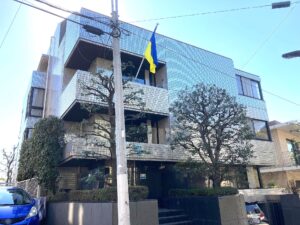
Right Now, the Japanese Embassy in Kyiv Does Not Handle Passports
As of September 2026, the Embassy of Japan in Ukraine, in Kyiv, is not issuing passports or certificates, and only accepts visa applications for short-term business and family visits. The Embassy of Ukraine in Tokyo operates by reservation, and requires men aged 18 to 60 to present an electronic military-registration document. This article lines up what each embassy's counter can and cannot do.
-
The Town Where Port Work Began on September 2, 1794: Odesa and Its Age as a Free Port
Odesa was rebuilt as a port in 1794 on the site of Hadzhybei, where an Ottoman fortress had stood. A grid street plan, the governorship of the Duc de Richelieu, and decades as a duty-free “porto-franco” helped it grow rapidly through wheat exports. This article covers the encyclopedias’ figures, a discrepancy over how long the free-port era lasted, and the 2022 removal of the “Founders” monument.
-
311,792 Students Enrolled: Japan’s Correspondence High Schools, Where 74 Credits Come From Reports and Schooling
At a Japanese correspondence high school, you work on reports at home and elsewhere, and build up credits through scheduled in-person schooling days and exams. Graduation requires 74 or more credits and at least 3 years. As of May 2026, enrollment passed 310,000 for the first time. This article covers how the learning works, satellite facilities, the 2022-2023 rule changes, and the tuition support payment system that changed in fiscal 2026 (as of September 2026).