What Kind of Country Is Ukraine? — Area, Population, Language, Daily Life
A basic overview of Ukraine's area, population, languages, and daily life. The last census was in 2001, so every population figure since then is an estimate. For each number, we note the date and scope it covers, moving through geography, language, and daily life in that order.
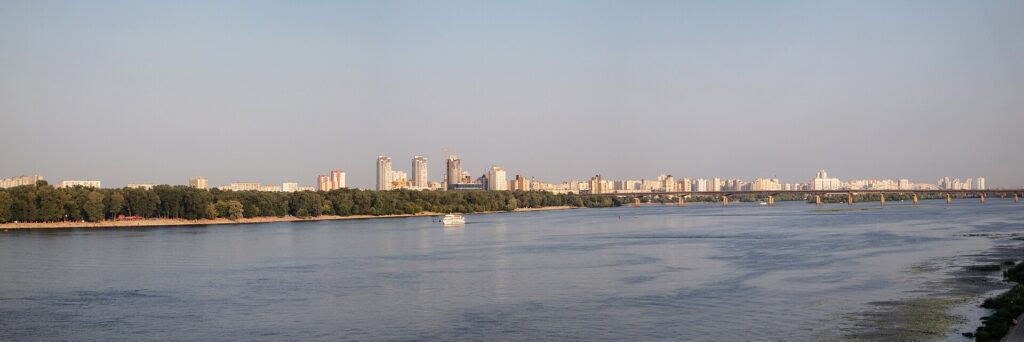

You can answer questions about the map’s location or the name of the capital right away. But population, the languages spoken, and the shape of daily life have all had their underlying premises shift over the past decade or so. What follows sets out each figure while noting what date and what scope it covers.
How to Read the Numbers in This Article
The last nationwide census in Ukraine was held on December 5, 2001. According to metadata (for reporting year 2022) that the State Statistics Service of Ukraine itself entered into the UN Statistics Division’s population estimates questionnaire, every population figure since then is an estimate, and the status of the data is declared as “provisional from 2003 onward.” The same document also states that the data for each January 1 from 2015 through 2021 excludes the temporarily occupied Autonomous Republic of Crimea and the city of Sevastopol.
In other words, a sentence like “Ukraine’s population is X million” is not meaningful on its own. Which estimate, from when? Does it include Crimea? Does it include territory occupied since 2022? Does it include people who fled abroad? Change any of these, and the number moves.
Geography: Location, Size, and Administrative Units
The area is 603,520 square kilometers, and the population of the capital, Kyiv, is 2.95 million (as of February 1, 2022). Both figures come from JETRO’s (Japan External Trade Organization) “Overview and Basic Statistics.”
According to ukraine.ua, the national branding site run by the NGO “Brand Ukraine” in cooperation with Ukraine’s Ministry of Foreign Affairs, the total length of internationally recognized borders is more than 5,600 kilometers on land and more than 1,300 kilometers at sea. Ukraine borders seven countries: Russia, Belarus, Poland, Slovakia, Hungary, Romania, and Moldova (this is a description from a site meant to communicate the national brand, not raw data from a surveying agency).
Administrative units are set out in Article 133 of the Constitution. That article lists Ukraine as consisting of the Autonomous Republic of Crimea, 24 oblasts (regions), and the cities of Kyiv and Sevastopol, which hold special status. An oblast is an administrative unit, not a category of personality or political stance such as “people from the west” or “people from the east.”
Population: Which Figure, From When, Covering What Scope
Two points in time, taken from the State Statistics Service’s series of population figures as of the start of each year:
| Date (January 1) | Present population (thousands) | Urban | Rural |
|---|---|---|---|
| 2002 | 48,457.1 | 32,574.4 | 15,882.7 |
| 2020 | 41,902.4 | 29,139.3 | 12,763.1 |
Twenty-three days before the full-scale invasion, as of February 1, 2022, the population was 41.13 million (excluding Crimea and Sevastopol; published by JETRO citing the State Statistics Service as the source).
Since Russia’s full-scale invasion of Ukraine on February 24, 2022, the distribution of people has shifted substantially. In UNHCR’s Refugee Data Finder, the number of refugees with Ukraine as their country of origin was 5,224,131 at the end of 2025, and the number of internally displaced people was 3,712,000 (the IDP figure comes from IDMC). Both are counts of people in that status at year-end, not cumulative totals, and because the counting frameworks differ, they cannot be added together.
The ethnic breakdown most often cited comes from the results of the all-Ukrainian census of December 2001. Japan’s Ministry of Foreign Affairs (MOFA), in its 「ウクライナ基礎データ「 (“Ukraine Basic Data,” dated September 3, 2026), cites this as its source and lists Ukrainians at 77.8%, Russians at 17.3%, Belarusians at 0.6%, and others including Moldovans, Crimean Tatars, and Jews. However, this survey was conducted only once, 25 years ago, and there has been no census since. What the census asked was “which ethnicity do you consider yourself to belong to,” which is separate from the language a person speaks or their political stance. These figures cannot be read as the current distribution of people’s thinking or sense of identity.
The same MOFA basic-data page also gives the area as 603,700 square kilometers and the population as 41.16 million (excluding Crimea, 2022, State Statistics Service of Ukraine), which differs slightly from the JETRO figures cited at the top of this article (603,520 square kilometers, 41.13 million). Both figures come from Japanese public bodies citing the same State Statistics Service of Ukraine as their source, yet the values differ. The reason for the discrepancy has not been confirmed. When citing a figure, it is safer to note exactly which agency’s edition it was taken from.
OCHA (the UN Office for the Coordination of Humanitarian Affairs), meanwhile, states on its Ukraine page that, as assumptions for the 2026 Humanitarian Needs and Response Plan, the total population is 34.2 million, the number of people in need of humanitarian assistance is 10.8 million, and the required funding is USD 2.3 billion. This “total population” is a working figure for building the humanitarian plan, and differs in character from the State Statistics Service’s population estimates.
Language: Before “What Language Do They Speak,” Ask “Who Was Asked, and How”
Start with the institutional framework. Article 10 of the Constitution establishes Ukrainian as the state language, and the same article also guarantees the free development, use, and protection of Russian and other languages of Ukraine’s national minorities.
How this is applied in practice is set out in Law No. 2704-VIII of April 25, 2019, “On Ensuring the Functioning of the Ukrainian Language as the State Language.” Three of its provisions closest to daily life are as follows.
- Article 30: The language of service to consumers is the state language. Information in the state language may be accompanied by other languages. If a customer requests it, that individual interaction may be conducted in another language acceptable to both parties.
- Article 20: No one is required to use a language other than the state language while at work (serving foreigners or stateless persons is among the exceptions). Employment contracts are concluded in the state language.
- Article 21: The language of instruction is the state language. In classes taught in a minority language that is an official EU language, the right to use that language alongside the state language is guaranteed.
From here on, “what language people actually speak” is a matter of opinion polling rather than law — and polls have a design. The methodology notes for a survey conducted December 4–27, 2022 by the Kyiv International Institute of Sociology (KIIS) (CATI, computer-assisted telephone interviews using randomly generated mobile numbers, 2,005 respondents) state the following: the survey covered all regions except the Autonomous Republic of Crimea. It did not include residents of areas that were not under the control of the Ukrainian government as of February 24, 2022 (Crimea, the city of Sevastopol, and parts of Donetsk and Luhansk oblasts). It did not survey citizens who left the country after February 24, 2022.
This design is common to KIIS’s other surveys as well. In other words, “the people of Ukraine” as depicted by this kind of nationwide survey are citizens aged 18 and over living in territory under government control at the time of the survey. People who remain under occupation and people who have taken refuge abroad fall outside the tally. KIIS itself notes that, under wartime conditions, systematic bias arises in addition to sampling error.
With that in mind, consider the results. In a survey conducted May 26–June 5, 2023 (984 respondents, CATI, 16% of whom were internally displaced people), respondents were asked whether Russian speakers face systematic suppression or persecution because of their language; 84% answered that “there is no problem using Russian, and there is no suppression or persecution,” while 8% answered that there is (in May 2022, the figures were 93% and 5%). Even limited to respondents who speak Russian mainly or exclusively at home, 81% said there is no suppression and 13% said there is.
In a survey conducted September 2–14, 2025 (2,012 respondents, CATI), each respondent was read only one of three language-policy options, chosen at random, and asked to evaluate it (roughly 666–675 respondents per option, margin of error up to 5.1%). The option KIIS labeled “strategic Ukrainianization” (стратегічна українізація) was fully or somewhat supported by 87% of respondents, while 10% found it unacceptable. KIIS states that this was the only option supported across regions (81–90%) and across household language groups (83–88%). Reading a person’s political stance from “whether they speak Russian” does not square with these results.
Daily Life: Currency, Customer Service, and the Table
The currency is the hryvnia. Article 99 of the Constitution establishes that “the monetary unit of Ukraine is the hryvnia” and makes ensuring its stability the primary task of the central bank, the National Bank of Ukraine.
By law, the language a customer is first addressed in at a shop or service is the state language (Article 30, above). How this is actually carried out in shops on the street presumably varies by region and by shop, but the actual practice has not been confirmed.
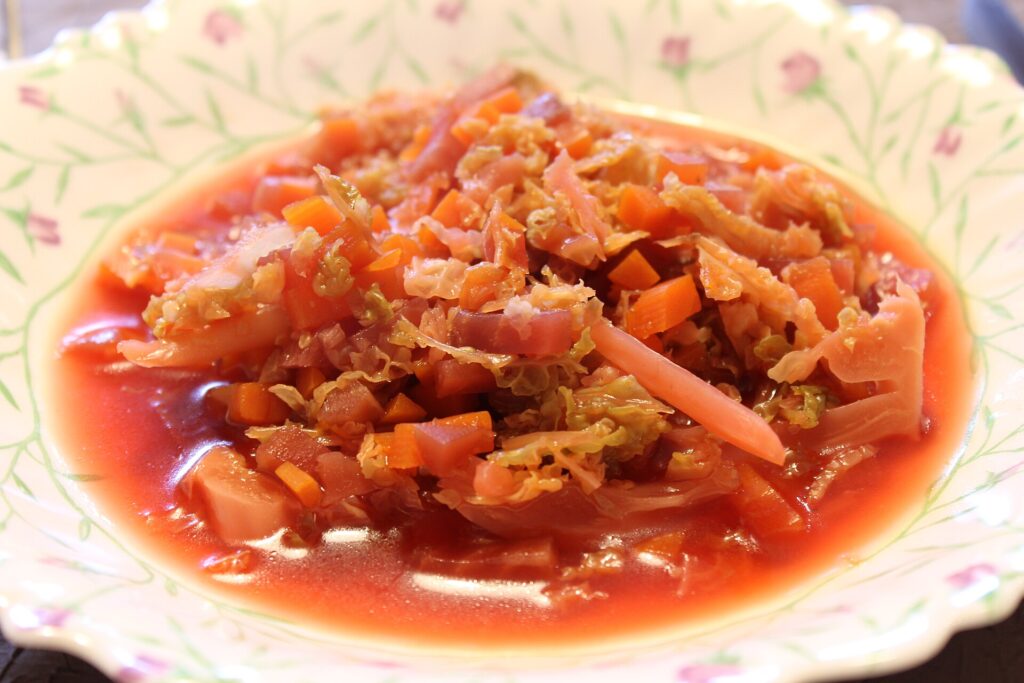
One item from the table. At Ukraine’s request, the culture of borscht cooking was inscribed in 2022 on UNESCO’s List of Intangible Cultural Heritage in Need of Urgent Safeguarding (Decision 5.EXT.COM 5). The inscription describes borscht as “a traditional dish made by combining beets, sugar beets, or fermented beet juice with a broth,” and notes that it has many variations and is passed down across generations within families. The substance of this inscription is that “there is no single recipe or method.”

For greetings, according to ukraine.ua, “pryvit” is used in casual settings, while in formal settings people use “Dobroho ranku,” “Dobryi den,” or “Dobryi vechir” depending on the time of day.
And daily life today is not that of peacetime. OCHA projects that 10.8 million people will need humanitarian assistance in 2026, citing attacks on civilians and critical infrastructure and new displacement caused by shifts in the front line.
Three Things to Keep in Mind, So As Not to Speak of Ukraine as a Monolith
- Always attach “as of when, covering what scope” to a figure. Population, the number of displaced people, and language shares all become a different story if that is left out.
- Don’t use the name of a region to describe a person’s character or political stance. An oblast is an administrative unit, not a category of people.
- When citing a survey result, cite who was asked, when, and how. That residents of occupied territory and people who fled abroad are excluded is a constraint common to many nationwide surveys.
Sources and references
- Constitution of Ukraine (Articles 10, 99, and 133; English version published by the Verkhovna Rada)
Published by Verkhovna Rada of Ukraine, Legislation Database (zakon.rada.gov.ua) · Checked: 2026-09-22 - Law No. 2704-VIII of April 25, 2019, "On Ensuring the Functioning of the Ukrainian Language as the State Language" (Articles 20, 21, and 30)
Published by Verkhovna Rada of Ukraine, Legislation Database · Checked: 2026-09-22 - Населення ["Population," as of January 1, thousands] (page last updated June 30, 2020)
Published by State Statistics Service of Ukraine · Checked: 2026-09-22 - Demographic Yearbook: Questionnaire on Population Estimates, Part 2: Metadata — Ukraine, reporting year 2022
Published by UN Statistics Division (entered by the State Statistics Service of Ukraine) · Checked: 2026-09-22 - Overview and Basic Statistics (Ukraine)
Published by JETRO (Japan External Trade Organization) · Checked: 2026-09-22 - Мова та ідентичність в Україні на кінець 2022-го ["Language and Identity in Ukraine at the End of 2022"] (survey conducted December 4–27, 2022, 2,005 respondents; description of methodology)
Published by Kyiv International Institute of Sociology (KIIS) · Checked: 2026-09-22 - Чи зазнають російськомовні громадяни України утисків та переслідувань через російську мову ["Do Russian-speaking citizens of Ukraine face suppression and persecution because of the Russian language"] (survey conducted May 26 – June 5, 2023, 984 respondents)
Published by Kyiv International Institute of Sociology (KIIS) · Checked: 2026-09-22 - Ставлення до окремих варіантів мовної політики в Україні ["Attitudes toward selected options of language policy in Ukraine"] (survey conducted September 2–14, 2025, 2,012 respondents)
Published by Kyiv International Institute of Sociology (KIIS) · Checked: 2026-09-22 - Refugee Data Finder (country of origin = Ukraine; refugee and IDP figures for end-2024 and end-2025; IDP figures from IDMC)
Published by UNHCR (Office of the United Nations High Commissioner for Refugees) · Checked: 2026-09-22 - Ukraine (figures from the 2026 Humanitarian Needs and Response Plan)
Published by OCHA (UN Office for the Coordination of Humanitarian Affairs) · Checked: 2026-09-22 - Culture of Ukrainian borscht cooking (inscribed in 2022 on the List of Intangible Cultural Heritage in Need of Urgent Safeguarding; Decision 5.EXT.COM 5)
Published by UNESCO Intangible Cultural Heritage · Checked: 2026-09-22 - What countries are bordering Ukraine? (June 16, 2023)
Published by ukraine.ua (run by the NGO "Brand Ukraine" in cooperation with Ukraine's Ministry of Foreign Affairs) · Checked: 2026-09-22 - How to say "hello" in Ukrainian? (April 13, 2023)
Published by ukraine.ua (same as above) · Checked: 2026-09-22 - Ukraine — Internal Displacement Report — General Population Survey Round 24 (April 23 – June 30, 2026, telephone survey)
Published by IOM Displacement Tracking Matrix (DTM) · Checked: 2026-09-22 - ウクライナ基礎データ (Ukraine Basic Data, dated September 3, 2026; source for the ethnic-composition figures from the 2001 census, area, population, date of national recognition, trade volume, and total assistance)
Published by Ministry of Foreign Affairs of Japan (MOFA) · Checked: 2026-09-23
Corrections and updates
- Added the ethnic-composition figures (from the 2001 census), which could not be included at the time of publication because Japan's Ministry of Foreign Affairs website was unreachable. Also added to the article the fact that the area and population figures from Japan's Ministry of Foreign Affairs and JETRO differ. This is not a correction of an error in the existing text but an addition made possible by newly available sources.
- Changed the title (previous title: "Ukraine's Geography, Language, and Daily Life — A Basic Guide That Checks Its Number Premises as It Reads")
If you find an error in this article, please tell us via Corrections. Once we have checked it, we will record in the article what was corrected and why.