
Ukraine’s Language Situation | Differences from Russian, and How to Translate into Ukrainian
In Ukraine, both Ukrainian and Russian are used, reflecting the country’s historical background.
When visiting Ukraine for business or communicating with Ukrainians, knowing even a little Ukrainian can make it easier to build a good relationship.
This article explains Ukraine’s language situation, its differences from Russian, and how to translate from Japanese into Ukrainian.
It also introduces some Ukrainian greetings, so please use them when communicating.
The History of Ukraine’s Language

Before independence, the Supreme Council (Verkhovna Rada) of the Ukrainian Soviet Socialist Republic adopted a language law in October 1989 that made Ukrainian the republic’s official language, and the 1996 Constitution (Article 10) established it as the state language.
Understanding Ukrainian is essential not only for business communication with Ukrainians, but also for understanding the local culture and history. Here is an explanation of the historical background and origins of the Ukrainian language.
The History of the Ukrainian Language
The history of the Ukrainian language goes back to the breakup of Proto-Slavic from the 6th century onward, through the period of Proto-Ukrainian that continued until the 11th century.
In the era of Kyivan Rus (Kievan Rus), Old East Slavic was widely used, forming the basis of the modern Ukrainian language.
From the 12th to 13th centuries, Old Rus’ developed, and from the 14th to 18th centuries, Ruthenian developed, forming the foundation of modern Ukrainian.
However, under the Russian Empire and the Soviet Union, the use of Ukrainian was banned on many occasions.
Under the Russian Empire, publishing in Ukrainian was banned, and Russian was compulsory in educational institutions as well.
When Ukraine achieved independence in 1991, Ukrainian drew renewed attention as a symbol of the nation and secured its status as the official language.
Today, the government is putting effort into spreading and teaching Ukrainian, and encourages its use throughout the country.
The Indo-European Language Family and the Slavic Branch
Ukrainian belongs to the Slavic branch of the Indo-European language family, and is especially closely related to Russian and Belarusian.
Ukrainian, Russian, and Belarusian are classified as East Slavic languages, and while they have close historical and geographic ties, each has evolved in its own way.
Ukrainian shares many features of vocabulary and grammar with other Slavic languages, but it also has many expressions and structures of its own.
Ukrainian has been influenced from outside by Russian, Polish, and even the Turkic languages, among others, and that diversity is reflected in the language itself.
For political and cultural reasons as well, Ukrainian is an important element symbolizing the identity of the Ukrainian people.
For this reason, it is important for Japanese companies entering the Ukrainian market to deepen their understanding of the Ukrainian language.
Language Distribution in Ukraine
According to Ukraine’s 2001 census, 67.5% of people gave Ukrainian as their native language, and 29.6% gave Russian.
Some people in Ukraine have a native language other than these two, but Ukrainian is basically the language used in Ukraine today.
Differences Between Ukrainian and Russian

Ukrainian and Russian both belong to the Slavic branch of the Indo-European family, and have a historically close relationship.
However, the two languages differ in pronunciation, alphabet, grammar, and vocabulary.
For Japanese companies considering working with people in Ukraine, understanding the differences between Ukrainian and Russian is important for smooth communication.
Pronunciation Differences Between Ukrainian and Russian
Ukrainian and Russian differ in vowel pronunciation. In Ukrainian, vowels are always pronounced the same way regardless of whether they carry the stress.
For example, Ukrainian о is pronounced “o” no matter where it falls, so there is no change in sound depending on stress.
In Russian, by contrast, vowel pronunciation changes when unstressed. о in particular is known for changing to sounds like “a” or “e” when it is unstressed.
Understanding this difference can also help you grasp meaning more accurately in business conversations.
Alphabet Differences Between Ukrainian and Russian
Ukrainian and Russian both use the Cyrillic alphabet, but each language has letters of its own.
These differences in letters affect not just pronunciation, but the structure of the languages themselves.
Letters Found Only in Ukrainian
Ukrainian has letters not found in Russian, such as ґ, є, і, and ї, each with its own sound.
In particular, ґ represents the [g] sound. Ukrainian г is a sound that changed from [g] to [h] around the year 1200, and is pronounced close to an “h” made from the back of the throat (нога, “leg/foot,” sounds like noha). Russian г is a [g] sound, so the same letter is pronounced differently in the two languages.
Letters Found Only in Russian
Russian has letters not found in Ukrainian, such as э, ы, ъ, and ё, which form sounds specific to Russian.
Ukrainian has no such letters; и represents a vowel sound between і and Russian ы.
Grammatical Differences and the Number of Cases
There are also some important grammatical differences between Ukrainian and Russian. In particular, the number of cases and the use of the vocative case show a major difference between the two languages’ grammatical structures.
- Ukrainian: seven cases (nominative, accusative, genitive, locative, dative, instrumental, vocative)
- Russian: six cases (nominative, genitive, dative, accusative, instrumental, prepositional)
Ukrainian has a “vocative case,” in which the form of a noun changes when addressing someone.
Standard Russian grammar has no such case.
For example, мама, meaning “mother,” changes form to мамо when used to address her.
The differences in letters, pronunciation, and vocabulary, and the history of Ukrainian being treated as “a dialect of Russian,” are covered in detail in Where Do Ukrainian and Russian Differ?
Language Communication in Ukraine

To succeed at business communication in Ukraine, it is important to understand the local language situation.
In particular, understanding how Ukrainian and Russian are used, and how widespread English is, will make your exchanges with people smoother.
Here is an explanation of how well English is understood in Ukraine’s cities and rural areas, and some basic Ukrainian expressions Japanese speakers can use.
How Well English Is Understood in Ukraine’s Cities
In Ukraine’s major cities — tourist destinations and business hubs such as the capital Kyiv, Lviv, and Odesa — more and more people, especially among younger generations, can speak English.
This reflects the growth of business and the tourism industry as internationalization has progressed.
In the IT industry and international companies in particular, English is often used as a common language, and opportunities to communicate in English are increasing, mainly in urban areas.
That said, English is not fully understood in everyday life or at local businesses.
Fluent English speakers are limited to some young people and professionals such as IT engineers, and communicating in English still remains a minority experience.
For this reason, for business meetings and negotiations, it is important to either arrange for a Ukrainian-speaking staff member to interpret, or to confirm in advance whether communication in English will be possible.
Knowing greetings and simple conversation in Ukrainian will help you build better relationships with local people.
Language Use in Rural Areas
In contrast to the cities, English is not widely spoken in Ukraine’s rural areas. In the countryside, Ukrainian or Russian is mainly used in daily life.
In particular, in the western and central regions where Ukrainian is widely used, many people speak Ukrainian as their first language.
Ukrainian dialects are traditionally divided into three groups: northern, southwestern, and southeastern. The standard language is based mainly on the southeastern dialects around Poltava and Kyiv, and also incorporates features of the southwestern dialects.
In addition, since the tourism industry in rural areas is not as developed as in the cities, few people can respond in English to tourists or business visitors.
When traveling to such areas, it is important to remember basic greetings and words of thanks so you can smoothly order at a restaurant, use transportation, and communicate with local people.
If your business partner is based in a rural area, understanding Ukrainian is an important element in deepening the working relationship.
Building trust in rural areas requires respect for the local culture and language, which will ultimately also lead to business success.
Ukrainian Words Japanese Speakers Should Know
When visiting Ukraine, learning basic Ukrainian greetings and expressions of thanks like the ones below will help your communication go more smoothly.
| Japanese | Ukrainian |
| Hello | добрий день (dobryi den) |
| Thank you | дякую (diakuiu) |
| Goodbye | до побачення (do pobachennia) |
| Yes | так (tak) |
| No | ні (ni) |
Especially in a business setting, using even a little of the other person’s language can show sincerity and interest, and make a good impression on your business partner.
Tools for Translating from Japanese into Ukrainian

Using translation tools is essential for smooth communication in business or tourism in Ukraine.
Here are the main tools for translating between Japanese and Ukrainian, along with their features and the advantages of each.
DeepL Translate
DeepL Translate is regarded as one of the more accurate translation tools available.
DeepL Translate’s advantage is that it uses machine learning to understand the context and nuance of text, providing natural and accurate translation.
It can handle languages with complex case systems and grammar, like Ukrainian, appropriately, so it can also be relied on for translating specialized business documents and technical terms.
DeepL is very simple to use.
Just visit the official site and enter the Japanese text you want translated, and it is instantly translated into Ukrainian.
It is also characterized by context-aware translation: rather than simply translating word for word, it takes into account the flow and nuance of the whole sentence.
Google Translate
Google Translate is a translation tool used widely around the world, valued for its ease of use and convenience.
The official site and the smartphone app let you translate easily, which is convenient for everyday communication and travel.
Google Translate supports more than 100 languages, including Ukrainian. Because it covers so many languages, it is useful not only in business but also for travel and personal exchanges.
It also allows real-time translation using voice input, not just text. This can be useful for reading a menu in Ukraine or understanding signs around town.
Lingvanex
Lingvanex is a translation service you can use for free from its official site. It makes translating from Japanese into Ukrainian easy, which is convenient for companies and individuals wanting to keep costs down.
Because the translation itself is free, it is well suited to short messages and everyday conversation.
Lingvanex is known for its user-friendly screen design, made to be easy to use even for beginners.
In addition to basic translation functions, it also displays Ukrainian greetings and basic words, which makes it a good recommendation for people encountering Ukrainian for the first time.
Understanding Ukraine’s Language Also Leads to Understanding Its Culture and History
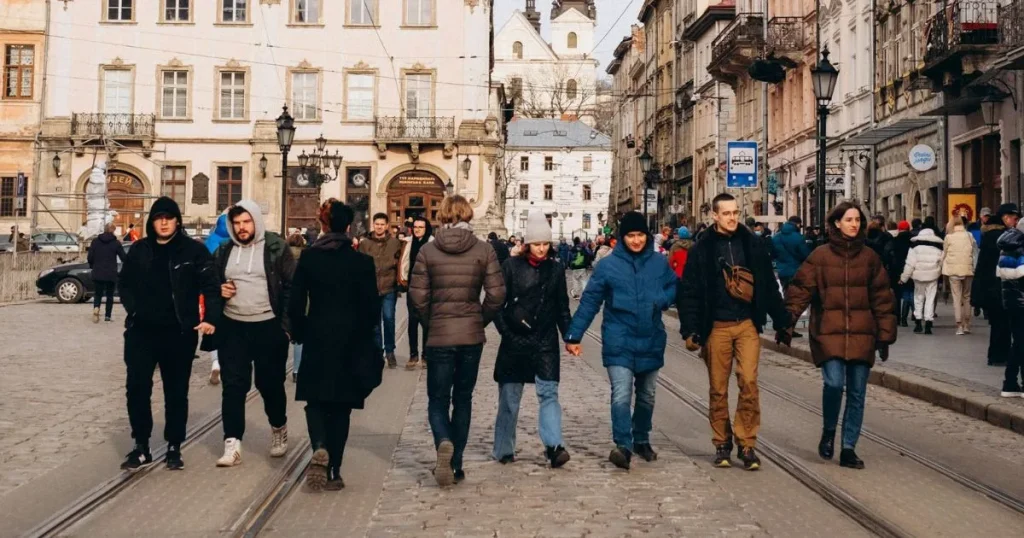
Ukraine’s language has been strongly shaped by its history. The coexistence of Ukrainian and Russian, regional dialects, and government language policy are among the many factors intertwined to produce the situation today.
Understanding the history of the language is essential to a deeper understanding of Ukraine. Ukraine’s history is explained in detail in the article below.
Reference: What Kind of Country Is Ukraine? A 3-Minute Refresher on Its Culture and History
When communicating with people in Ukraine for business or travel, make good use of Japanese-to-Ukrainian translation tools to build good relationships.
This will make your communication with people in Ukraine richer, and bring major benefits.
Sources and article record
Sources and references
- Ukrainian language
Published by Internet Encyclopedia of Ukraine (CIUS) · Checked: 2026-09-23 - Orthography
Published by Internet Encyclopedia of Ukraine (CIUS) · Checked: 2026-09-23 - Russification
Published by Internet Encyclopedia of Ukraine (CIUS) · Checked: 2026-09-23 - Конституція УкраїниArticle 10
Published by Верховна Рада України · Checked: 2026-09-23 - All-Ukrainian population census 2001: Linguistic composition
Published by State Statistics Committee of Ukraine · Checked: 2026-09-23
Corrections and updates
- Changed “Principality of Kievan Rus” to “Kyivan Rus,” based on Ukrainian usage (the earlier spelling is given alongside it at first mention).
- Corrected the following: the explanation of the pronunciation of ґ and г had been reversed; the vocative case and ы had been described as “not found in any other Slavic language”; the basis of the standard language had been given as “eastern Ukraine”; and the language's official status had been dated to 1991. The Russian column was removed from the greetings table, and the kana readings were revised.
If you find an error in this article, please tell us via Corrections. Once we have checked it, we will record in the article what was corrected and why.