
The Railway That Carried 4 Million People West Is Now Starting to Link Up with the EU’s Track Gauge
In the first year of the full-scale invasion, Ukraine's railways carried 4 million people to the west of the country. According to the State Statistics Service, freight fell to less than half its previous level in 2022 and stood at 161.3 million tonnes in 2025. This article draws on official announcements as of September 2026 to describe a business kept running by freight revenue despite passenger losses, and the first EU-gauge track, opened in 2025.
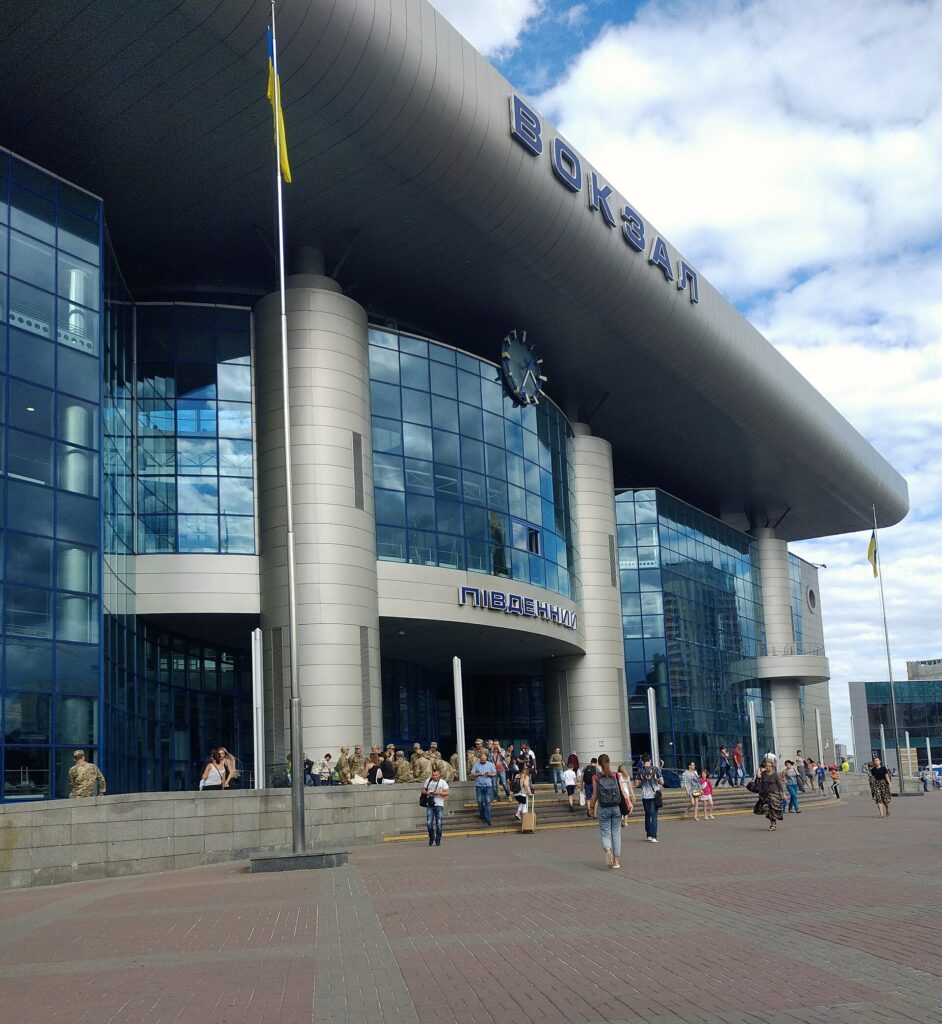
_(48199089446).jpg)
When Russia’s full-scale invasion of Ukraine began on February 24, 2022, Ukraine’s air travel stopped. Rail became the remaining means of moving long distances within the country. The trains are run by the state railway company Ukrzaliznytsia (Ukrainian Railways), whose sole shareholder is the Ukrainian state, with the Cabinet of Ministers exercising its rights.
In the invasion’s first year, the railway carried millions of people west. Since then it has kept running by earning money from freight to cover passenger-side losses, and in 2025 the first track matching the EU’s gauge opened. The figures below are as publicly available as of September 2026.
Nearly 200,000 People a Day in the First Few Days
The National Institute for Strategic Studies (NISS), under the Presidential Administration, wrote in a February 2023 analysis that, in the first few days of the invasion, close to 200,000 people a day evacuated by rail. The same analysis states that over the course of 2022, 4 million people evacuated by rail to western oblasts, and 600,000 abroad. Evacuation trains were free to ride, and more than 100,000 pets were carried along with their owners.
At the time, Deputy Prime Minister Kubrakov, who was responsible for infrastructure, announced on January 1, 2023, that more than 4 million people had been evacuated from the front line since the invasion began, and 314,000 tonnes of humanitarian aid transported. These figures are based on the railway company’s own tallies, not an independent count by a third party.
The cost was not small. The state news agency Ukrinform reported that 303 railway employees died between February 24 and December 26, 2022, and NISS likewise put the death toll since the invasion began at 303.
Freight Cut in Half, Passengers Down by a Third
The State Statistics Service (Derzhstat) compiles annual passenger and freight figures by mode of transport. The rail figures are as follows. These statistics exclude territory temporarily occupied by Russia and parts of areas where fighting has taken (or is taking) place.
| Year | Rail passengers | Rail freight |
|---|---|---|
| 2022 | 52.7 million (64.8% of 2021) | 150.6 million tonnes (47.9% of 2021) |
| 2024 | 65.7 million (101.2% of 2023) | 174.9 million tonnes (117.9% of 2023) |
| 2025 | 63.0 million (95.8% of 2024) | 161.3 million tonnes (92.2% of 2024) |
Freight in 2022 fell to less than half the previous year’s level. Month by month, freight in March 2022, the month after the invasion, was about 8.3 million tonnes, roughly a third of the 26.16 million tonnes carried in January. NISS names iron and manganese ore, coal, steel and construction materials as the items with the largest declines, citing the loss of domestic steel mills, the blockade of sea ports by Russian forces, and the halt of rail traffic with Russia and Belarus. Grain saw only a 14.1% decline. Grain export routes during the period when ports were shut are covered in Where Ukraine’s Grain Leaves From.
Freight recovered in 2024 but fell again in 2025. The State Statistics Service’s table notes that on March 23, 2025, the railway company’s information system suffered a large-scale cyberattack, and that some March documents could not be processed and were carried over into April.
Long-Distance Passengers: 28 Million
There are two ways of counting rail passengers. The State Statistics Service’s 63.0 million (2025) includes commuter trains. Separately, the ministry then responsible, the Ministry for Communities’ Restoration, Infrastructure and Transport, announced in January 2026 that long-distance trains carried 28 million passengers in 2025, 200,000 more than the year before. Since the Statistics Service’s overall rail passenger figures fell, this suggests the decline was mainly on the commuter side, but the Statistics Service does not break the total down between long-distance and commuter.
According to the same ministry announcement, of 2025’s passengers, 1.9 million were children and 240,000 were pets. Well-used domestic routes were the Kyiv-Lviv line and the line connecting Kyiv with Kharkiv and Dnipro, both near the front. It said 2,200 runs were organized in 2025 for official delegations from abroad.
Freight Earns, Passengers Lose
The railway company’s consolidated 2024 financial statements show freight as the main pillar of revenue. Operating results by segment were as follows.
- Freight: revenue of 81.9 billion hryvnias, operating profit of 20.4 billion hryvnias
- Long-distance and international passengers: revenue of 10.7 billion hryvnias, operating loss of 8.8 billion hryvnias
- Commuter passengers: operating loss of 9.3 billion hryvnias
Passenger fares are set by the state, and according to the financial statements, freight tariffs had also not been raised since mid-2022. The responsible ministry explained in December 2025 that, to keep passenger service running — including runs from areas near the front — 12.4 billion hryvnias would be allocated by year end from the state budget’s reserve fund.
How Trains Stop During Air Raids
The railway itself is also a target of attack. On September 18, 2026, the Cabinet of Ministers revised how trains are operated depending on the level of aerial threat. The Ministry for Recovery, Infrastructure and Transport explained that at the “yellow” threat level, boarding, alighting and running continue, while at the “red” level, boarding and departures stop and passengers move to shelters. Minister Kalashnyk said a passenger train locomotive had just been attacked only a few kilometers from the Polish border, and pointed to Russia’s systematic targeting of rail infrastructure.
Bringing the Track Gauge in Line with Europe
Ukraine’s railways are built to the 1,520-millimeter gauge widely used across the former Soviet space. Poland, Hungary and many other EU countries use the 1,435-millimeter gauge, which had required changing bogies or transferring at the border.
On September 5, 2025, a 1,435-millimeter track opened over the 22-kilometer stretch between Chop and the regional capital Uzhhorod in western Zakarpattia Oblast. The responsible ministry describes it as the first standard-gauge project of this scale in independent Ukraine. It was laid alongside the existing 1,520-millimeter track, and half of its 1.3 billion hryvnia construction cost was covered by a grant from the EU’s Connecting Europe Facility (CEF). The announcement said direct passenger trains connecting Uzhhorod with Bratislava, Vienna and Budapest would begin running from September 12.
On September 20, 2026, it was announced that electrification of this stretch had been completed. The section is electrified at 3 kV DC, while neighboring Hungary uses 25 kV AC, so running without changing locomotives requires electric locomotives capable of handling multiple power systems. The next step is to complete electrification from Chop to the Hungarian border (Záhony on the Hungarian side) by the end of 2026.
A standard-gauge line connecting Lviv with Poland is also planned, running from Skniliv near Lviv to Mostyska 2 station near the Polish border. A September 2025 announcement said the EU had allocated 76 million euros in grant funding from the CEF. The completion date is not given in official announcements confirmable as of September 2026.
Beyond the tracks, a bill to bring railway safety and interoperability into line with EU rules has been submitted to the Verkhovna Rada, and as of December 2025 the responsible committee was recommending its adoption at first reading. On rolling stock, a contract has been signed to buy 55 dual-power electric locomotives from France’s Alstom, with the first unit due to arrive in January-March 2027. Japan, too, has sent items such as rail through JICA, covered in What JICA Has Sent to Ukraine.
The railway that carried people west in the invasion’s first year is now starting to link up with track of the EU’s own gauge. Propped up by freight revenue and the state budget to cover passenger losses, and repaired and run again after every attack, that state of affairs still continues as of September 2026.
Sources and article record
Sources and references
- Кількість перевезених пасажирів за видами транспорту за 2025 рікconfirmed values. Rail 63.0 million, 95.8% year-on-year, note excluding occupied territory, etc., including commuter trains
Published by State Statistics Service of Ukraine · Checked: 2026-09-24 - Обсяги перевезених вантажів за видами транспорту за 2025 рікconfirmed values. Rail 161.3 million tonnes, 92.2% year-on-year, note on the March 23, 2025 cyberattack
Published by State Statistics Service of Ukraine · Checked: 2026-09-24 - Кількість перевезених пасажирів за видами транспорту за 2024 рікconfirmed values. Rail 65.7 million, 101.2% versus 2023
Published by State Statistics Service of Ukraine · Checked: 2026-09-24 - Обсяги перевезених вантажів за видами транспорту за 2024 рікconfirmed values. Rail 174.9 million tonnes, 117.9% versus 2023
Published by State Statistics Service of Ukraine · Checked: 2026-09-24 - Кількість перевезених пасажирів за видами транспорту за 2022 рікconfirmed values. Rail 52.7 million, 64.8% versus 2021
Published by State Statistics Service of Ukraine · Checked: 2026-09-24 - Обсяги перевезених вантажів за видами транспорту за 2022 рікconfirmed values. Rail 150.6 million tonnes, 47.9% versus 2021, cumulative monthly figures
Published by State Statistics Service of Ukraine · Checked: 2026-09-24 - Підсумки роботи залізничного транспорту України у 2022 роціFebruary 15, 2023. Nearly 200,000 people a day, 4 million to the west and 600,000 abroad, free rides, over 100,000 pets, decline by category, 303 employees
Published by National Institute for Strategic Studies · Checked: 2026-09-24 - З 24 лютого Укрзалізниця евакуювала чотири мільйони осіб та перевезла 314 тисяч тонн гуманітаркиJanuary 1, 2023. Deputy Prime Minister Kubrakov's announcement, 303 employees
Published by Ukrinform · Checked: 2026-09-24 - Мінрозвитку: У 2025 році залізницею перевезено на 200 тисяч пасажирів більше, ніж роком ранішеJanuary 8, 2026. Long-distance 28 million, 1.9 million children, 240,000 pets, main routes, 2,200 delegation runs
Published by Cabinet of Ministers of Ukraine · Checked: 2026-09-24 - Управління сферою залізничного транспорту у 2025 році: ключові результати та плани на наступний рікDecember 10, 2025. 12.4 billion hryvnia reserve fund, the bill, 55 Alstom locomotives, Skniliv-Mostyska 2
Published by Ministry for Communities' Restoration, Infrastructure and Transport of Ukraine · Checked: 2026-09-24 - В Україні запустили першу євроколію: поїзди з Ужгорода курсуватимуть до Братислави, Відня та БудапештуSeptember 5, 2025. 22 km, 1.3 billion hryvnias, CEF, direct trains from September 12, 1,520mm and 1,435mm, EU's 76 million euros
Published by Ministry for Recovery, Infrastructure and Transport of Ukraine · Checked: 2026-09-24 - Завершення електрифікації першої євроколії Ужгород — Чоп наближає Україну до транспортної мережі ЄС, — Микола КалашникSeptember 20, 2026. Completion of electrification, 3 kV DC and 25 kV AC, electrification to the border by end of 2026
Published by Ministry for Recovery, Infrastructure and Transport of Ukraine · Checked: 2026-09-24 - Рух поїздів під час повітряних загроз: Уряд визначив алгоритм роботи залізниціSeptember 18, 2026. Yellow and red threat levels, the attack on a locomotive near the border
Published by Ministry for Recovery, Infrastructure and Transport of Ukraine · Checked: 2026-09-24 - Консолідована фінансова звітність АТ «Укрзалізниця» за 2024 рік зі звітом аудитораsole shareholder the state, revenue and operating results by segment, freight tariffs held flat
Published by JSC “Ukrainian Railways” · Checked: 2026-09-24
If you find an error in this article, please tell us via Corrections. Once we have checked it, we will record in the article what was corrected and why.