
The Traveling Blind Bards Called Kobzari, and Their Instrument, the Bandura
The bandura, Ukraine's folk instrument, has no frets and produces one pitch per string. The kobzari, who traveled the country reciting epic songs with this instrument, were persecuted under both imperial Russia and the Soviet Union, and the tradition nearly died out in the 1930s. In 2024, the effort to safeguard it was recognized by UNESCO.
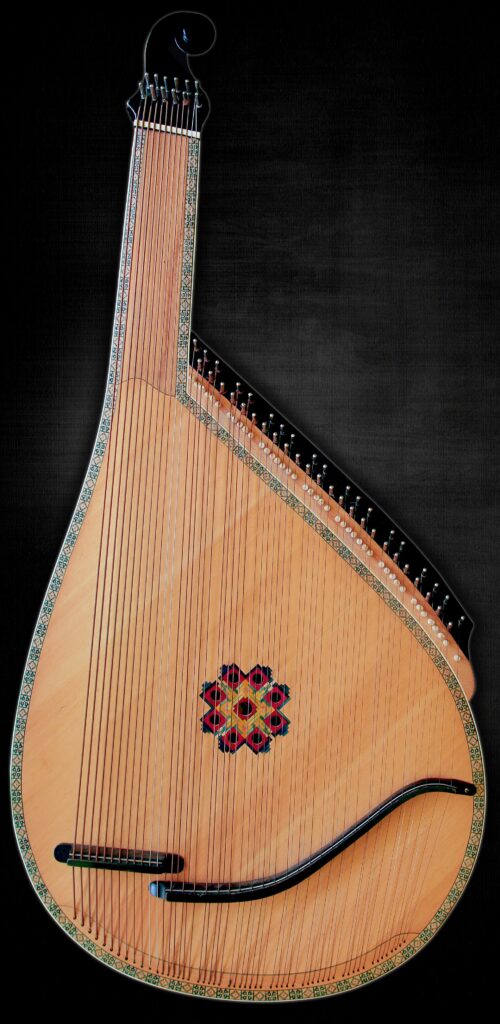

Set diagonally on the lap, plucked with the right hand for the melody and the left for the accompaniment: the bandura (бандура), Ukraine’s folk instrument, is a stringed instrument close to the lute in shape and appearance. But the way its strings are strung and how they produce sound are completely different from a lute.
The history of the people who played it is layered into this instrument: singers, many of them blind, who walked from village to village to perform; people persecuted under both imperial Russia and the Soviet Union. And in 2024, the effort to safeguard that tradition was recognized by UNESCO.
32 to 55 Strings, One Pitch per String
According to the entry “Bandura” in the Internet Encyclopedia of Ukraine (published by the Canadian Institute of Ukrainian Studies, or CIUS; hereafter IEU; first published in the print vol. 1 of 1984), the bandura has 32 to 55 strings. Of these, 8 to 14 bass strings (bunty) run along the neck, and 24 to 43 treble strings (prystrunky) run along the side of the soundboard. The melody is played on the treble strings, and the bass strings are used only for accompaniment.
The same entry lists two differences from other lute-family instruments: having treble strings, and having no frets. Each string produces only one pitch. In this respect its mechanism is completely different from a guitar, where pressing the strings changes the pitch.
Before the 20th century, shapes and tunings varied widely and the instrument was basically diatonic, but standardization has advanced in recent years, and modern instruments can usually produce a full chromatic scale. According to the same entry, the widely used Chernihiv-type bandura measures 109 by 51 centimeters. The body is made of woods such as maple or cherry, and the soundboard of spruce.
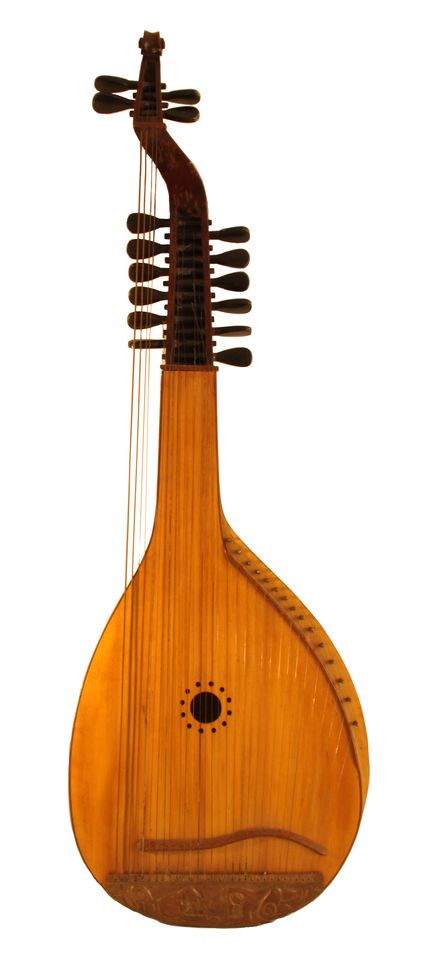

There are different playing styles. In the Chernihiv style, the instrument is held diagonally to the body on the lap, with the melody played by the right hand and the accompaniment by the left. In the Kharkiv style (also called the Zinkiv style), the instrument is held parallel to the body, with the left hand reaching over from above to play the treble strings and the right hand playing the bass strings. The construction of the instrument also differs slightly by style.
From the Kobza to the Bandura
There is a similarly named instrument, the kobza (кобза). According to IEU’s entry “Kobza” (revised 2026), the kobza is an old lute-family instrument of Eastern origin, first recorded in the Codex Cumanicus of 1303. Its early form is thought to have had three strings, played by pressing the strings to change pitch — a different playing technique from the fretless, one-pitch-per-string bandura.
The “Bandura” entry treats a lute-like instrument depicted in an 11th-century fresco at St. Sophia Cathedral in Kyiv as the oldest recorded instrument in the bandura family in Ukraine. Treble strings were added around the 16th century, and by the 17th and 18th centuries the instrument was favored at the Zaporozhian Sich (the Cossacks’ home base), among common people, and in noble households alike. The same entry writes that in the 18th century the bandura came to replace the kobza, and that today the two names are used almost interchangeably.
In 1894, the writer and performer Hnat Khotkevych designed an asymmetrical bandura, expanding its range. In the 20th century, additional strings for producing chromatic notes and mechanisms for shifting a string’s pitch by a semitone were devised, and instruments of different sizes, from treble to bass, were also built for ensemble playing.
The Singers Called Kobzari
Singers who traveled carrying this instrument are called kobzari (кобзар, plural кобзарі). IEU’s entry “Kobzars” (revised 2026) explains that, strictly speaking, the term refers to bandura players who had completed a set apprenticeship and mastered a specific repertoire, and that most of them were blind.
What they sang were epic songs called dumy (дума). According to IEU’s entry “Duma,” dumy took as their subject events of the Cossack era in the 16th and 17th centuries, had no fixed melodic form, and were performed more in a chanted, recitative style than sung, accompanied by the bandura, kobza, or lira. Their themes include Cossacks escaping captivity under the Turks or Tatars, death on the battlefield, and return to their homeland.
According to the “Kobzars” entry, the tradition of traveling kobzari is thought to have originated in the 16th century in the area of what is now Poltava oblast. It is often said that kobzari were held in esteem by the Cossacks, but the entry presents this only as a “commonly held” tradition, and also cites another view: that the tradition grew out of church-run almshouses that cared for blind and disabled Cossacks. By the end of the 18th century, being a kobzar had become almost exclusively an occupation of blind and disabled people, who formed brotherhoods to protect their common interests.
The same entry also notes that the poet Taras Shevchenko depicted kobzari in both his poems and his paintings, and titled his own collection of poems Kobzar.
Under Two Regimes
Imperial Russia
IEU’s “Kobzars” entry writes that, from the 19th into the 20th century, and especially from the 1870s, kobzari were persecuted by the imperial Russian authorities as people who spread pro-Ukrainian sentiment and historical memory. The turning point came in 1902, at the 12th All-Russian Archaeological Congress held in Kharkiv. Performances by kobzari drew a large response, and the congress adopted a resolution recognizing the value of their art. After that, concerts by kobzari began to be held in various places.
The bandura also came to be taught in schools. At the Lysenko Music and Drama School in Kyiv, bandura classes began — in 1908 according to the “Kobzars” entry, or in 1909 according to the “Bandurysts” entry (the two entries differ by one year). In 1909, Khotkevych published the first history and method book for the bandura.
The Soviet Union
According to the “Kobzars” entry, the first bandura ensemble was formed in Kyiv in July 1918, and was reorganized under the Soviet Union in 1923 as the State Bandura Capella. In the 1920s, researchers at the Academy of Sciences carried out important studies of the kobzari.
The situation changed completely in the 1930s. The same entry states that, amid forced collectivization, the Holodomor of 1932–33, and the Stalinist regime’s suppression of Ukrainian culture, kobzari were persecuted once again. Their religious and moral traditional repertoire was suppressed, performances were restricted, and some were arrested and executed. It writes that “by the end of the 1930s, the traditional, authentic kobzar had ceased to exist.”
In its place came the “Soviet kobzar.” In April 1939, the First Republican Congress of Kobzars and Lirnyky was held, organized by an institute of the Academy of Sciences of the Ukrainian Soviet Socialist Republic. Performers with modernized instruments were brought together, and new works such as “Duma about the Communist Party” and “Duma about Lenin” were created and performed at the closing concert.
Khotkevych, who wrote that method book, was himself one of the victims. According to IEU’s entry “Khotkevych, Hnat” (revised 2001), he was arrested at the end of February 1938, sentenced to death by shooting by an NKVD (People’s Commissariat for Internal Affairs) tribunal in Kharkiv on March 29, and executed on October 8. He was posthumously rehabilitated in 1956.
| Year | Event |
|---|---|
| 1303 | The first record of the kobza (the Codex Cumanicus) |
| 1870s onward | Kobzari persecuted by the imperial Russian authorities |
| 1894 | Khotkevych designs an asymmetrical bandura |
| 1902 | Kobzari perform at the 12th All-Russian Archaeological Congress in Kharkiv |
| 1908 or 1909 | Bandura classes begin at the Lysenko Music and Drama School in Kyiv |
| July 1918 | The first bandura ensemble, in Kyiv |
| 1923 | Reorganized as the State Bandura Capella |
| 1930s | Persecution of kobzari; the traditional kobzar dies out |
| October 8, 1938 | Khotkevych is executed by shooting |
| April 1939 | The First Republican Congress of Kobzars and Lirnyky |
| 1949 | The chorus of performers who remained abroad relocates to Detroit, in the United States |
| 1970s | An informal movement begins to preserve traditional playing methods |
| 2024 | The safeguarding programme for the kobza and lira tradition is selected for UNESCO’s “Good Safeguarding Practices” |
Bringing Back a Tradition That Nearly Died Out
Outside Ukraine, a separate lineage continued. According to IEU’s entry “Ukrainian Bandurist Chorus,” a chorus of bandura players who had remained in Germany after the Second World War relocated together to Detroit, in the United States, in 1949, continuing to perform while working as laborers by day. Schools teaching the bandura have also been established in North America and Australia.
IEU’s “Kobzars” entry writes that, in Soviet Ukraine too, an informal movement arose in the 1970s to perform the traditional repertoire in the traditional style on traditionally built instruments.
At the far end of that current is UNESCO’s 2024 decision. According to UNESCO’s Intangible Cultural Heritage page, Ukraine’s “Safeguarding Programme of Kobza and Wheel Lyre Tradition” was selected for the Register of Good Safeguarding Practices at the 19th session of the Intergovernmental Committee in 2024. This was not an inscription on the Representative List, but recognition of the safeguarding effort itself.
According to UNESCO’s description, performers formed guilds called tsekhy (цех, singular tsekh) to govern their own activity and protect their rights. They faced numerous hardships and prosecutions in the 1920s and 1930s, but in the 1980s the practitioners who remained rebuilt the tsekh system, and knowledge and skill are passed on through long apprenticeships combining lectures and practice. Today’s tsekhy are also said to carry on the tradition of working alongside blind people, and to fund themselves through crowdfunding and donations.
Ukraine’s other elements on UNESCO’s lists are covered in the article on pysanka.
Hearing the Bandura in Japan
There are also bandura players based in Japan.
The singer and bandura player Natasha Gudziy, according to the profile on her official website, was affected by the Chornobyl nuclear disaster at age 6, and began studying the bandura at a music school at age 8. She has been active in Japan in earnest since 2000. In July 2005, she performed at a dinner at the Prime Minister’s Official Residence during a visit to Japan by the President of Ukraine. She appears on the Ministry of Foreign Affairs’ list of recipients of the Heisei 28 (fiscal 2016) Foreign Minister’s Commendation, listed as a “singer and bandura (a Ukrainian folk instrument) player,” for her achievement in “promoting mutual understanding between Japan and Ukraine through music.”
The bandura player Kateryna, according to her official website, was born in Prypiat, a town 2.5 kilometers from the power plant, and was 30 days old at the time of the accident. At age 6, she joined a music ensemble of children affected by the nuclear accident and took part in overseas performances, and at 19 she moved her base of activity to Tokyo.
Concert schedules are posted on each performer’s official website.
Sources and article record
Sources and references
- BanduraThe number and structure of strings, playing technique, the 11th-century fresco, its relation to the kobza, and the 1894 asymmetrical model. First published in the print vol. 1 of 1984. Written by: Andrij Hornjatkevyč
Published by Internet Encyclopedia of Ukraine (CIUS) · Checked: 2026-09-24 - KobzaFirst recorded in 1303, the number of strings, and playing technique. Revised 2026. Written by: Victor Mishalow
Published by Internet Encyclopedia of Ukraine (CIUS) · Checked: 2026-09-24 - KobzarsDefinition, origins, the brotherhoods, persecution under the imperial era, 1902, the 1908 classes, the 1918 and 1923 ensembles, the 1930s persecution, the April 1939 congress, and the 1970s movement. Revised 2026. Written by: Victor Mishalow, Mykola Mushynka
Published by Internet Encyclopedia of Ukraine (CIUS) · Checked: 2026-09-24 - BandurystsThe first formal classes in 1909, persecution during the Soviet period, and schools abroad. Revised 2026. Written by: Victor Mishalow, Wasyl Wytwycky
Published by Internet Encyclopedia of Ukraine (CIUS) · Checked: 2026-09-24 - DumaThe form, subject matter, and accompaniment of dumy. First published in the print vol. 1 of 1984. Written by: Petro Odarchenko
Published by Internet Encyclopedia of Ukraine (CIUS) · Checked: 2026-09-24 - Khotkevych, HnatThe 1909 method book, the 1938 arrest and execution, and the 1956 rehabilitation. Revised 2001. Written by: Ivan Koshelivets
Published by Internet Encyclopedia of Ukraine (CIUS) · Checked: 2026-09-24 - Ukrainian Bandurist ChorusThe 1949 relocation to Detroit. First published in the print vol. 5 of 1993. Written by: Wasyl Wytwycky
Published by Internet Encyclopedia of Ukraine (CIUS) · Checked: 2026-09-24 - Safeguarding programme of kobza and wheel lyre tradition2024, 19.COM, the Register of Good Safeguarding Practices, and the description of the tsekh
Published by UNESCO Intangible Cultural Heritage · Checked: 2026-09-24 - 平成28年度外務大臣表彰 受賞者(個人)Entry no. 101: singer and bandura player, and the achievement cited
Published by Ministry of Foreign Affairs of Japan (MOFA) · Checked: 2026-09-24 - ナターシャ・グジー プロフィールBeing affected by the disaster, music school from age 8, activity in Japan from 2000, and the July 2005 performance at the Prime Minister's Official Residence
Published by Office Zirka (Natasha Gudziy's official website) · Checked: 2026-09-24 - プロフィール:カテリーナBorn in Prypiat, affected at 30 days old, joining a music ensemble at age 6, and moving to Tokyo at 19
Published by kateryna-music (Kateryna's official website) · Checked: 2026-09-24
If you find an error in this article, please tell us via Corrections. Once we have checked it, we will record in the article what was corrected and why.