

Section
Connections with Japan
Life in Japan, cultural exchange, and ties built through work.
-
Four People in Autumn 2012: Ukrainians Who Received Japanese Decorations and Foreign Minister’s Commendations
The Japanese government awards decorations to foreign nationals who have contributed to exchange with Japan, and the Ministry of Foreign Affairs separately gives Foreign Minister's Commendations. This article lists 15 people living in Ukraine or holding Ukrainian nationality who were confirmed in the official lists and embassy announcements from 2006 to 2018, together with the achievements as stated in the announcements, and shows the difference between the two systems and the count in the lists since 2019.
-
2,902 Ukrainians Have Evacuated to Japan; 1,931 Are Living There Now
Since March 2022, 2,902 people have entered Japan counted as “Ukrainian evacuees,” and 1,931 remain in Japan as of the end of August 2026 (preliminary figures from the Immigration Services Agency). Three in four arrived in the first ten months, and about 70% are women. They now live across 44 prefectures. Since complementary protection began, the breakdown of statuses of residence has also changed substantially.
-
After Cigarettes and Iron Ore Disappeared, Here’s What Japan Now Buys From Ukraine
Looking at product categories in the Ministry of Finance's trade statistics, cigarettes, which made up half of Japan's imports from Ukraine in 2021, stopped appearing in the statistics from 2023, and iron ore likewise disappeared by 2024. The largest import category now is aluminum. Japan's exports remain centered on passenger cars, with railway rails standing out in 2024 and transformers in 2025.
-
Where Has the Japanese Red Cross’s ¥10.2 Billion in Ukraine Relief Donations Gone?
The Japanese Red Cross Society's “Ukraine Humanitarian Crisis Relief Fund” had received more than ¥10.2 billion by the end of August 2026. About ¥5 billion was sent to the international Red Cross movement during 2022, and the rest has gone to programs run jointly with the Ukrainian Red Cross Society, including rehabilitation, mobile clinics, and home care. The fund's collection period has been extended to the end of March 2027.
-
Japan’s Support for Ukraine: About $20 Billion in Total — the Single Largest Item Is a Loan Repaid From Russian Assets
In February 2026, the Japanese government stated that its support for Ukraine totaled "about $20 billion in total." This figure combines amounts pledged and amounts actually disbursed, and the Ministry of Foreign Affairs' pages do not show a breakdown by field. The single largest item is a loan of 471.9 billion yen, to be repaid from the earnings on Russia's frozen assets. This article traces the announcements with a clear amount and date, starting from the $100 million pledge in 2022.
-
1,498 People Studying Japanese in Ukraine: The Japan Foundation’s FY2024 Survey
According to the Japan Foundation's FY2024 survey, Ukraine has 14 institutions teaching Japanese, 93 teachers, and 1,498 learners—down from the FY2021 survey. This article looks at the trend since FY2012, a change in how teachers are counted, and the history of Japanese-language teaching at universities in Kyiv, based on the survey reports and university records.
-
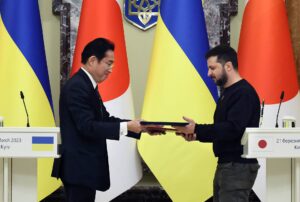
A Japan-Ukraine Timeline ── From the 1965 Sister-City Partnership to Yen Loans
From the 1965 sister-city partnership between the City of Yokohama and the City of Odesa, to the opening of diplomatic relations in 1992, to the yen loans and evacuee intake after 2022. This article puts Japan-Ukraine relations into a timeline made only of events whose date and announcing body can be identified. It also separates whether support figures are ceilings or amounts actually disbursed, and what an evacuee count is actually counting.