
Floating Wreaths on the River, Leaping Over Fire: The Midsummer Festival of Ivan Kupala
Ukraine's midsummer festival Ivan Kupala survives as a pre-Christian ritual that came to overlap with the feast day of John the Baptist. Under the old calendar it fell in July, but the 2023 calendar reform moved the church feast to June 24. This article covers the wreath and fire customs, the songs, and the changes of the Soviet era as recorded in the encyclopedias.
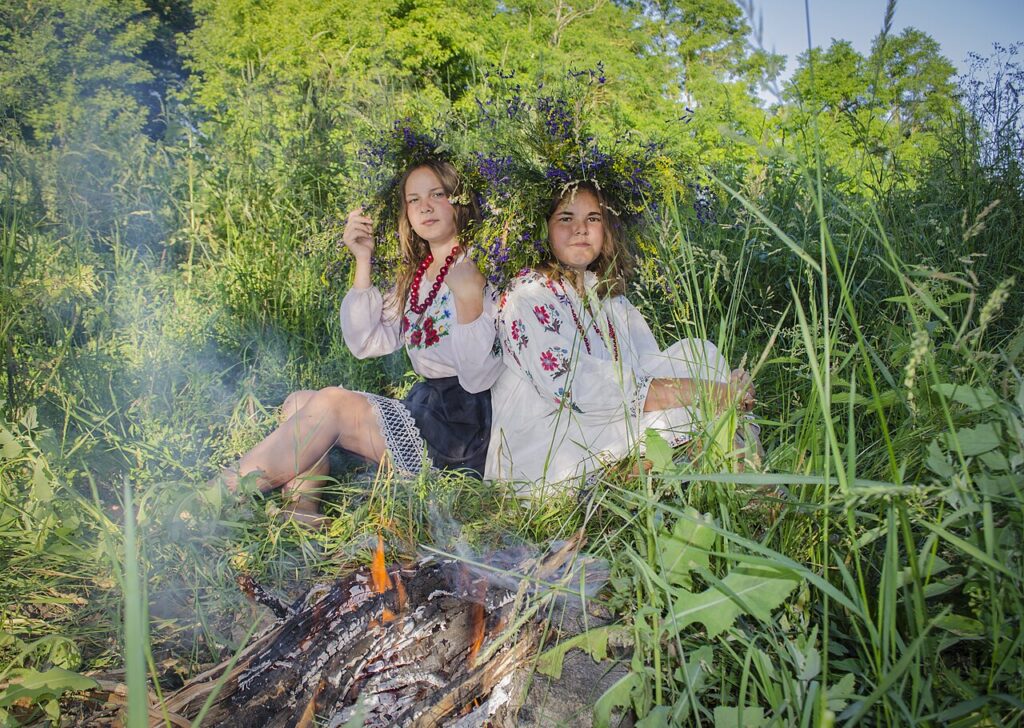

On a night around the summer solstice, young people gather by the riverside, light a fire, and leap over it. Girls place wreaths woven from freshly picked flowers on their heads, and finally float them on the water, reading the direction they drift as a fortune for love. Ukraine’s Ivan Kupala (Івана Купала) is a summer festival known for customs like these.
The entry “Ivana Kupala” in the Encyclopedia of Modern Ukraine (ESU), compiled by the National Academy of Sciences of Ukraine and others, calls the festival a “summer calendar festival,” and states that its origins are linked to pre-Christian rituals of the summer solstice period. The name is most often explained as coming from Kupala, a pagan deity of the earth’s fruitfulness; it is also called “Kupala,” “Kupailo,” or “John’s Day.”
A Festival That Came to Overlap with John the Baptist’s Day
As Christianity spread, the church tried to suppress this festival. According to the entry “Kupalo festival” in the Internet Encyclopedia of Ukraine (IEU), compiled by the Canadian Institute of Ukrainian Studies at the University of Alberta, the church tried instead to put in its place the feast of the Nativity of John the Baptist (June 24), but the customs survived as a folk ritual and became the festival of “Ivan (John) Kupala.” ESU likewise explains that the Kupala rituals merged with the feast of the Nativity of John the Baptist.
The date needs care. According to ESU, this feast day falls on June 24 in the Julian calendar (the old calendar), which, in the 20th and 21st centuries, corresponds to July 7 in the civil calendar now in use (the Gregorian calendar). Since the rituals traditionally begin the evening before, while the feast was celebrated on the old calendar, the festival night fell on the night of July 6 to 7 in the civil calendar.
ESU goes on to state that, after the 2023 calendar reform, the Orthodox Church of Ukraine (OCU) and the Ukrainian Greek Catholic Church (UGCC) celebrate the Nativity of John the Baptist on June 24. Both churches decided to celebrate fixed-date holidays by the new calendar from September 1, 2023. This is the same reform that moved Christmas from January 7 to December 25; the background is covered in our article on Ukrainian Christmas moving from January 7 to December 25.
Note that Ivan Kupala is not a public holiday. It does not appear among the holidays set out in Article 73 of the Labor Code, or in the list of religious holidays on which work is suspended.
The Old Name in the Record
According to IEU, written records of this festival go back to the 11th century, and the word “Kupala” first appears in the Hypatian Chronicle’s entry for 1262. ESU likewise cites one of the earliest references to the Kupala season in the Halych-Volhynian Chronicle’s entry for 1262. According to ESU, the first detailed description of the festival on Ukrainian soil is the early-17th-century Hustyn Chronicle, which treats the festival as pagan.
Both church and secular authorities repeatedly tried to ban the festival. As an example, IEU cites Hetman Ivan Skoropadsky issuing a decree banning the festival in 1719, and states that, although similar decrees were repeated afterward, the tradition was too old and deep-rooted to disappear.
How the Night Was Spent, According to the Sources
ESU records the festival’s rituals in detail, along with their regional variations. What follows is what ESU describes as traditional customs — it does not mean every household or village practices them the same way today.
- Wreaths: girls wove wreaths from flowers picked before sunrise — one to wear on the head, another to decorate the festival tree. Thyme, tansy, marigold and cornflower were common, with nettle or wormwood woven in as protection against evil
- The festival tree: usually willow, in some places cherry, pine in the northern Polisia region, and birch in the southeast. Decorated with ribbons and wreaths, it was set up on a riverbank or pond shore, a hill, or a field at the edge of a village. Its name also varied by region — “Kupailo,” “Kupailytsia,” “Marena,” and others
- A doll: in parts of Chernihiv, Sumy and Poltava, girls made a straw doll called “Kupalo,” which was burned or sunk in the water after the festival
- Fire: jumping over the fire was an essential part of the festival, representing purification from evil. It was believed that if two people jumped without letting go of each other’s hands, they would have a happy marriage, while scorched clothing was a bad sign for married life
- Floating wreaths: girls floated candle-lit wreaths on the water, reading the outcome — drifting toward where a suitor lived meant marriage, spinning in place meant the suitor was uninterested, and sinking was a bad sign
ESU writes that women and girls played the central role in this festival. At night, girls sat around the decorated tree and sang, and the songs centered on love and wishes for a happy marriage.
A well-known legend holds that a fern blooms only on Kupala night. According to ESU, this flower was guarded by evil spirits and almost no one had ever seen it, but it was believed that whoever obtained it would know everything, become rich and happy, and understand the language of birds and beasts. IEU likewise states that it was believed that only on this night did the earth reveal its secrets, making a fern flower bloom at the spot where treasure was buried.
IEU also records that, as a symbol of the sun’s power weakening after the solstice, some regions set fire to a wheel wrapped in dry grass or straw and rolled it down a hill, and that herbs picked on this night were believed to have healing power, and were brought to church to be blessed on John’s feast day.
Kupala Songs
The festival had its own set of songs. The entry “Kupala songs” in ESU describes them as folk songs sung around the summer solstice and the “Petrivka fast” that follows it, sung to accompany the festival on the night of June 23–24 in the old calendar, or July 6–7 in the new.
According to the same entry, under Christian influence, the songs’ older refrains of “Kupala” or “Kupailo” were replaced with phrases such as “Ivan’s Kupala.” Many of the Kupala songs sung today are, in the view of folklorists, only loosely connected to the festival’s mythological base, and are considered above all lyrical songs about love.
The festival has also become a subject of literature and music. IEU lists works by Gogol, Mykhailo Starytsky, Lesya Ukrainka, Olha Kobylianska and Mykhailo Kotsiubynsky, and music by Mykola Lysenko and others. Lesya Ukrainka also published a piece describing the Kupala festival in the Volhynia region in 1894 (per IEU’s bibliography).
The Soviet Era, and Now
In the 20th century, the festival’s form changed greatly. ESU states that the traditional Kupala rituals were greatly narrowed by Soviet anti-religious policy and the destruction of traditional ways of life.
According to IEU, the Soviet Union also tried to co-opt the festival in a different form. In 1958, the Verkhovna Rada of the Ukrainian Soviet Socialist Republic designated the last Sunday of June as “Soviet Youth Day,” and tried to incorporate traditional rituals into its celebration, but IEU states that, because of its manufactured character, it was not widely embraced.
ESU (revised December 2023) states that, today, the festival is known in most oblasts of Ukraine. While it has faded somewhat in the Carpathian region, rich regional variation is said to remain in Polisia, Podilia and the central regions. ESU adds that the theatrical-style events now held for Ivan Kupala are attempts to recreate the ritual on stage.
A festival that spends the midsummer night with fire, water and flowers has remained on record since the 11th century, even as it was suppressed by the church, banned by hetmans, and nearly remade by the Soviet Union.
Sources and article record
Sources and references
- Івана Купала [Ivana Kupala]V. K. Borysenko; ESU Volume 11, revised December 2023; the origin and name; the merging with the feast of the Nativity of John the Baptist; Julian June 24 = Gregorian July 7; the OCU and UGCC after the 2023 calendar reform; the 1262 chronicle; the Hustyn Chronicle; the 20th-century narrowing; the wreaths, festival tree, doll, fire, floating wreaths and fern flower; the present-day distribution
Published by Encyclopedia of Modern Ukraine (Institute of Encyclopedic Research of the National Academy of Sciences of Ukraine, Shevchenko Scientific Society) · Checked: 2026-09-24 - Купальські пісні [Kupala Songs]I. V. Klymenko; ESU Volume 16, revised December 2016; the night of June 23–24 old calendar, July 6–7 new calendar; the replacement of the refrains; lyrical songs of love
Published by Encyclopedia of Modern Ukraine · Checked: 2026-09-24 - Kupalo festivalMykola Mushynka; the substitution of John's feast day [June 24]; the fern flower; the wheel; the blessing of herbs; the 11th-century record and the Hypatian Chronicle's entry for 1262; Skoropadsky's 1719 decree; its use as a subject in literature and music; Lesya Ukrainka's 1894 "Kupala na Volyni"; the 1958 "Soviet Youth Day"
Published by Internet Encyclopedia of Ukraine (Canadian Institute of Ukrainian Studies, University of Alberta) · Checked: 2026-09-24 - Постанови Архієрейського Собору від 24 травня 2023 р. [Resolutions of the Council of Bishops of May 24, 2023]the shift to the Revised Julian calendar; from September 1, 2023
Published by Orthodox Church of Ukraine (pomisna.info) · Checked: 2026-09-24 - Календарна реформа УГКЦ в Україні: коротко про головне [The UGCC's Calendar Reform in Ukraine: Briefly, the Main Points]fixed-date holidays moving to the new calendar
Published by Synod of Bishops of the UGCC (synod.ugcc.ua) · Checked: 2026-09-24 - Кодекс законів про працю України [Labor Code of Ukraine], Article 73version as of September 24, 2026; the list of holidays and religious rest days; the note on non-application during martial law
Published by Verkhovna Rada of Ukraine (zakon.rada.gov.ua) · Checked: 2026-09-24
If you find an error in this article, please tell us via Corrections. Once we have checked it, we will record in the article what was corrected and why.
Related articles
-
From Kyivan Rus’ to the 16th Century — Galicia-Volhynia and Two Unions
This article traces the history of the land that is now Ukraine before the Cossacks emerged as a political force: from the Trypillia culture of around 5000 BCE, through the Greek colonies on the Black Sea coast, Kyivan Rus', and the Grand Duchy of Lithuania, to the Union of Lublin in 1569 and the Union of Brest in 1596. The view of Kyivan Rus' as the state of a single "Old Rus' nationality" is the official framework put forward by a panel of historians commissioned by the Soviet Communist Party in the 1930s. Ukrainian historiography since Hrushevsky has regarded the Principality of Galicia-Volhynia as the successor to the Kyivan state.
-
Free Passage Through the Locks: The 2020 Inland Waterway Law and Freight on the Dnipro
Adopted in December 2020 and taking effect on January 1, 2022, the Law on Inland Water Transport opened Ukraine's rivers to foreign-flagged vessels and made passage through the locks free of charge. Figures for freight on the river differ by roughly fourfold between the State Statistics Service and the Ministry of Infrastructure. Using the text of the law and government announcements current as of September 2026, this article traces the law's content and its stages of implementation, and the decline in shipping and the halted locks since the full-scale invasion.
-
From “Kokujikō” to Accredited Schools: The Japanese Language School Accreditation System That Began in 2024
The Act on the Accreditation of Japanese Language Education Institutions, which took effect on April 1, 2024, launched a system under which the Minister of Education, Culture, Sports, Science and Technology accredits Japanese language schools, and a new national qualification, the “Registered Japanese Language Teacher.” This article covers the three programs — for study, for work, and for daily life — the relationship with the previous “kokujikō” schools, and the accreditation results and Japanese Language Teacher Examination figures published as of September 2026.