
Ukraine’s Christmas Moves from January 7 to December 25
Under a July 2023 law, Ukraine removed January 7 from its list of national holidays, leaving only December 25 as Christmas. That same September, two of the country's major churches also switched to a calendar that celebrates Christmas on December 25. This article separates the law, the church calendars, and family customs, and explains the twelve dishes of Christmas Eve and koliadky along the way.


For a long time, Christmas in Ukraine’s calendar fell on January 7. In the summer of 2023, that date was removed from the list of national holidays, leaving only December 25. On September 1 of that same year, two of the country’s major churches switched to a calendar that celebrates Christmas on December 25.
But summing this up in one line — “Ukraine’s Christmas became December 25” — misses some things. The national holiday was decided by law; the date of worship was decided by each church. And how a given household celebrates is decided by that household. These three things move independently of one another.
What the law changed was the “list of holidays”
Ukraine’s public holidays are set out in Article 73 of the Labor Code (Кодекс законів про працю України). Looking at the text as it stood on January 1, 2023, it read: “January 7 and December 25 — the Nativity of Christ (Різдво Христове).” In other words, at that point December 25 was already a holiday too, listed alongside January 7.
This was amended by Law No. 3258-IX, “On Amendments to Article 73 of the Labor Code of Ukraine,” adopted by Ukraine’s Verkhovna Rada (parliament) on July 14, 2023. The substance of the amendment is brief, as follows.
- Remove the line “January 7 and December 25 — the Nativity of Christ” from the list of holidays, and add “December 25 — the Nativity of Christ”
- In the list of “religious holidays on which work is not performed,” likewise remove the line including January 7 and add December 25
- Change Ukraine’s Statehood Day to July 15, and Defenders of Ukraine Day to October 1
The law was published on July 29, 2023 in one of the official gazettes, the Verkhovna Rada’s newspaper Holos Ukrainy (Голос України), and took effect the following day, July 30. The bill number was 9431.
It is worth noting that other commemorative dates moved at the same time as the date of Christmas. This law was not a standalone measure that moved only Christmas; it was part of a broader amendment that reorganized the country’s commemorative dates together.
One more thing appears in the text: the opening of Article 73 states that the provisions of this article do not apply during a period of martial law (per Law No. 2136-IX of March 15, 2022). While martial law continues following Russia’s full-scale invasion, a date being a holiday on paper does not necessarily mean it will be treated as a day off.
What the churches changed was the “liturgical calendar”
Even if the law changes the list of holidays, each church decides for itself the day on which it holds worship. This is where the “Revised Julian calendar” comes in.
December 25 on the Julian calendar (the “old” calendar) corresponds to January 7 on the civil calendar now in use (the Gregorian calendar). A decision document from the Council of Bishops of the Orthodox Church of Ukraine (ПЦУ, hereafter OCU) explains that the Julian calendar’s dates have gradually drifted from astronomical events, and that by the 20th and 21st centuries the difference from the spring equinox had grown to 13 days. This is why the Christmas of the old calendar falls on January 7.
The Revised Julian calendar was approved at a 1923 council of Orthodox churches held in Constantinople, based on the work of Serbian astronomer Milutin Milanković. Under this calendar, fixed-date holidays such as Christmas are celebrated on the same date as in the civil calendar (December 25, in Christmas’s case). However, both of the churches described below kept their traditional method for calculating the date of Easter (Pascha).
The Orthodox Church of Ukraine (OCU)
On May 24, 2023, the OCU’s Council of Bishops decided to switch to the Revised Julian calendar. The main points of the decision are as follows.
- The switch takes effect on September 1, 2023, the start of the church’s new year
- The calculation of Easter (the traditional Paschalia) does not change
- Parishes or monasteries that wish to continue on the Julian calendar may do so, if at least two-thirds of the members approve at a parish assembly or similar body
The decision also touches on the background. Under a decision of the Holy Synod in October 2022, parishes that wished were permitted to hold a Christmas service on December 25, 2022. As of February 2023, 103 parishes had been permitted to switch to the Revised Julian calendar. The decision also states that while the Julian calendar was once seen as a marker of Ukraine’s own church culture, it is now perceived by many as tied to Russian church culture instead.
The Ukrainian Greek Catholic Church (УГКЦ, hereafter UGCC)
The UGCC decided ahead of the OCU. At the 93rd session of the Synod of Bishops of the UGCC in Ukraine, held February 1–2 2023 in Briukhovychi (within the city of Lviv), it was decided that “fixed” holidays would be celebrated on the new calendar from September 1, 2023, while the calculation of Easter would remain unchanged.
Under the new calendar, Christmas falls on December 25 and Theophany (Богоявлення) on January 6. Parishes not yet ready were permitted, with a bishop’s approval, to keep celebrating on the old calendar until September 2025 (under which Christmas falls on January 7 and Theophany on January 19). Sviatoslav Shevchuk, the head of the UGCC, said that support reached “almost 90%” in a preliminary survey. This is the church’s own account, not an independent survey’s figure.
| Date | Event |
|---|---|
| As of January 1, 2023 | Article 73 of the Labor Code lists the holiday as “January 7 and December 25 — the Nativity of Christ” |
| February 1–2, 2023 | The UGCC’s Synod of Bishops decides to switch to the new calendar from September 1 |
| May 24, 2023 | The OCU’s Council of Bishops decides to switch to the Revised Julian calendar from September 1 |
| July 14, 2023 | The Verkhovna Rada adopts Law No. 3258-IX |
| July 30, 2023 | The law takes effect. January 7 is removed from the list of holidays, leaving December 25 |
| September 1, 2023 | The OCU and the UGCC switch to the new calendar |
| September 1, 2025 | Deadline for the transition period during which the UGCC permitted the old calendar |
What is listed here are the decisions of two churches, the OCU and the UGCC. Ukraine has other churches and religious communities as well, and even within the OCU, parishes are permitted to continue on the old calendar. It cannot be said that “all of Ukraine’s churches moved to December 25.”
Christmas Eve (Sviatvechir) and the Twelve Dishes
Even as the date changes, it doesn’t mean the substance of Christmas changes all at once. The entry on “Christmas” in the Internet Encyclopedia of Ukraine (IEU), compiled by the University of Alberta’s Canadian Institute of Ukrainian Studies, writes that the most interesting part of Ukrainian Christmas is the evening before it — Christmas Eve (Святвечір / Sviatvechir).
According to the same entry, the “Holy Supper” of Christmas Eve consists of twelve ceremonial dishes made without meat or dairy. However, neither the order of the dishes nor the dishes themselves are the same everywhere. The IEU writes that “each region keeps to its own tradition,” and gives as an example the menu of the Hutsul region in the Carpathian Mountains.
Beans, fish, boiled potato dumplings (pyrohy or varenyky), stuffed cabbage rolls (holubtsi), zhurbaka or kucha, mashed potatoes seasoned with garlic, stewed fruit, rohaza (peas seasoned with oil or honey), plums and beans, poppy-seed pyrohy, sauerkraut broth with cracked grain, millet porridge, and boiled corn
From the Hutsul-region example in the Internet Encyclopedia of Ukraine’s “Christmas” entry (translated from English; some dish names are given only in the source article’s Japanese phonetic transcription)
Counting this example, thirteen dish names appear, not twelve. It seems best to take “twelve dishes” less as a fixed rule than as a rough marker, with the count and contents varying from place to place.
One dish that often comes up by name is kutia (кутя). According to the IEU, it is made from whole boiled wheat grains combined with honey and ground poppy seed.
The IEU also describes how Christmas Eve used to unfold. During the day, all work stopped except preparing the supper; the head of the household would bring in a sheaf of hay and grain from the threshing floor. The sheaf, called the didukh (дідух, meaning “grandfather”), was placed in the place of honor beneath the icons. Hay was spread under and over the table, and garlic was placed in the four corners. When the kutia was served, the head of the household would take the first spoonful and, opening the window or stepping outside, call out, “Frost, come and eat kutia.” After the meal, three spoonfuls of each dish would be set aside on a separate plate for deceased family members.
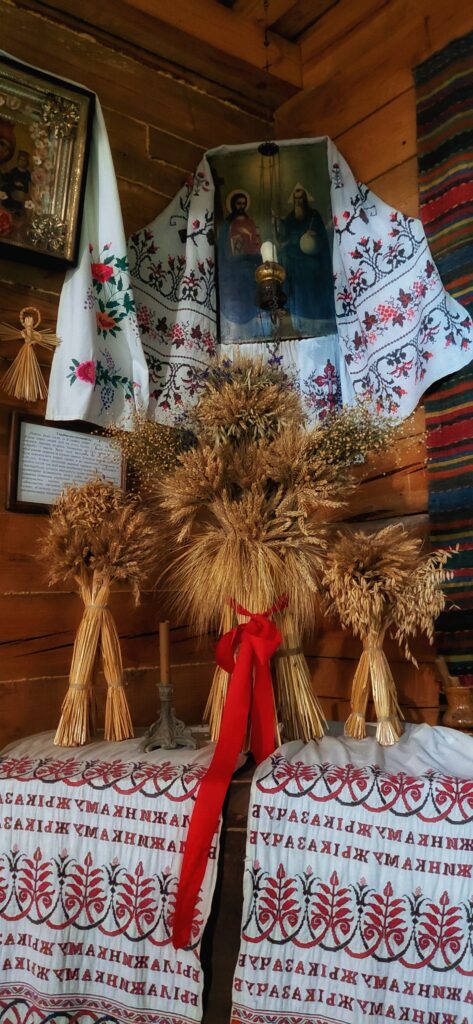

What needs to be flagged here is that the IEU writes this in the form of “in former days.” The same entry also notes that during the Soviet period in Ukraine, many of the Christmas rituals disappeared, and that after independence many were revived, especially in the western oblasts. This entry’s most recent revision is dated 2005. It is natural to think that how many dishes are set out today, and which rituals are kept, differs from household to household and region to region. Some households will keep to the number twelve, and others will not, and this article has not found a source showing the proportions.
Koliadky — The Songs Sung at Christmas
Another pillar of Christmas is koliadka (колядка, plural koliadky), the carols sung going door to door. The IEU’s entry on “Carols” divides Ukraine’s winter festive songs into two: koliadky, sung at Christmas, and shchedrivky (щедрівки), sung on New Year’s Eve.
According to the same entry, both kinds of song retain old layers such as sun worship and ancestor veneration, with lyrics that depict farming life and wish for a good harvest and health. As time passed, biblical themes were layered onto this — the Nativity of Christ, the shepherds, the Magi from the East, and Herod. The IEU gives, as well-known koliadky, “Boh predvichnyi” (“Eternal God”) and “Nova radist stala” (“New Joy Has Come”), among others.
The IEU’s “Christmas” entry also states that the caroling may be accompanied by the vertep (вертеп) puppet theater, the folk play “koza” in which someone dresses as a goat, and a handmade star. The religious celebration is said to continue for three days, spent in worship, caroling, and visiting relatives and acquaintances.
The melody well known in Japan as “Carol of the Bells” does not come from a Christmas koliadka, but from the New Year’s shchedrivka called “Shchedryk.” That history is covered in detail in From “Shchedryk” to “Carol of the Bells”.
The Date May Move, but the Way of Celebrating Is Not Just One
To sum up, what happened in 2023 splits into three layers. January 7 was removed from the list of national holidays (the law). Two major churches switched to a calendar under which Christmas worship is held on December 25 (a church decision). And how, and when, each household celebrates — something neither the law nor any church decision determines uniformly.
The IEU’s “Christmas” entry notes that Christmas was originally celebrated in the East on January 6, together with Theophany, and was placed as an independent feast on December 25 in Rome in the mid-4th century. 2023 was not the first time the date of Christmas has moved.
If you ask an acquaintance from Ukraine, “When do you celebrate Christmas?” the answer could be December 25, January 7, or both. Not deciding that any one of these is “the correct Ukrainian Christmas” is the surest way to understand it.
Sources and references
- Закон України «Про внесення змін до статті 73 Кодексу законів про працю України» від 14.07.2023 № 3258-IX (the full text of the amendment)
Published by Верховна Рада України (zakon.rada.gov.ua) · Checked: 2026-09-23 - The document card for the same law (adoption date, bill No. 9431, published July 29, 2023 in Holos Ukrainy, took effect July 30)
Published by Верховна Рада України (zakon.rada.gov.ua) · Checked: 2026-09-23 - Кодекс законів про працю України, Article 73 (version as of January 1, 2023: “7 січня і 25 грудня - Різдво Христове”, and the note on non-application during martial law)
Published by Верховна Рада України (zakon.rada.gov.ua) · Checked: 2026-09-23 - Кодекс законів про працю України, Article 73 (current version: “25 грудня - Різдво Христове”)
Published by Верховна Рада України (zakon.rada.gov.ua) · Checked: 2026-09-23 - Постанови Архієрейського Собору від 24 травня 2023 р. (the switch to the Revised Julian calendar, starting September 1, retaining the Paschalia, the two-thirds clause, 103 parishes, the 13-day difference, the 1923 council)
Published by Православна Церква України (pomisna.info) · Checked: 2026-09-23 - Історичне рішення: УГКЦ в Україні переходить на новий календар (the 93rd session, February 1–2, 2023, switch from September 1, “almost 90%”)
Published by Українська Греко-Католицька Церква (ugcc.ua) · Checked: 2026-09-23 - Календарна реформа УГКЦ в Україні: коротко про головне (the dates of major holidays under the new calendar, and the transition period until September 1, 2025)
Published by Синод Єпископів УГКЦ (synod.ugcc.ua) · Checked: 2026-09-23 - Christmas (2005 revision. Christmas Eve, the twelve dishes, the Hutsul-region menu, kutia, didukh, the rituals, the Soviet period and after independence)
Published by Internet Encyclopedia of Ukraine (Canadian Institute of Ukrainian Studies, University of Alberta) · Checked: 2026-09-23 - Carols (first published in the 1984 print Volume 1; author: Petro Odarchenko. Koliadky and shchedrivky, the layering of themes, representative songs)
Published by Internet Encyclopedia of Ukraine (CIUS) · Checked: 2026-09-23
If you find an error in this article, please tell us via Corrections. Once we have checked it, we will record in the article what was corrected and why.