
Becquerels, Sieverts, Per Hour and Per Year — the Units Behind Nuclear Plant News
The IAEA regularly states that radiation levels at the Zaporizhzhia nuclear power plant remain normal. This article sets out the difference between becquerels, grays, and sieverts, how per-hour and per-year figures relate to each other, the older units — curies and bers — that still appear in Ukrainian law, and how to tell what an IAEA statement is actually reporting and whose information it is based on.
“Radiation levels at the plant remain normal.” The International Atomic Energy Agency (IAEA) has repeatedly issued statements like this about the Zaporizhzhia Nuclear Power Plant, which is under Russian control. For example, the August 29, 2026 statement, after reporting three drone attacks, said “Radiation levels at the site remain normal.” That sentence has no numbers and no units. Here is a guide to what to look for when you read a news report that does have numbers.
This article does not judge what a given radiation reading means for health. The number of reactors and how the occupation came about are covered in Ukraine has 15 reactors, and six of them are at an occupied nuclear plant.
Becquerels, grays, and sieverts
The Ministry of the Environment’s Unified Basic Materials on the Health Effects of Radiation and Other Matters (fiscal 2022 edition) explains units of radiation by dividing them into the emitting side and the receiving side.
| Unit | Which side | What it measures |
|---|---|---|
| Becquerel (Bq) | Emitting side | The strength of radioactivity. One becquerel is the amount of decay in which one atomic nucleus changes per second. It expresses the amount of radioactive material in soil, food, or tap water. |
| Gray (Gy) | Receiving side | The amount of energy absorbed where radiation passed through (absorbed dose). |
| Sievert (Sv) | Receiving side (the human body) | The amount of exposure a person receives — a dose weighted for the type of radiation and the differing sensitivity of each organ (equivalent dose, effective dose). |
According to the same materials, when expressed in sieverts, exposure from outside the body and exposure from radioactive material taken into the body can be compared and added using the same yardstick. Becquerel figures and sievert figures measure different things, so they cannot be compared directly.
“Per hour” and “per year”
Figures that often appear in the news, such as “0.1 microsievert per hour,” are dose rates per hour. One microsievert is one-thousandth of one millisievert, and one millisievert is one-thousandth of one sievert. A figure such as “1 millisievert per year,” on the other hand, is the total dose received over one year.
The same Ministry of the Environment materials give an example of the calculation linking the two. After the accident at Tokyo Electric Power Company’s Fukushima Daiichi Nuclear Power Plant, “0.23 microsievert per hour” — the figure used by municipalities as a guide for designating areas for decontamination — is derived from the value at which the additional exposure caused by the accident reaches 1 millisievert per year. Assuming 8 hours a day outdoors and 16 hours in a wooden house that reduces radiation to 0.4 times the outdoor level, 1 millisievert per year works out to 0.19 microsievert per hour. Adding the natural background radiation of 0.04 microsievert per hour gives 0.23. The materials state that this calculation is a simplified estimate made on the safe side, and that actual exposure could be lower.
What this shows is that even the same “per hour” figure means something different depending on whether it includes natural background radiation or represents only the additional amount from an accident or similar event. Whether a figure in the news is one or the other needs to be confirmed from the wording of the statement itself.
Older units that survive in Ukrainian law
Ukrainian materials sometimes use units that predate the sievert and the becquerel. The 1991 law defining the contaminated zones from the Chornobyl accident (No. 791a-XII) writes annual exposure as, for example, “1.0 millisievert (0.1 ber),” giving the sievert alongside the older unit ber (бер, the equivalent of the English “rem”). From this, you can tell that 1 millisievert equals 0.1 ber.
The same law expresses the degree of soil contamination in curies (Кі), for example as “cesium at 15.0 curies or more per square kilometer.” The curie is an older unit for the amount of radioactivity, and when placing a figure from this law alongside one given in becquerels, you need to convert them to the same unit before comparing. When reading Ukrainian-language materials, check the unit symbol before reading the number.
What an IAEA statement actually reports
According to the IAEA, as of September 2026 its staff are stationed at all of Ukraine’s nuclear power plants and at the Chornobyl plant. Most of the weekly statements report on the conditions that underpin nuclear safety rather than on radiation readings themselves: whether the plant is connected to an external power line, how many days’ worth of fuel the emergency diesel generators have, whether sounds of fighting or drones have been observed nearby, and whether staff are able to work without being pressured, among other things.
On radiation, the IAEA reports information that reaches it from the plant. The May 22, 2026 statement said that data from multiple radiation monitoring stations, both inside and outside the Zaporizhzhia plant’s site, is sent to the IAEA every day. But the July 15 statement said that, based on the data visible at IAEA headquarters, it appeared that more than two-thirds of the monitoring stations outside the site were not transmitting data. The plant explained that some stations were unable to transmit because of power outages or damage, and assessed that, while the current arrangement could still fulfill the purpose of monitoring in principle, the margin and reserves had shrunk. The IAEA says it will keep examining how this affects emergency monitoring.
The same is true for Chornobyl. When a fire burned 1,100 hectares in the exclusion zone on May 7, 2026, the IAEA reported that “the plant confirmed that no abnormal radiation levels were detected either during or after the fire.” A sentence like “remains normal” is a report of the fact that someone measured it and passed that on to the IAEA.
Reading whose statement it is
The Zaporizhzhia plant has been under Russian control since March 2022. The “(the) plant” or “plant representatives” that appear in IAEA statements refer to this Russian-controlled side of the plant. On the Ukrainian side, the state enterprise Energoatom, which operates the country’s nuclear plants, and the State Nuclear Regulatory Inspectorate of Ukraine (SNRIU) issue their own separate statements. The IAEA receives information from both and distinguishes in its wording where each piece came from.
When reading news that contains numbers, checking them in the following order reduces the chance of misreading them.
- Who measured the figure (the plant, a regulator, IAEA staff, or a third-party body)
- Where it was measured (inside or outside the site, and in which town)
- What the unit is (becquerels, sieverts, or an older unit)
- Whether it is “per hour” or “per year,” and whether it includes natural background radiation
- When the reading is from, and whether it has changed compared with other days
A general approach to reading the news is set out in Five things to check first when reading news about Ukraine.
Sources and article record
Sources and references
- 放射線による健康影響等に関する統一的な基礎資料(令和4年度版)「ベクレルとシーベルト」
Published by 環境省 · Checked: 2026-09-24 - 同「単位間の関係」becquerel, gray, sievert; equivalent dose and effective dose
Published by 環境省 · Checked: 2026-09-24 - 同「グレイからシーベルトへの換算」
Published by 環境省 · Checked: 2026-09-24 - 同「事故後の追加被ばく線量(計算例)」the basis for the 0.23 microsievert/hour figure: 8 hours outdoors, 16 hours indoors, and a reduction factor of 0.4
Published by 環境省 · Checked: 2026-09-24 - 同「放射能の単位」相当の説明definition of one becquerel
Published by 環境省 · Checked: 2026-09-24 - Закон України від 27.02.1991 № 791а-XIIArticles 1 and 2: mSv and бер given together, Кі/km²
Published by Верховна Рада України (legal database) · Checked: 2026-09-24 - Update 351 – IAEA Director General Statement on Situation in UkraineMay 22, 2026; daily transmission of monitoring-station data
Published by IAEA · Checked: 2026-09-24 - Update 358July 15, 2026; more than two-thirds of off-site monitoring stations not transmitting data
Published by IAEA · Checked: 2026-09-24 - Update 364August 29, 2026; three drone attacks and the statement “Radiation levels at the site remain normal”
Published by IAEA · Checked: 2026-09-24 - Update 350May 14, 2026; the fire at Chornobyl and radiation readings
Published by IAEA · Checked: 2026-09-24 - Update 367September 17, 2026; IAEA staff stationed at all nuclear power plants
Published by IAEA · Checked: 2026-09-24
If you find an error in this article, please tell us via Corrections. Once we have checked it, we will record in the article what was corrected and why.
Related articles
-
Lviv’s Armenian Cathedral, and the City’s Armenian Community
Lviv's Armenian Cathedral, begun in 1363, was for centuries the center of the city's Armenian community. This article traces its own law, three theories on the year of union with Rome, the break of 1945, and the 2003 consecration, drawing on encyclopedias and census records.
-
The Queen of France Who Signed in Cyrillic: Anna, Princess of Kyiv
Anna, daughter of Yaroslav the Wise, married King Henry I of France at Reims Cathedral in 1051, and after her husband’s death became regent for the young King Philip I. This article looks at her Cyrillic signature, her second marriage and excommunication, her undocumented final years, and how much of the story that kings swore their coronation oath on “her Gospel” actually holds up.
-
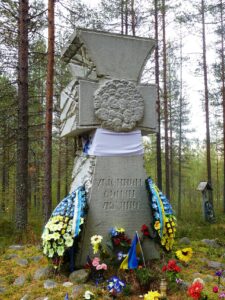
The 1,111 Shot at Sandarmokh in Autumn 1937, and the “Executed Renaissance”
From October 27 to November 4, 1937, in a forest in Karelia, northwestern Russia, 1,111 prisoners from the Solovki camp were shot by the Soviet secret police. Among them were people who had shaped Ukrainian culture in the 1920s, including theater director Les Kurbas and playwright Mykola Kulish. Sources disagree on how many came from Ukraine, ranging from 201 to about 300. This article covers the course of events, the figures, and what happened after the site was found.