
In a Country Where Power Plants Keep Being Targeted, Electricity Gets Made in Small Pieces
Russia has repeatedly attacked Ukraine's power plants and grid since 2022. According to the International Energy Agency (IEA), generating capacity that stood at roughly 38 gigawatts before the full-scale invasion had fallen to 12 gigawatts by spring 2024. Capacity restored through repairs was lost again in attacks over the winter of 2025–26. This article tracks, in numbers, the shift from large power plants toward gas generators and batteries spread across many sites.

The winter of 2025–26 was, according to a report from the UN Office of the High Commissioner for Human Rights (OHCHR), the coldest in Ukraine since 2010. Nighttime temperatures fell below minus 20 degrees Celsius on some days, and scheduled power cuts in Kyiv and Kherson reached up to 22 hours a day, averaging up to 16 hours a day in January. When the power stops, so does heating, and so does the water supply to upper floors of apartment buildings.
Since the full-scale invasion of 2022, Russia has continued to attack Ukraine’s power plants, substations, transmission lines, and heat-supply facilities. How much generating capacity has been lost, and how has it been restored? This article traces the numbers published by international organizations and the Ukrainian government.
From roughly 38 gigawatts to 12
An analysis the IEA published in October 2025 puts Ukraine’s actually usable generating capacity (dispatchable power sources) before the full-scale invasion at roughly 38 gigawatts. In the war’s first year, 19 gigawatts were lost to occupation, destruction and damage, and after attacks intensified in spring 2024 it fell to 12 gigawatts. Three gigawatts were restored through repairs before the winter of 2024–25, and restoration and new construction have continued since, the same analysis states.
The IEA’s September 2024 report describes what was lost in more detail. Russia’s occupation of the Zaporizhzhia Nuclear Power Plant alone took 6 gigawatts out of use. Before 2022, this plant generated roughly a quarter of Ukraine’s electricity. In the attacks of March to May 2024, 9 gigawatts were lost, mainly from thermal and hydro power. On the transmission side, about half of the extra-high-voltage substations of Ukrenergo, the state transmission company, were damaged.
| Point in time | Usable generating capacity | Source |
|---|---|---|
| Before the full-scale invasion of February 2022 | Roughly 38 gigawatts | IEA (October 2025) |
| After the war’s first year | 19 gigawatts lost | IEA (October 2025) |
| After the spring 2024 attacks | 12 gigawatts | IEA (October 2025) |
| Winter 2025–26 | Roughly 11 gigawatts could be generated domestically (demand reached up to 18 gigawatts) | OHCHR (June 2026), citing a Ukrainian think tank’s estimate |
There are other figures for Ukraine’s generating capacity. The IEA’s 2024 report puts nominal installed capacity at 56 gigawatts (the seventh-largest in Europe). A June 2023 assessment by the UN Development Programme (UNDP) found that of roughly 37 gigawatts of installed capacity, more than 19 gigawatts had been destroyed, damaged, or occupied. “Nominal capacity,” “installed capacity,” and “actually usable capacity” are not the same thing, so when comparing figures it matters what exactly is being counted.
What happened in the winter of 2025–26
In a report dated 29 June 2026, OHCHR recorded at least 423 attacks on power generation, transmission and distribution facilities between October 2025 and March 2026. Of these, 48 were attacks that targeted three or more regions at once using multiple types of weapons. On 3 February 2026, for example, 71 missiles and 450 long-range drones were used, damaging 14 facilities across six oblasts and the city of Kyiv. OHCHR notes that it counts only cases it could confirm through independent sources, and that Ukrainian authorities have reported higher numbers.
Against winter demand that reached up to 18 gigawatts, only about 11 gigawatts could be generated domestically. Ukrainian authorities began nationwide scheduled power cuts from October 2025, and President Zelensky declared a state of emergency in the power sector on 14 January 2026 (both per the OHCHR report).
Heat supply was also targeted this winter. In Ukrainian cities, district heating — piping hot water to homes from combined heat and power (CHP) plants that generate electricity and heat together — is common; in Kyiv, nearly 95% of the roughly 3 million residents rely on it. According to OHCHR, CHP plants were attacked at least 74 times across nine oblasts and the city of Kyiv between October 2025 and March 2026, with Kyiv’s three main CHP plants alone hit at least 40 times. When Kyiv’s Fourth CHP plant went offline in February 2026, the government reported that heating stopped for 1,100 apartment buildings housing about 500,000 people, along with 118 schools and kindergartens and 18 hospitals.
OHCHR states that these attacks on energy facilities “appear to have violated fundamental principles of international humanitarian law governing the conduct of hostilities.”
The cost of the damage, and the cost of rebuilding
The Fifth Rapid Damage and Needs Assessment (RDNA5), published in February 2026 by the World Bank, the Government of Ukraine, the European Commission and the United Nations, put damage in the energy and extractives sector at $24.8 billion (as of 30 November 2025). About 70% of that, $17.1 billion, was electricity, broken down as $14.2 billion for generation equipment, $2.3 billion for transmission, and $0.7 billion for distribution.
Meanwhile, the amount needed over the next ten years is $90.6 billion, up 33.7% from the fourth edition of the assessment, of which $70.8 billion is for rebuilding the power system. The report lists distributed generation, the introduction of renewable energy, restoring dispatchable power sources, and the physical protection of critical equipment as ways to go about it. It puts economic losses at $88.2 billion, which the report explains reflects reduced energy demand and constraints on grid operation.
Repairs, and the European power grid
Equipment that has been destroyed gets targeted again even after repair. The IEA’s 2025 analysis cites the Trypillia thermal power plant, destroyed in spring 2024 and rebuilt, as an example: it was seriously damaged again by 19 drones in an attack on 7–8 September 2025. As protection, Ukraine has installed gabions filled with earth, sandbags, anti-drone netting, and reinforced-concrete structures around substations and transformers.
The European power grid has been making up for the shortfall. Ukraine’s power grid synchronized with the European grid in March 2022. According to the IEA, electricity imports in 2024 reached a record 4,436 gigawatt-hours, and from December 2024 the reliably usable import capacity has been 2.1 gigawatts in winter and 1.7 gigawatts in summer. Between June and September 2025, once generation had recovered, Ukraine became a net exporter of electricity. However, the IEA notes that with the grid congested on both the Ukrainian side and in neighboring EU countries, there are limited realistic options for significantly expanding import capacity in the near future.
Splitting large power plants into small generators
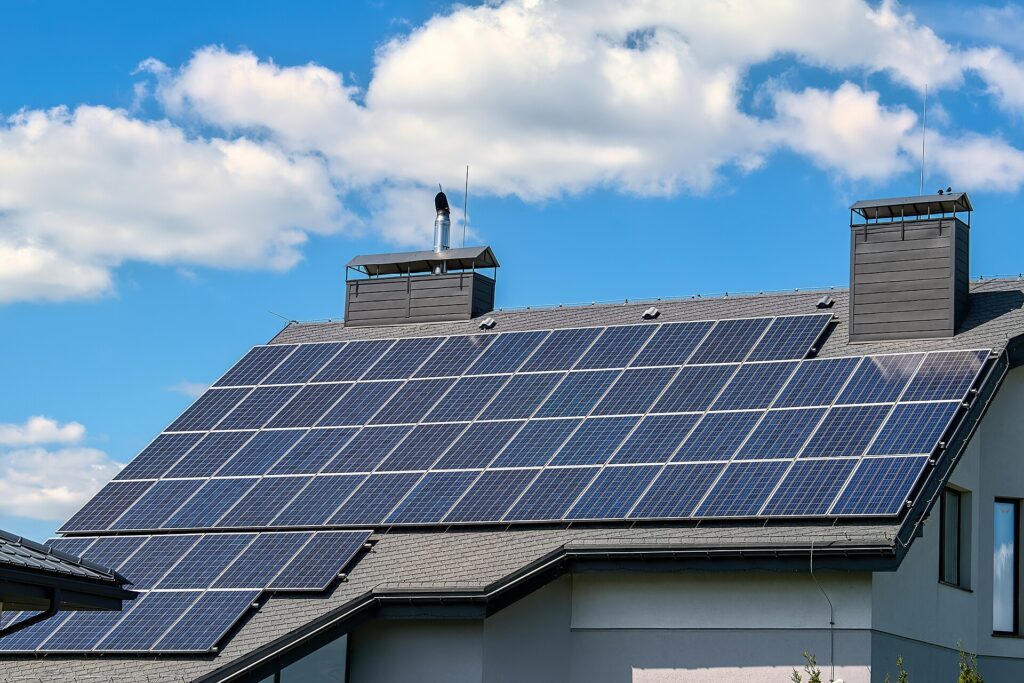
The IEA explains that wind turbines and small gas plants are harder to attack, and more costly for an attacker to target, than large, centralized power plants. From an early stage, the Ukrainian government set a policy of expanding small gas turbines in the 5–40 megawatt class, along with solar panels and batteries on the roofs of government buildings, hospitals, schools, homes and businesses (IEA, 2024). By early 2024, solar capacity installed by consumers had reached nearly 1,500 megawatts.
According to the Ministry of Energy, municipal public utilities and private and state-owned companies brought a combined 762 megawatts of new gas-generation capacity online in 2025. As of early February 2026, distributed gas generation totaled 1.4 gigawatts (1.1 gigawatts connected to the grid and 0.3 gigawatts for own use), roughly 60% of it built by private investors. The ministry says about 3 gigawatts of projects are underway, and a draft revision of the distributed-generation strategy calls for a combined 2.2–2.7 additional gigawatts of reliably usable capacity, allocated by region. The Ukrainian news agency Interfax-Ukraine, citing the ministry, reported distributed gas generation at about 1.8 gigawatts as of 21 July 2026.
The government has also simplified procedures. According to the Ministry of Energy, it has reduced the paperwork and permits needed to build distributed power sources and made it possible to begin construction in parallel with preparing design documents, while laws extending the exemption from import duty and value-added tax on energy equipment until 1 January 2029 (Nos. 4698-IX and 4710-IX) were passed by the Verkhovna Rada in 2025.
Battery storage is also growing. According to the IEA, DTEK, the largest private energy company, brought online storage facilities with 200 megawatts of output and 400 megawatt-hours of capacity at six sites across the country in September 2025. Solar power does have a winter weakness, though: the IEA notes that solar capacity factors fall below 10% in December and January, making it essential to combine solar with dispatchable sources such as wind, batteries, and gas-fired power.
As of autumn 2026
The Ministry of Energy’s daily morning report on the state of the power system said that on the morning of 23 September 2026, power cuts caused by fighting and attacks were occurring in Donetsk, Zaporizhzhia, Kyiv, Sumy and Kharkiv oblasts, while no supply restrictions were planned for that day.
The IEA’s 2025 analysis notes that intensified attacks in autumn have become a “seasonal pattern.” How much of the generating capacity restored over summer can be protected before winter — the numbers on distributed generation are one gauge of that preparedness.
The state of control over the Zaporizhzhia Nuclear Power Plant, and the weight the energy sector carries in the economy, are covered in Ukrainian industry in wartime.
Sources and article record
Sources and references
- Ukraine's energy security: A pre-winter assessmentOctober 2025. Roughly 38GW before the invasion, 19GW lost in the first year, 12GW after spring 2024, 3GW restored, the Trypillia thermal plant, protective measures, 2024 imports of 4,436GWh, import capacity of 2.1/1.7GW, net exports June–September 2025, DTEK's battery storage, the autumn seasonal pattern, reasons for decentralization
Published by International Energy Agency (IEA) · Checked: 2026-09-23 - Ukraine's Energy Security and the Coming WinterSeptember 2024. Zaporizhzhia plant 6GW/roughly a quarter of electricity, 9GW lost March–May 2024, about half of extra-high-voltage substations damaged, 56GW nominal capacity, 5–40MW gas turbines, roughly 1,500MW of consumer-installed solar, winter capacity factor below 10%
Published by International Energy Agency (IEA) · Checked: 2026-09-23 - Attacks against Ukraine's energy infrastructure and update on the human rights situation in Ukraine, 1 December 2025 – 31 May 202629 June 2026. 423 and 48 attacks, the 3 February attack, 18GW demand vs. roughly 11GW domestic, scheduled power cuts, the state of emergency, 74 attacks on CHP plants/40 in Kyiv, 95% district heating, the Fourth CHP plant, the cold snap, international humanitarian law
Published by UN Office of the High Commissioner for Human Rights, Human Rights Monitoring Mission in Ukraine (OHCHR/HRMMU) · Checked: 2026-09-23 - Ukraine Fifth Rapid Damage and Needs Assessment (RDNA5)damage in the energy and extractives sector of $24.8 billion; electricity $17.1 billion — generation $14.2 billion, transmission $2.3 billion, distribution $0.7 billion; losses of $88.2 billion; needs of $90.6 billion — electricity $70.8 billion — up 33.7% from the fourth edition
Published by World Bank Group, Government of Ukraine, European Commission, United Nations · Checked: 2026-09-23 - UNDP energy damage assessment for Ukraine reveals continued vulnerabilities20 June 2023. More than 19GW of roughly 37GW destroyed, damaged, or occupied
Published by United Nations Ukraine (UNDP announcement) · Checked: 2026-09-23 - Ukraine's Energy Sector in 2025: Development of Distributed Generation2 January 2026. 762MW of gas generation brought online in 2025
Published by Ministry of Energy of Ukraine · Checked: 2026-09-23 - 1,4 ГВт газової генерації введено в експлуатацію в Україні від початку повномасштабного вторгнення10 February 2026. 1.4GW total — 1.1GW and 0.3GW — about 60% private, roughly 3GW of projects underway, a 2.2–2.7GW target
Published by Ministry of Energy of Ukraine · Checked: 2026-09-23 - Energy Resilience: Distributed Generation Capacity Grows Across Regions12 February 2026. Simplified procedures; exemption from import duty and VAT until 1 January 2029 under Laws No. 4698-IX and No. 4710-IX
Published by Ministry of Energy of Ukraine · Checked: 2026-09-23 - Близько 1,8 ГВт розподіленої газової генерації встановлено в Україні – Міненергоciting the Ministry of Energy, roughly 1.8GW as of 21 July 2026
Published by Interfax-Ukraine · Checked: 2026-09-23 - Оперативна ситуація в енергосистемі України станом на ранок 23 вересняareas with power cuts on 23 September 2026, and no planned supply restrictions
Published by Ministry of Energy of Ukraine · Checked: 2026-09-23
If you find an error in this article, please tell us via Corrections. Once we have checked it, we will record in the article what was corrected and why.