
Ukraine’s Table — Borscht’s UNESCO Listing, and Cuisine That Changes by Region
Borscht's UNESCO listing is not on the Representative List but on the List of Intangible Cultural Heritage in Need of Urgent Safeguarding. This article covers grain porridges, the eastern and western forms of paska bread, regional groupings of cuisine, and drinks and pork products. Claims of origin that could not be verified are gathered at the end of the article.
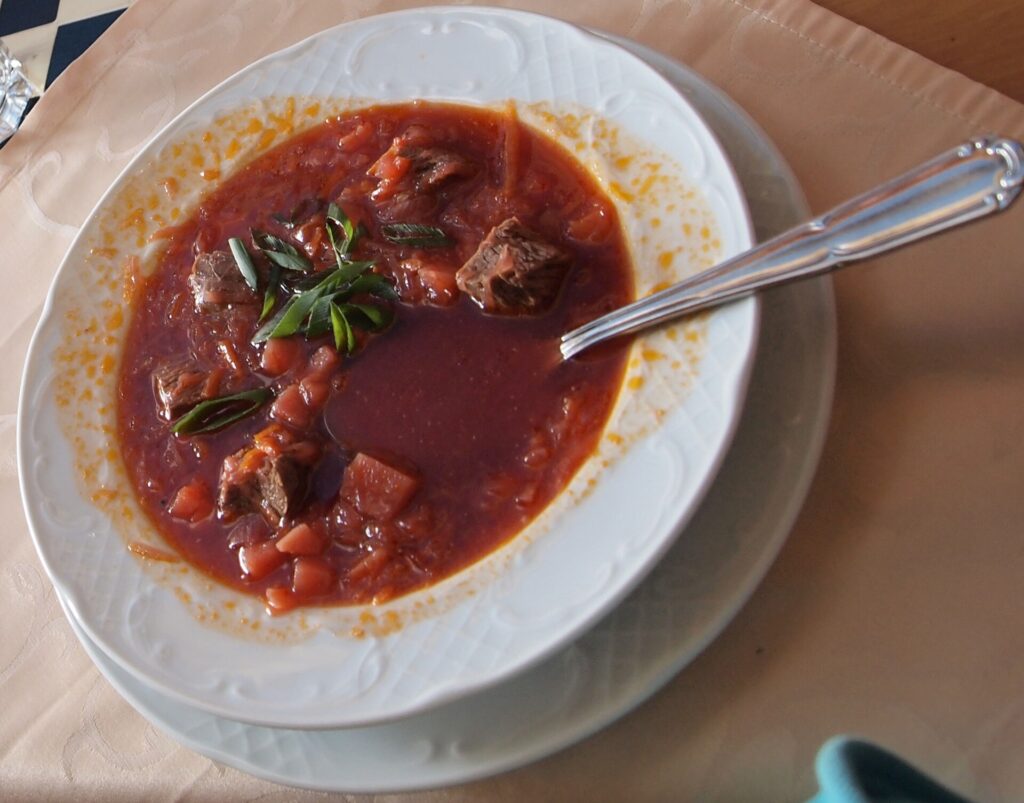

Introductions to Ukrainian cuisine often state its origins and beginnings with certainty. In this article, explanations of origin and beginning that could not be verified are not included in the body text but are gathered at the end of the article.
Borscht’s UNESCO Listing Is on the List of Heritage “in Need of Urgent Safeguarding”
The name of the UNESCO Intangible Cultural Heritage element is “Culture of Ukrainian borscht cooking,” file reference number 01852. On 1 July 2022, at an online-only fifth extraordinary session of the Intergovernmental Committee (5.EXT.COM), it was inscribed on the List of Intangible Cultural Heritage in Need of Urgent Safeguarding. This is not an inscription on the Representative List. It is also a separate system from the World Heritage system, which covers structures and nature.
| Item | Detail |
|---|---|
| Element name | Culture of Ukrainian borscht cooking |
| File reference number | 01852 |
| Submitting State | Ukraine |
| Date of inscription | 1 July 2022 (5.EXT.COM, held online) |
| Ukraine’s request for urgent examination | 21 April 2022 |
| Entry on Ukraine’s national inventory | 13 October 2020 |
| List on which it was inscribed | List of Intangible Cultural Heritage in Need of Urgent Safeguarding |
| Decision number | 5.EXT.COM 5 (handled as a “Case of extreme urgency”) |
| Periodic reporting | Submitted 15 December 2022; next due 15 December 2026 |
The reason it was judged to be “in need of urgent safeguarding” is also stated in the inscription file. Since the armed conflict that began in February 2022 (the file’s own wording; this article treats it as Russia’s full-scale invasion of Ukraine, which began on 24 February 2022), bearers have been separated from their original communities and from the cultural context needed to make and eat borscht. The surrounding environment and traditional agriculture have been destroyed, cutting off access to local vegetables. The inscription file also states, on top of this, that communities across Ukraine have rallied around this element.
What was inscribed is not the dish itself but the knowledge and practice of its cooking. The file describes borscht as a dish made by combining a broth with beetroot, sugar beet, or fermented beetroot juice, stating that “there are many variations, and the practice includes recipes, cooking methods, and the occasions for which it is made.” It is cooked in a large pot and served with bread or garlic bread. It is mainly made by women, but many men also make it as an everyday dish. It is passed down within families, and children take part in cooking it. In the region of Podillia (Поділля), the third day of a wedding still keeps a ritual name meaning “going to the bride’s, to eat borscht.”
The element page’s inscription text does not say whether a dish of the same name exists in neighboring countries. However, the committee’s decision text (5.EXT.COM 5) that decided the inscription, while making the inscription, also reaffirms that it “takes note that the culture of borscht cooking is shared by other communities in the region” and that “inscription on a list of the Convention does not imply exclusivity or ownership.” This inscription is not a recognition that borscht belongs to Ukraine alone; it is a judgment that Ukraine’s culture of cooking borscht is in a state requiring urgent safeguarding. It cannot be used as evidence for deciding “which country’s dish” it is.
Even the Contents of Borscht Are Not a Single Thing
The entry “Traditional foods” in the Internet Encyclopedia of Ukraine (Canadian Institute of Ukrainian Studies, University of Alberta; written by S. Stechishin) describes borscht as “made from vegetables centered on beets and cabbage, with a meat or fish stock,” and then lists a meatless Christmas Eve borscht made by boiling vegetables in water and souring it with beet kvas, sorrel borscht, spring borscht, cold borscht, and clear borscht, stating that there are regional variations such as Poltava-style, Galician-style, and Kyiv-style.
The explanations from Authentic Ukraine, a project produced by Ukraine’s Ministry of Culture and Strategic Communications (formerly the Ministry of Culture and Youth and Sports) with support from Google Ukraine, likewise state that there are versions of borscht using beans in Podillia, small flour dumplings in Poltava Oblast, wheat flour in the south, and beer in Slobozhanshchyna (Слобожанщина).
The Potato Arrived in the 17th Century
The same “Traditional foods” entry also lays out the order in which ingredients arrived. Wheat, barley, and millet have been archaeologically confirmed as cultivated in Ukraine 3,000 years ago; rye arrived about 2,000 years ago; buckwheat was brought from Asia in the 11th century. The potato arrived in the 17th century, from the Americas by way of Europe. Corn, tomatoes, pumpkin, beans, chili peppers, and cocoa were added later still, and the entry states that these greatly widened the range of the cuisine.
In other words, potato-based dishes such as varenyky and deruny are dishes that came into being only after this crop arrived. What the same entry calls “ancient” are instead the grain dishes, boiled either whole or ground into flour: kasha (buckwheat), millet, cornmeal from Hutsulshchyna and Zakarpattia (mamalyha, kulesha), the thin porridge yushka thinned with water or milk, and the thick millet porridges kulish and lemishka. It states that the staple food of the Zaporozhian Cossacks was salamakha, buckwheat or rye flour boiled in water, and cracked millet.
Flour and Potato Dishes Split Into “Wrapped” and “Unwrapped”
According to the same “Traditional foods” entry, halushky are dumplings made from wheat, buckwheat, or corn flour, sometimes with potato or cheese added and sometimes without. Varenyky are filled dumplings, with fillings including cheese, potato and cheese, cabbage, meat, fish, buckwheat, and plums, served with fried bacon, fried onion, or sour cream.
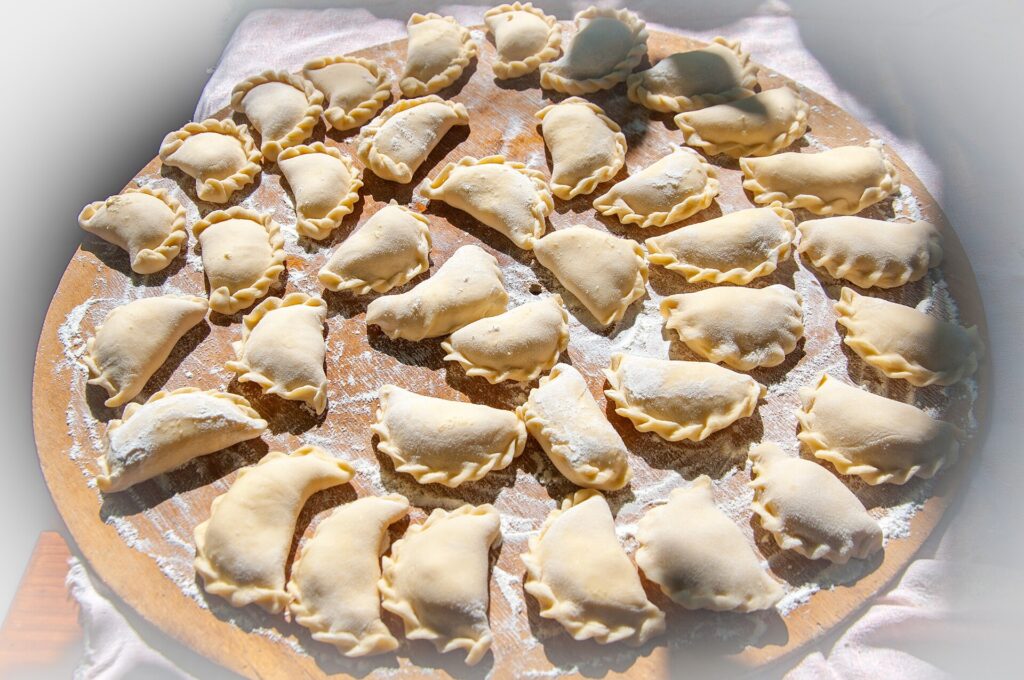

Authentic Ukraine defines halushky as “dough boiled without any filling,” recording that they exist across Ukraine but are considered a signature dish of Poltava. It states that the filling of varenyky varies by region: crushed beans in Polissia (Полісся), cheese in Zakarpattia (Закарпаття), and shkvarky (small pieces of fried pork fat) in Chernihiv Oblast. Deruny, grated potato pancakes, go by different regional names such as kremzlyky and terchanyky, with the name deriving from the method of preparation, “grated” (derty).
Holubtsi’s “Rice and Ground Meat” Is Recent
Authentic Ukraine’s page on holubtsi, citing S. Khymenko’s Ukrainski Stravy, 3rd edition (1960), explains it as follows. There is no single recipe common across Ukraine; the filling was mainly millet, replaced in some regions by cracked corn or buckwheat. On the left bank of the Dnipro and in the south, whole cabbage leaves were used to make large rolls; in the west, leaves were split to make small ones. They were filled with grain and fried onion and pork cracklings, with meat added only on festive days. The form familiar today, with rice, ground meat, and tomato paste, took shape in the 1920s-30s.
The Internet Encyclopedia of Ukraine, for its part, states that in Hutsulshchyna (Гуцульщина) and Bukovyna (Буковина) there is a version of holubtsi made with a fermented dough and baked with sour cream. Even under the same name, the contents shift by region and by era.
The Table of the Mountains and the Border
“Traditional foods” attributes cornmeal dishes (mamalyha, kulesha) to Hutsulshchyna and Zakarpattia, and salted sheep’s-milk cheeses (bryndza, brynza) to Hutsulshchyna and Bukovyna. Authentic Ukraine’s explanation of banosh describes it as a Hutsul dish, cornmeal cooked in cream or sour cream and combined with cheese, cracklings, and porcini mushrooms.
The same entry treats regional variety not only at the level of individual dishes but also as regional groupings of cuisine as a whole. It does not merely note that there are Poltava-style, Galician-style, and Kyiv-style versions of borscht; it states that Bukovyna, Zakarpattia, Volyn, the Dnipro region, and Sloboda Ukraine each have a coherent regional cuisine of their own. It also states that the mountain regions and Polissia saw smaller changes in diet than other regions. The same entry then offers the view that cookbooks, cooking classes, and ready-made industrial food products are eroding these regional differences — an observation from the time the print encyclopedia was written, not a statement about the present.
On bograch, the same project states that it is the Hungarian goulash made in Zakarpattia, and that researchers believe the name derives from the Hungarian word for a large cauldron. It records that chebureki is a Crimean Tatar dish, that the name itself means “meat pie” in Crimean Tatar, and that in Ukraine it is also eaten under the name “chir-chir” among the Greek community of Mariupol.
The national inventory of intangible cultural heritage published by Ukraine’s Ministry of Culture has also registered the cooking of chebureki (spelled “֧іберек” in the inventory) and yantyk as practices of Crimean Tatar traditional cuisine, dated 25 July 2022. The same inventory also lists, dated 16 November 2018, the tradition of cooking “et ayaklak,” a mutton pie handed down by the Karaites of Melitopol. The inventory groups these two together, separately from other entries, under items “representing the culture of Ukraine’s indigenous peoples.” What the inventory records is the bearers and location at the time of registration; it does not indicate the current state of transmission, including in territories under occupation.
Bread Plays a Different Role Day to Day and at Milestones
“Traditional foods” identifies the bread common in Ukraine as a sour rye bread leavened with sourdough, stating that white wheat bread is more common in the south and southeast. It then lists ritual breads distinct from everyday bread: braided kalach, the Easter paska, filled knysh, and the wedding korovai. Kalach is baked for Christmas and for funerals and is said to symbolize eternity. According to a separate entry in the same encyclopedia, korovai is a wedding bread decorated with dough flags and figures of the sun, moon, birds, and animals, which is cut and distributed to all the guests by an attendant after the ceremony.
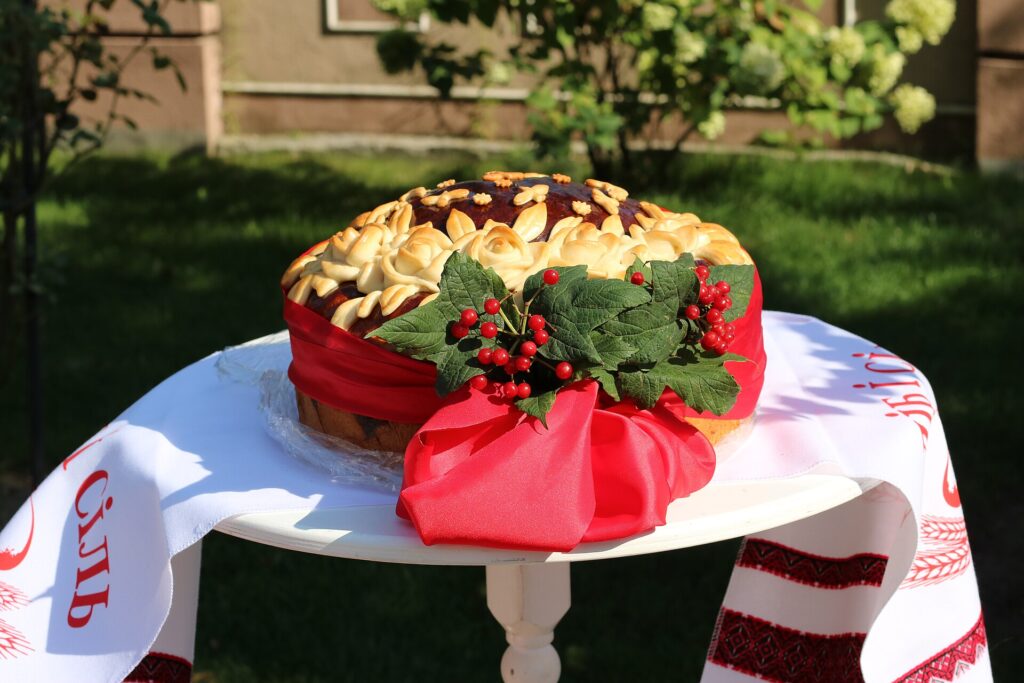

The same entry states that paska’s form is likewise not a single thing. In western Ukraine it is a low cylinder decorated with dough ornaments; in eastern Ukraine it becomes a tall cylinder. Babka, also baked for the same Easter, uses a dough of milk, butter, eggs, sugar, and raisins, lightly scented with saffron, vanilla, or lemon peel, the entry states. Wedding breads are not limited to korovai either; other breads named diven, lezhen, and shyshky are listed. On Sundays and holidays, a leavened dough pyrohy and the smaller pyrizhky are baked, the latter filled with cheese, meat, cabbage, peas, buckwheat, mushrooms, plums, or poppy seed. Breads are named less by how they are baked than by “when, and for whom, they are baked.”
Drying, Pickling, Fermenting
According to Authentic Ukraine, uzvar uses dried pears, apples, plums, cherries, and blueberries, with dried apricots in the south, and holds an important place at the Christmas table. “Traditional foods” adds to this the bread-based kvas (syrivets), pickling brine, and spring birch sap as folk drinks, and states that the beet kvas used to sour borscht is one of the preparations made in readiness for winter.
On alcohol, the same entry lists mead, wine, the fruit-steeped narivka, the herb-flavored zapikanka, chili-infused horilka (horilka z pertsem), and beer as drinks that have “been enjoyed for centuries.” The chili-infused version is only one of these, not a description of horilka as a whole. This article does not address regions of production, brand names, or the history of distillation.
Kutia, according to the same encyclopedia’s entry (first published in the print Encyclopedia of Ukraine, vol. 2, 1988), is a ritual dish combining wheat or barley grains and ground poppy seed with a honey sauce, eaten on Christmas Eve (bahata kutia) and on the eve of the Feast of the Baptism of the Lord (holodna kutia). It is regarded as one of the oldest of the twelve traditional dishes, with its proportions and ritual use differing by region. The entry also states that a portion used to be left on the table after the meal for the souls of the dead.
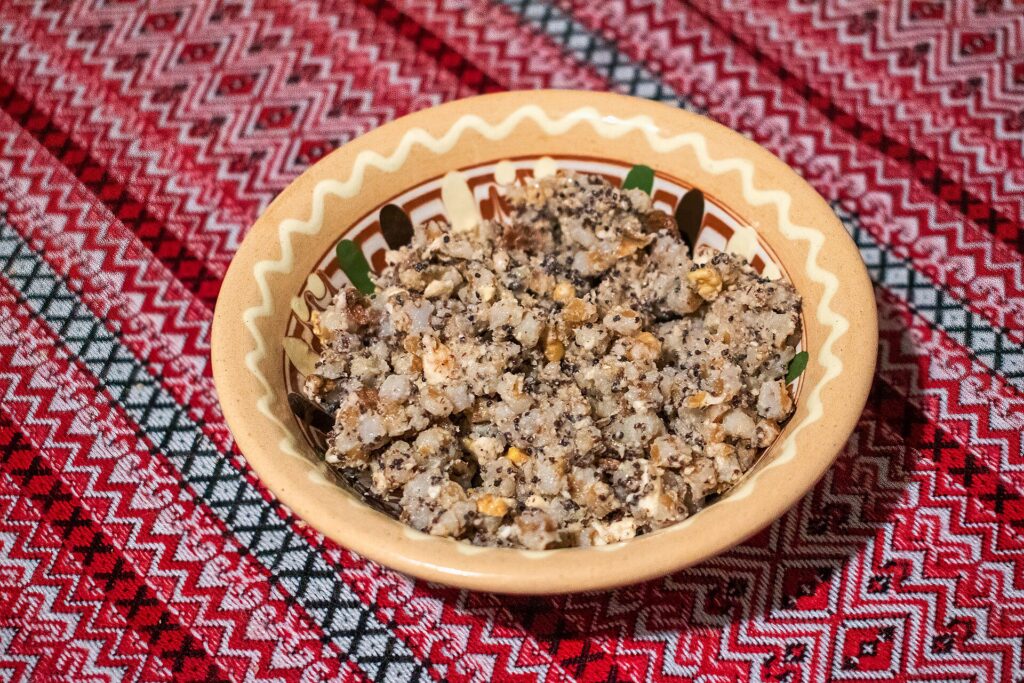

The Christmas Eve meal centers on meatless dishes. Authentic Ukraine explains that kapusnyak, a sauerkraut soup, is likewise made without meat and finished with vegetable oil during fasting periods.
Can It Be Said That the Diet Is “Centered on Meat and Fat”?
“Traditional foods” states that meat was normally eaten on holidays, Sundays, and family celebrations, and that pork and its processed products were the most commonly eaten. Read the other way, this means the everyday table was centered on grains, potatoes, cabbage, beans, mushrooms, and dairy.
The pork products the same entry lists are ham, kovbasa (sausage), kyshka (blood sausage), saltsison (jellied head meat), smoked bacon, and salted pork fat (salo). The fats used in cooking, likewise, are salted pork fat, sunflower oil, linseed oil, hemp seed oil, and butter. It also states that mutton is commonly eaten in southern Ukraine, while veal rarely appears at the table. “A dish that uses fat” and “a diet centered on fat” are different things.
This entry, however, first appeared in the print encyclopedia, and its statements of “today” reflect the time it was written. It is not a direct statement of Ukraine’s current diet.
Dishes Listed on the National Inventory
Borscht was entered on Ukraine’s Ministry of Culture’s national inventory of intangible cultural heritage on 13 October 2020, before its UNESCO inscription. This inventory also lists other regional dishes. From the version current as of 16 July 2025, the following overlap with dishes covered in this article (the Crimean Tatar and Karaite dishes were covered in the previous section).
| Name on the inventory | Region on the inventory | Date of registration |
|---|---|---|
| The culture of cooking Ukrainian borscht | Oblasts nationwide, plus the city of Kyiv and the city of Sevastopol | 13 October 2020 |
| The pie-cooking tradition of Yavoriv | Yavoriv, Lviv Oblast | 6 July 2022 |
| The cooking and eating of Biliaivka’s fish yushka (soup) | Biliaivka, Odesa Oblast | 6 July 2022 |
| Hutsul brynza | Rakhiv district, Zakarpattia Oblast, and parts of Ivano-Frankivsk and Chernivtsi oblasts | 6 July 2022 |
| The cooking of the traditional Ukrainian dish “holubtsi” | Settlements around Holovanivsk, Kirovohrad Oblast, among others | 4 May 2023 |
The names of dishes on the inventory, phrased as “cooking tradition” or “cooking and eating” rather than as the name of the dish itself, indicate not the dish but a way of making and eating it that has been handed down in a particular place. The holubtsi entry states, in its geography field, that this dish is made across present-day Ukraine and in other countries. Being on the national inventory, like the UNESCO inscription, is not a recognition that a dish belongs to Ukraine alone.
Dishes Whose Origin Cannot Be Stated With Certainty
On Chicken Kyiv (Котлета по-київськи), Authentic Ukraine states that its distinguishing feature is that it is made from a single piece of chicken breast rather than ground meat, and, noting that other countries also claim to have invented it, sets out both a French theory (the chef Nicolas Appert) and an American theory, without indicating which is correct. This article likewise does not state where or when it was invented. The same applies to Lviv’s syrnyk (a Galician cheesecake): the same project writes, avoiding a firm claim, that the cook Daria Tsvek “is said to be” its creator.
Rather than memorizing the names of dishes, looking first at who has eaten them, when, and on what occasion shows that a dish of the same name wears a different face from place to place. What UNESCO inscribed for borscht, too, was not the recipe but the way it is handed down.
Sources and article record
Sources and references
- Culture of Ukrainian borscht cookingconfirms the element name; file reference number 01852; submitting State Ukraine; inscribed on the List of Intangible Cultural Heritage in Need of Urgent Safeguarding at 5.EXT.COM in 2022; decision number 5.EXT.COM 5; the "Case of extreme urgency" designation; the full inscription text; and the periodic report submitted 15 December 2022, next due 15 December 2026
Published by UNESCO Intangible Cultural Heritage · Checked: 2026-09-23 - Traditional foodswritten by S. Stechishin; confirms the timing of crop introductions, the potato's 17th-century arrival, bread and ritual breads, the eastern and western forms of paska, babka's dough, diven/lezhen/shyshky, pyrohy and pyrizhky, halushky and varenyky, the definition, varieties, and regional differences of borscht, holubtsi, the distribution of sheep's-milk cheese and cornmeal dishes, uzvar and kvas, types of alcohol, meat and pork products and cooking fats, the five regional cuisine groupings, and relations of influence with neighboring countries; first published in the print Encyclopedia of Ukraine; the page shows no volume or year of first publication
Published by Internet Encyclopedia of Ukraine (Canadian Institute of Ukrainian Studies, University of Alberta) · Checked: 2026-09-23 - Kutiaconfirms wheat or barley grains and ground poppy seed with a honey sauce; Christmas Eve bahata kutia and the eve of the Baptism of the Lord holodna kutia; its status as one of the oldest of the twelve dishes; regional variation; and the custom of leaving a portion on the table for the dead; first published Encyclopedia of Ukraine vol. 2, 1988
Published by Internet Encyclopedia of Ukraine (Canadian Institute of Ukrainian Studies, University of Alberta) · Checked: 2026-09-23 - Korovaiconfirms the wheat-flour braided wedding bread, dough flags and ornaments of the sun, moon, birds, and animals, its placement at the wedding, its distribution to guests by an attendant after the ceremony, and the entry's own interpretation of it as "a vestige of an old belief in the magic of grain"; first published Encyclopedia of Ukraine vol. 2, 1989
Published by Internet Encyclopedia of Ukraine (Canadian Institute of Ukrainian Studies, University of Alberta) · Checked: 2026-09-23 - About the projectconfirms that the project was produced by Ukraine's Ministry of Culture and Youth and Sports with support from Google Ukraine
Published by Authentic Ukraine · Checked: 2026-09-23 - Borsch with pampushkasconfirms red, green, mushroom, and cold varieties, and regional versions using beans in Podillia, flour dumplings in Poltava Oblast, wheat flour in the south, and beer in Slobozhanshchyna
Published by Authentic Ukraine (Ministry of Culture and Youth and Sports of Ukraine) · Checked: 2026-09-23 - Varenykyconfirms the types of filling and the regional differences: beans in Polissia, cheese in Zakarpattia, and shkvarky in Chernihiv Oblast
Published by Authentic Ukraine · Checked: 2026-09-23 - Poltava halushkyconfirms that they are dough boiled without filling, that the name differs depending on whether the dough is torn by hand or cut with a knife, and that they are considered a signature dish of Poltava
Published by Authentic Ukraine · Checked: 2026-09-23 - Derunyconfirms the alternative names kremzlyky and terchanyky, that the name derives from the preparation method "grated" (derty), their spread in the north and east, and that they were made on Sundays for breakfast or dinner
Published by Authentic Ukraine · Checked: 2026-09-23 - Golubtsiconfirms, citing S. Khymenko's Ukrainski Stravy, 3rd edition, 1960, the absence of a common recipe, fillings of millet, cracked corn, or buckwheat, the large form on the left bank and in the south versus the small form in the west, cracklings and fried onion, meat only on festive days, kvas during fasting periods, and the change to rice, ground meat, and tomato paste in the 1920s-30s
Published by Authentic Ukraine · Checked: 2026-09-23 - Banoshconfirms that it is a Hutsul dish, cornmeal porridge cooked in cream or sour cream, cheese, cracklings, and porcini mushrooms, and the traditional saying that, because it uses sheep's-milk cheese, it was made by men
Published by Authentic Ukraine · Checked: 2026-09-23 - Bograchconfirms that it is a Hungarian goulash made in Zakarpattia, that researchers believe the name derives from the Hungarian word for a cauldron, paprika, and that it is a stew rather than a soup
Published by Authentic Ukraine · Checked: 2026-09-23 - Cheburekconfirms that it is a Crimean Tatar dish, that the name means "meat pie" in Crimean Tatar, and that it is called "chir-chir" among the Greek community of Mariupol
Published by Authentic Ukraine · Checked: 2026-09-23 - Kapusnyakconfirms a sauerkraut soup, made without meat and with vegetable oil during fasting periods, and with fatty pork cuts for stock in winter and on holidays
Published by Authentic Ukraine · Checked: 2026-09-23 - Uzvarconfirms dried pears, apples, plums, cherries, and blueberries, apricots in the south, and its place at the Christmas table
Published by Authentic Ukraine · Checked: 2026-09-23 - Chicken Kyivconfirms that it is made from a single piece of meat rather than ground meat, that other countries claim to have invented it, and both the French theory involving Nicolas Appert and the American theory
Published by Authentic Ukraine · Checked: 2026-09-23 - Galician cheesecakeconfirms that the food researcher Daria Tsvek is "said to be" its creator, and that the recipe appears in her book
Published by Authentic Ukraine · Checked: 2026-09-23 - Decision of the Intergovernmental Committee: 5.EXT.COM 5confirms Ukraine's request date of 21 April 2022, its entry on the national inventory on 13 October 2020 (criterion U.5), the decision to inscribe, and the sentence "Takes note that the culture of borscht cooking is shared by other communities in the region and recalls that inscription on a list of the Convention does not imply exclusivity or ownership"
Published by UNESCO Intangible Cultural Heritage · Checked: 2026-09-23 - Fifth extraordinary session of the Intergovernmental Committee for the Safeguarding of the Intangible Cultural Heritageconfirms that it was held fully online on 1 July 2022, and that the borscht element was inscribed on the urgent-safeguarding list at this session
Published by UNESCO Intangible Cultural Heritage · Checked: 2026-09-23 - National Inventory of the Intangible Cultural Heritage of Ukraineversion current as of 16 July 2025; confirms 022н.к.с. the culture of cooking borscht (Order No. 2182 of 13 October 2020), 027н.к.с. the pie tradition of Yavoriv, 034н.к.с. the fish yushka of Biliaivka, 044н.к.с. Hutsul brynza (all Order No. 228 of 6 July 2022), 066н.к.с. holubtsi (Order No. 234 of 4 May 2023) and that entry's geography field; and, under the "inventory representing the culture of Ukraine's indigenous peoples," 013н.к.с. et ayaklak (Order No. 995 of 16 November 2018) and 049н.к.с. cheburek and yantyk (Order No. 269 of 25 July 2022)
Published by Ministry of Culture of Ukraine · Checked: 2026-09-23
Corrections and updates
- Added statements on the timing of crop introductions, the eastern and western differences in paska and the types of ritual bread, pork products and cooking fats, types of alcohol, and regional cuisine groupings. All were added after confirming the statements of the Internet Encyclopedia of Ukraine (Canadian Institute of Ukrainian Studies, University of Alberta).
- Added the date of UNESCO inscription (1 July 2022). Also added that the committee's decision text explicitly states that "inscription on a list does not imply exclusivity or ownership," and revised a paragraph that had stated, based only on the element page's description, that "there is no mention of neighboring countries." Also added statements about dishes on Ukraine's Ministry of Culture's national inventory of intangible cultural heritage (cheburek and yantyk, et ayaklak, the pie of Yavoriv, and others).
If you find an error in this article, please tell us via Corrections. Once we have checked it, we will record in the article what was corrected and why.
Related articles
-
Floating Wreaths on the River, Leaping Over Fire: The Midsummer Festival of Ivan Kupala
Ukraine's midsummer festival Ivan Kupala survives as a pre-Christian ritual that came to overlap with the feast day of John the Baptist. Under the old calendar it fell in July, but the 2023 calendar reform moved the church feast to June 24. This article covers the wreath and fire customs, the songs, and the changes of the Soviet era as recorded in the encyclopedias.
-
1,498 People Studying Japanese in Ukraine: The Japan Foundation’s FY2024 Survey
According to the Japan Foundation's FY2024 survey, Ukraine has 14 institutions teaching Japanese, 93 teachers, and 1,498 learners—down from the FY2021 survey. This article looks at the trend since FY2012, a change in how teachers are counted, and the history of Japanese-language teaching at universities in Kyiv, based on the survey reports and university records.
-
9% on Dividends, Not Profit: The Corporate Tax Diia City Companies Can Choose
Resident companies of Diia City, Ukraine's legal regime for IT companies, can choose to pay 9% on money leaving the company, such as dividends, instead of the standard 18% corporate tax on profit. Salary and remuneration for people working there is taxed at 5% income tax up to the equivalent of 240,000 euros a year. This article explains the two systems and their conditions, based on the provisions of the Tax Code.