
Vyshyvanka ── Embroidery That Differs by Region, Including a Pattern That Arrived in the Late 19th Century
The vyshyvanka, Ukraine's embroidered shirt, varies in technique and color from region to region. Among the patterns now displayed as "traditional" is a cross-stitch design that arrived from soap wrappers in the late 19th century. How far can the meanings often attached to these patterns actually be backed up by sources? This article also looks at how the vyshyvanka is treated in Ukraine's national heritage list and in UNESCO's list.
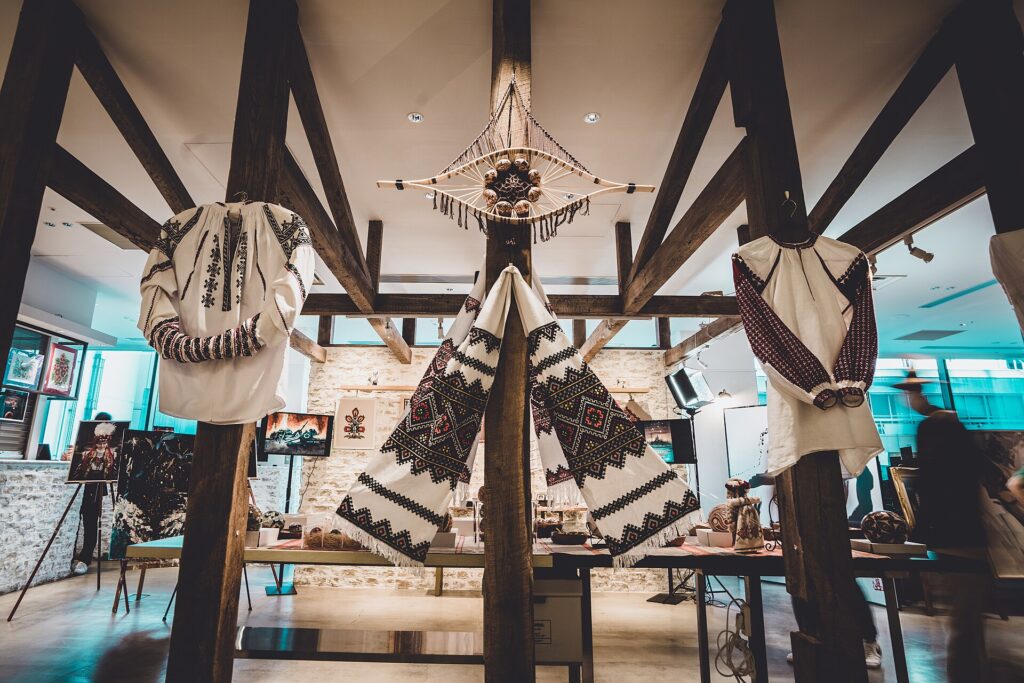
The vyshyvanka (вишиванка) is an embroidered shirt that has been worn in Ukraine. Ukraine’s official government website, ukraine.ua, describes it as “a type of traditional clothing and part of the national costume.” In Japanese it tends to be introduced simply as “national costume,” but in fact the technique and colors differ by region, and among the patterns now displayed as “traditional,” some arrived from outside the country in the late 19th century.
“Ukrainian Embroidery” Is Not a Single Thing
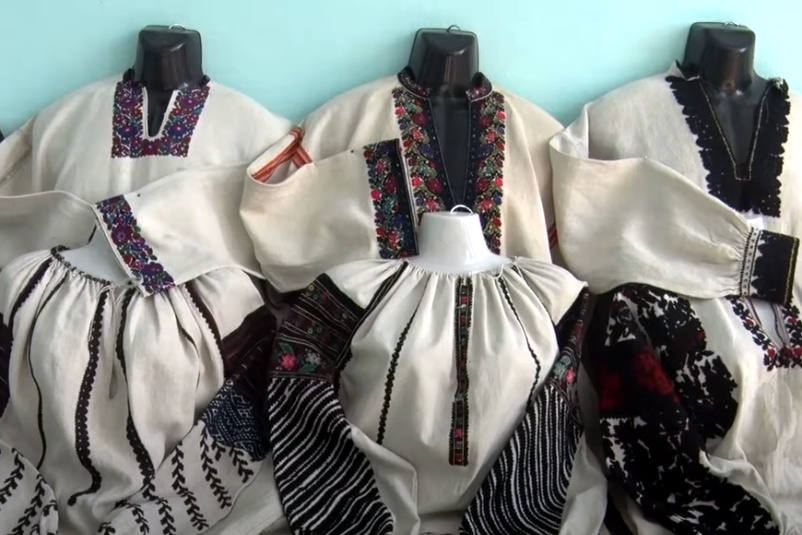
The entry on “Embroidery” in the Internet Encyclopedia of Ukraine, compiled by the Canadian Institute of Ukrainian Studies at the University of Alberta (first published in the 1984 print encyclopedia), divides Ukraine broadly into three embroidery zones based on differences in pattern and color.
| Zone | Main regions | Characteristics |
|---|---|---|
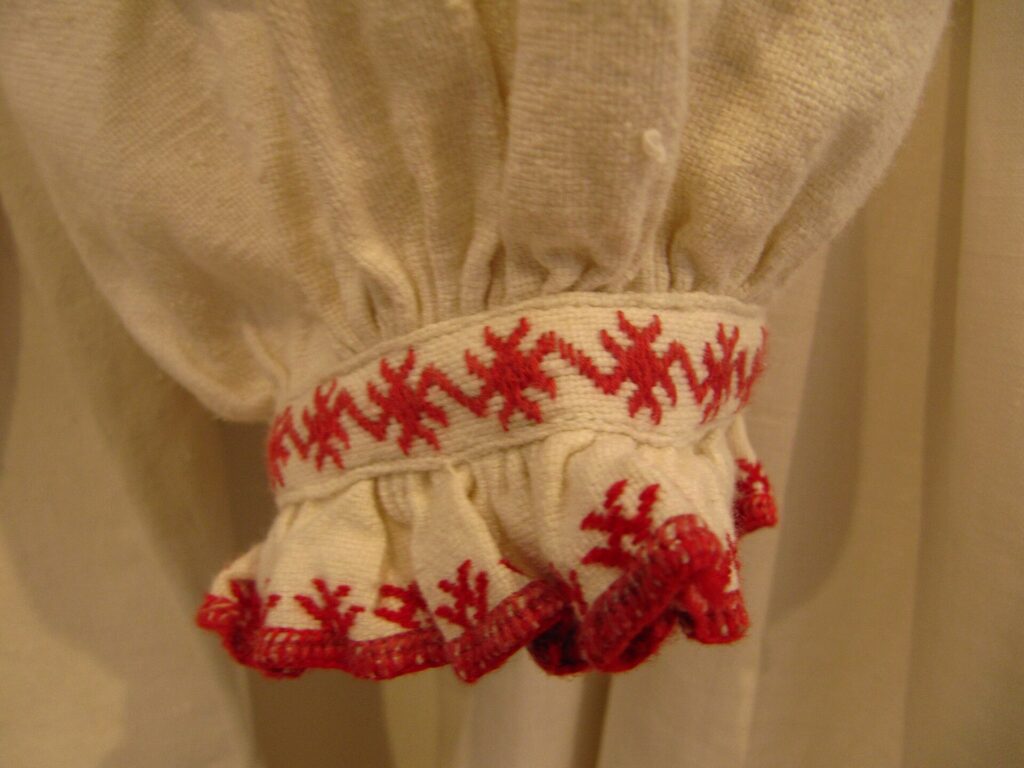
| Areas with poor transport access | Polissia, the Hutsul region | Strict geometric patterns. Hutsul work is multicolored; Polissia work is mainly red |
| Central and eastern regions | From the Boh River, along the Dnipro, to the Black Sea | Plant motifs predominate |
| Other regions | Volyn, Halychyna, the Boiko region, the Poltava region | Plant motifs are also interpreted in a strongly geometric way |
Tetiana Kara-Vasylieva, a Doctor of Art History and corresponding member of the National Academy of Arts of Ukraine, said in a paper presented at the 4th French-Ukrainian Archaeological Conference held in Kyiv in April 2015 that “the distinguishing feature of Ukrainian embroidery — especially that of Poltava, Podillia, and the Hutsul region — lies in the skillful working of the interior of geometric motifs.”
How Much Do We Actually Know About What the Patterns Mean?
Articles introducing the vyshyvanka often come with a table of correspondences, such as “this pattern means protection.” But few of these can be traced back to who said so, when, and on what source. Kara-Vasylieva’s paper cited above addresses this point head-on. Regarding geometric motifs, she states that “these motifs, born in ancient times, lost their semantics over time,” and writes the following about their connection to the “Tree of Life” and “World Tree”:
We can speak of a genealogical connection between the imagery of the rushnyk (ceremonial cloth) and the “Tree of Life” or “World Tree” only as a hypothesis, because there is no factual evidence for it, no well-founded folk name for this motif, and no recorded literary or ethnographic material.
From Tetiana Kara-Vasylieva, “The Geometric Ornament of Ukrainian Embroidery and Its Contemporary Interpretation” (2015); this passage is the source article’s own translation from Ukrainian
The conclusion states that “today it is difficult either to confirm or to deny the semantics of geometric motifs, let alone go down the path of decoding them,” and also describes the current situation by writing that “a huge enthusiasm has built up around ad hoc, mythmaking theories of decoding embroidery symbols — theories that have nothing to do with scholarly research.”
The folk names she cites are suggestive. The rosette pattern, which researchers sometimes classify as a solar symbol, is called a “star,” “key,” or “windmill” in Poltava embroidery. Others include “rabbit’s ears,” “deer’s head,” “cow’s eye,” and “little boat.” The names used by the people who actually made this embroidery were not cosmological terms, but the names of everyday objects around them.
Ukraine’s official government website also frames this as a belief, writing that “Ukrainians believe embroidery carries the meaning of a protective charm.” This article does not include a table of what each motif means, because we could not find one whose source could be traced.
Sometimes an “Old Pattern” Is New ── A Cross-Stitch That Came from Soap Wrappers
A lecture announcement by Oleksandra Storchai, head of the textiles and clothing department at the Ivan Honchar Museum (Kyiv), part of the National Center of Folk Culture, states that cross-stitch (хрестик) “was not the dominant embroidery technique in the territory of Ukraine until the end of the 19th century,” and explains that “the designs on Brocard’s soap labels were rendered precisely as crosses within a grid, and this spread the technique, driving out nearly all others.”
According to a document titled “Soap Embroidery” by Alina Khodanych, published by the National Museum of Folk Architecture and Life of Ukraine (Pyrohiv), the French-born perfumer Henri Brocard and his wife Charlotte began making soap in 1861, and after her husband’s death, Charlotte proposed wrapping the soap in patterned paper. On learning that the design was being copied into embroidery, she had an artist transfer the design onto grid paper — and this, the account explains, became the original basis for cross-stitch designs.
The same document states that this “Brocard embroidery” was especially popular in what are now Kyiv, Poltava, Cherkasy, and Chernihiv oblasts, while “Brocard embroidery was almost unknown in western Ukraine. At the time, this region was under the territory of a different state, and Brocard’s soap and perfume were not sold there.” Regional differences also arose depending on which country’s market a given area belonged to.
Change also came during the Soviet period. The Internet Encyclopedia of Ukraine, cited above, records that “from 1934, workshops of Ukrainian folk art were opened for the purpose of export” and that “by 1940, 109 arteli (cooperatives) employed 54,000 people,” and assesses that “the quality of folk embroidery declined.” However, this is the description of an encyclopedia compiled in Canada in 1984, and the evaluative part needs to be read together with that standpoint.
Ukraine’s National List, and UNESCO’s List
Ukraine’s Ministry of Culture and Information Policy’s “National List of Intangible Cultural Heritage Elements of Ukraine” (2023 July 28 edition, 77 entries in total) includes four elements related to embroidery. The numbers and order dates follow how they are listed there.
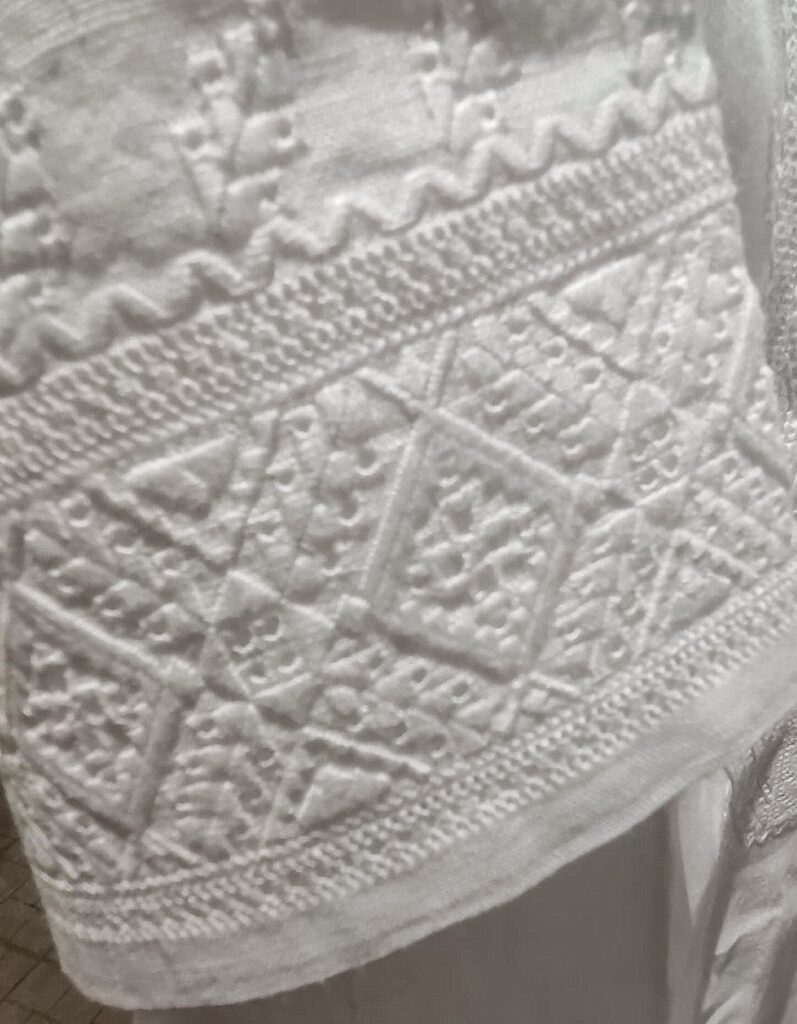
- The “white-on-white” embroidery technique of the settlement of Reshetylivka (No. 007 / Poltava oblast / Order No. 561 dated June 29, 2017)
- Folk embroidery of Borshchiv (No. 024 / Ternopil oblast and others / Order No. 2182 dated October 13, 2020)
- The technique for making “flowered” shirts of Klembivka (No. 025 / Vinnytsia oblast / same as above)
- The tradition and technique of embroidering women’s shirts of the Hadiach region (No. 074 / Poltava oblast and others / Order No. 380 dated July 12, 2023)
Of these, “Folk embroidery of Borshchiv” is known for shirts covered entirely in black thread. A resource introduction by the National Historical Library of Ukraine states that “only here was embroidery done in colorfast black wool thread.” A well-known account of the origin of the black color holds that women who lost their men to Tatar-Turkish raids vowed to wear mourning for seven generations, but the library introduces this only in the form that “several legends exist.” We could not confirm the earliest source of this legend, or how it lines up with when black thread began to be used.
By contrast, as of September 22, 2026, there are seven Ukrainian elements on UNESCO’s Intangible Cultural Heritage list: Petrykivka decorative painting (2013), Cossack songs of Dnipropetrovsk oblast (2016), the tradition of Kosiv painted ceramics (2019), the Crimean Tatar ornament pattern “ornek” (2021), the culture of Ukrainian borscht cooking (2022), pysanka (2024), and the safeguarding program for the kobza and lira tradition (2024). Embroidery itself is not included. The same site lists “the ‘white-on-white’ embroidery technique of the town of Reshetylivka” as a pending nomination awaiting review. If you come across a claim that the vyshyvanka itself is registered, the surest thing to do is check it against this list.
Vyshyvanka Day
“Vyshyvanka Day” falls on the third Thursday of May each year. The state news agency Ukrinform writes that it “was founded in 2006 by Lesia Voroniuk, then a student at Chernivtsi National University.” The next occurrence is May 20, 2027.
For Vyshyvanka Day 2022 (May 19), the European Union and the Ukrainian Institute called for an international online flash mob. The Institute’s announcement states that it also called on people in other countries to take part “to show solidarity with the people of Ukraine, who are bravely resisting Russia’s unjust and illegal invasion.” This shows how the shirt was invoked abroad after Russia’s full-scale invasion of Ukraine on February 24, 2022. We could not confirm any figures showing how much actual wearing of the shirt increased.
If you want to look at actual examples, the Honchar Museum publishes 488 garments and other items in its online collections database. Looking at genuine pieces with their region and period clearly stated will get you further, faster, than reading text that claims to explain what the patterns mean.
Sources and references
- Embroidery (the division into three embroidery zones and their characteristics; workshops from 1934, the 109 arteli employing 54,000 people in 1940, and the decline in quality. Written by: Damian Horniatkevych, Lidiia Nenadkevych; first published in Encyclopedia of Ukraine vol.1, 1984)
Published by Internet Encyclopedia of Ukraine (Canadian Institute of Ukrainian Studies, University of Alberta) · Checked: 2026-09-22 - Геометричний орнамент української вишивки та сучасна його інтерпретація (the loss of semantics of geometric motifs, the hypothetical nature of the ‘Tree of Life’ connection, folk names, the conclusion that it is ‘difficult either to confirm or deny,’ and criticism of mythmaking. Author: Т. Кара-Васильєва; 4th French-Ukrainian Archaeological Conference, Kyiv, April 2015)
Published by Institut français d'Ukraine (conference paper PDF) · Checked: 2026-09-22 - Ukrainian vyshyvanka — history, traditions & modernity (the definition of vyshyvanka, the statement that its meaning as a protective charm is ‘believed,’ and differences by region and village)
Published by ukraine.ua (Ukraine's official website) · Checked: 2026-09-22 - Національний перелік елементів нематеріальної культурної спадщини України (2023 July 28 edition, 77 entries in total; the names, protection numbers, regions, and order numbers of elements 007/024/025/074)
Published by Ukraine's Ministry of Culture and Information Policy · Checked: 2026-09-22 - Ukraine — Elements on the Lists of Intangible Cultural Heritage (the names, list categories, and years of Ukraine's 7 registered elements, and the fact that the ‘white-on-white’ embroidery technique of Reshetylivka is a pending nomination)
Published by UNESCO Intangible Cultural Heritage · Checked: 2026-09-22 - MFA: Hundreds of people around globe put on vyshyvankas to support Ukraine (the third Thursday of May; founded in 2006 by Lesia Voroniuk, then a student at Chernivtsi National University)
Published by Ukrinform (Ukraine's state news agency) · Checked: 2026-09-22 - European Union and the Ukrainian Institute invite you to participate in international online flash mob #VyshyvankaDay2022 (the May 19, 2022 flash mob by the EU and the Ukrainian Institute, and the wording of its call for solidarity)
Published by Ukrainian Institute · Checked: 2026-09-22 - Лекція про брокарівську вишивку (by Oleksandra Storchai. That cross-stitch was not the dominant technique until the end of the 19th century, and that Brocard's label designs, rendered as crosses on a grid, drove out other techniques)
Published by the Ivan Honchar Museum, National Center of Folk Culture · Checked: 2026-09-22 - Мильна вишивка (by Alina Khodanych. The 1861 start of soap manufacture, Charlotte's wrapping paper and grid design, the oblasts where it became popular, and the reason it was barely known in western Ukraine)
Published by the National Museum of Folk Architecture and Life of Ukraine (Pyrohiv) · Checked: 2026-09-22 - борщівська сорочка, вишиванка, народне мистецтво, вишивка, символи (the description of black wool thread, the framing that ‘several legends exist,’ and a list of related literature)
Published by the National Historical Library of Ukraine (NIBU) · Checked: 2026-09-22 - Collections (the categories and counts of the online collection: 488 garments, 200 rushnyky, and others. The usage-conditions field reads ‘information being prepared’)
Published by the Ivan Honchar Museum, National Center of Folk Culture · Checked: 2026-09-22 - Vyshyvanka Day (its description of the holiday's origin, and the list of news reports cited as sources for it. Used only as a lead for verification)
Published by English Wikipedia · Checked: 2026-09-22
Corrections and updates
- Changed the title (previous title: What Is a Vyshyvanka? ── Tracing an Embroidered Shirt Through Region and Sources)
If you find an error in this article, please tell us via Corrections. Once we have checked it, we will record in the article what was corrected and why.