
All articles
-
Free Passage Through the Locks: The 2020 Inland Waterway Law and Freight on the Dnipro
Adopted in December 2020 and taking effect on January 1, 2022, the Law on Inland Water Transport opened Ukraine's rivers to foreign-flagged vessels and made passage through the locks free of charge. Figures for freight on the river differ by roughly fourfold between the State Statistics Service and the Ministry of Infrastructure. Using the text of the law and government announcements current as of September 2026, this article traces the law's content and its stages of implementation, and the decline in shipping and the halted locks since the full-scale invasion.
-
Where “Half the World’s Chip-Grade Neon” Came From: Two Companies in Odesa and Mariupol
In March 2022, two Ukrainian companies stopped producing neon for semiconductors, and it was reported that "about half" of the world's supply would be lost. That figure was a news agency's own calculation from company and industry-research numbers, a pre-invasion estimate for refined neon. This article looks, using sources current as of September 2026, at how neon is a byproduct of steelmaking, and at what became of the company that moved from Mariupol to Odesa oblast.
-
Sitting With a Bandura: The Folk Painting “Cossack Mamai”
A Cossack sitting cross-legged and playing a bandura, with a horse, an oak tree, and weapons nearby: this is “Cossack Mamai,” a folk painting that decorated the walls, doors, and chests of Ukrainian homes in the 17th–19th centuries. Drawing on an entry in a Ukrainian historical encyclopedia, this article traces the painting’s fixed composition, the figures added from the mid-18th century, the name “Mamai,” and the form it reached by the late 18th century.
-
The Town Where Port Work Began on September 2, 1794: Odesa and Its Age as a Free Port
Odesa was rebuilt as a port in 1794 on the site of Hadzhybei, where an Ottoman fortress had stood. A grid street plan, the governorship of the Duc de Richelieu, and decades as a duty-free “porto-franco” helped it grow rapidly through wheat exports. This article covers the encyclopedias’ figures, a discrepancy over how long the free-port era lasted, and the 2022 removal of the “Founders” monument.
-
Funded by Nobles and Merchants: Kharkiv’s Karazin University, Opened in 1805
Kharkiv National University was authorized in 1804 and opened in 1805, the first university on Ukrainian land ruled by the Russian Empire. This article covers its founder Vasyl Karazin, who persuaded nobles and merchants to fund it; the university’s swings between autonomy and censorship; lectures in Ukrainian; its changing names; differing claims about being the “oldest”; and the damage it has suffered since 2022.
-
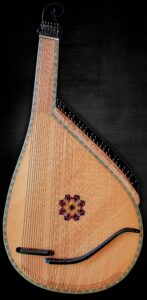
The Traveling Blind Bards Called Kobzari, and Their Instrument, the Bandura
The bandura, Ukraine's folk instrument, has no frets and produces one pitch per string. The kobzari, who traveled the country reciting epic songs with this instrument, were persecuted under both imperial Russia and the Soviet Union, and the tradition nearly died out in the 1930s. In 2024, the effort to safeguard it was recognized by UNESCO.
-

No Sketch, Just a Cat-Hair Brush: The Floral Decorative Painting of Petrykivka
The decorative painting that grew up in the town of Petrykivka, in Dnipropetrovsk Oblast, began as paintings on the white walls of farmhouses and became a single picture on paper. The technique of laying down flowers with a cat-hair brush, without a preliminary sketch, was inscribed on UNESCO's Representative List of the Intangible Cultural Heritage of Humanity in December 2013 — the first Ukrainian element ever inscribed. This article covers the brushwork, the imaginary flowers, and the painters.
-
The Trojan Hero Becomes a Cossack ── Kotliarevsky’s Eneida
The Eneida rewrote Aeneas, the hero of Virgil's epic, as a Cossack youth who speaks Ukrainian vernacular. This article traces, through encyclopedias and the text itself, the feast scenes with halushky and borscht, the new ten-line stanza form, and what the work meant for turning Ukrainian into a literary language. In 2026, its first Japanese translation was published.
-
Closed in 1817, Revived in 1991: The Kyiv-Mohyla Academy
The brotherhood school that began in a donated estate in 1615 became a collegium under Petro Mohyla in 1632, and trained hetmans and clergy. The school declined under the Russian Empire and was closed in 1817, only to be revived as a university in 1991, right after independence. This article traces that history through encyclopedias and legal decrees.
-
The Tale of Bygone Years Was Compiled Three Times in 1110s Kyiv
The Tale of Bygone Years, the chronicle that carries the history of Kyivan Rus, was compiled at a monastery in Kyiv in the early 12th century and revised twice more within a few years. No original manuscript survives; what can be read today are copies made in the 14th to 16th centuries. Drawing on encyclopedias and critical editions, this article covers who is credited with compiling it, where the manuscripts are held, how its years are counted, and the title used in its Japanese translation.