
The Trojan Hero Becomes a Cossack ── Kotliarevsky’s Eneida
The Eneida rewrote Aeneas, the hero of Virgil's epic, as a Cossack youth who speaks Ukrainian vernacular. This article traces, through encyclopedias and the text itself, the feast scenes with halushky and borscht, the new ten-line stanza form, and what the work meant for turning Ukrainian into a literary language. In 2026, its first Japanese translation was published.
Еней був парубок моторний / І хлопець хоть куди козак (“Aeneas was a lively young fellow, and a Cossack you wouldn’t be ashamed to show off anywhere.”)
Ivan Kotliarevsky, Eneida, Part 1, opening of stanza 1 (the English translation is this article’s own)
In the Aeneid, the epic by the ancient Roman poet Virgil, the Trojan hero Aeneas follows the will of the gods and bears the mission of laying the foundations of Rome. At the end of the 18th century, the Poltava poet Ivan Kotliarevsky (Іван Котляревський, 1769–1838) rewrote this hero as a Cossack youth who speaks the language of Ukrainian villages. That work is the Eneida (Енеїда).
In 2026, the first Japanese translation of this work was published, in the “Reliure” series (ルリユール叢書) from the publisher Gengenshobo (幻戯書房). What did the Eneida change from the original epic, and why does it hold a special place in the history of the Ukrainian language? This article traces that through what the encyclopedias say and through the text of the work itself.
Over 40 Years to Publication
For the author’s dates of birth and death, the Internet Encyclopedia of Ukraine (IEU), published by the Canadian Institute of Ukrainian Studies (CIUS) at the University of Alberta, gives September 9, 1769 to November 10, 1838. Ukraine’s national encyclopedia, the Great Ukrainian Encyclopedia (VUE), gives August 29 and October 29 by the calendar then in use. Both agree that he was born in Poltava and died in Poltava.
He began writing around 1794. The first three parts were published in St. Petersburg in 1798, and the edition containing all six parts did not appear until 1842, in Kharkiv, after the author’s death. The 1798 edition was funded and published by Maksym Parpura without the author’s permission (VUE; the Ukrainian Literary Encyclopedia). The circumstances of publication, and the later history of the Russian Empire’s ban on publishing in Ukrainian, are covered in the article on the Ems Ukase and in Where to Start Reading Ukrainian Literature.
Rewriting the Hero as a Village Youth
The Plot Stays the Same, but the Gods and Heroes Are Brought Down to Earth
IEU treats the Eneida as the leading Ukrainian example of “travesty” (травестія), a form that recasts a serious or heroic work as comedy. According to IEU, both the gods and the hero are dressed in Ukrainian folk costume and portrayed comically against the background of everyday Ukrainian life.
The Ukrainian Literary Encyclopedia (1988–1995), compiled by the Institute of Literature of Ukraine’s National Academy of Sciences, writes that while the author kept the skeleton of Virgil’s plot, he brought the gods and heroes down to earth and expanded the scenes of everyday life. Its assessment is that, whereas the figures of the original epic were symbols of Roman piety and civic duty who simply carried out the will of the gods, Kotliarevsky turned them into a folk “fairy tale” for a broad readership.
Opening the text, this rewriting begins from the very first lines. In Part 1, stanza 1, after the Greeks burn Troy, Aeneas is described as fleeing “with a sack on his back,” leading his singed comrades as they “fled Troy on their heels.” In stanza 3, the reasons given for the goddess Juno’s dislike of Aeneas are that he was born in Troy, that he calls Venus “Mama,” and that his late “uncle” Paris gave Venus the (golden) apple. The mythological grudge is told as though it were a family quarrel.
Relation to Earlier Parodies
Works parodying Virgil already existed elsewhere in Europe before this one. IEU cites the works of France’s Paul Scarron, Austria’s Alois Blumauer, and Russia’s Nikolai Osipov and Alexander Kotelnitsky, and while it notes that the burlesques by Osipov and Kotelnitsky served as models, it judges Kotliarevsky’s work to be “a completely original work,” far superior to them as art.
The Dishes at the Feast Scenes
Scenes of eating and drinking appear again and again in the Eneida. In Part 1, stanza 13, this is the meal of the Trojan party after they escape the storm:
Тут з салом галушки лигали, / Лемішку і куліш глитали / І брагу кухликом тягли (“Here they gulped down halushky with lard, wolfed down lemishka and kulish, and washed it down with braha from a cup.”)
Eneida, Part 1, stanza 13 (the English translation is this article’s own)
Halushky (галушки) are pieces of wheat dough torn off and boiled; lemishka (лемішка) and kulish (куліш) are porridges made from buckwheat flour or grain; braha (брага) is a fermented drink. In Part 2, stanza 13, the feast held to mourn Aeneas’s father, Anchises, sets out five pots of soup (юшка), four pots of halushky, close to six pots of borscht (борщ), boiled mutton, and roasted chicken, goose, and duck.
The Ukrainian Literary Encyclopedia writes that the Eneida alone uses 7,000 words spanning clothing, household implements, buildings, farm work, food, plants, and animals, and that the author proved Ukrainian could produce literature of high art. Ukrainian cuisine itself is covered in Ukraine’s Table.
The Ten-Line Stanza, and the Spoken Language
IEU points to two innovations in this work. One is that it was written in spoken Ukrainian. The other is that, instead of the syllabic verse (matching the number of syllables) commonly used at the time, it used iambic tetrameter and a new ten-line stanza form with a regular rhyme scheme. The Ukrainian Literary Encyclopedia likewise states that this work established, in Ukrainian literature, a way of writing verse that combines stress-based rhythm with syllable count (syllabo-tonic verse).
On the significance of writing in the spoken language, IEU explains that a work written at a time when memory of the Cossack state (the Hetmanate) was still alive, and when the oppression of serfdom was at its harshest, was widely read by contemporaries, produced imitations, and set in motion the process by which spoken Ukrainian gained the status of a literary language. VUE writes that this work “laid the beginnings of new Ukrainian literature” and became one stage in the formation of Ukraine’s literary written language. The Ukrainian Literary Encyclopedia quotes Ivan Franko’s remark that Ukrainian literature began to take on the character of modern literature from the time of Kotliarevsky.
The influence reached beyond Ukraine as well. According to both IEU and the Ukrainian Literary Encyclopedia, the anonymous Belarusian-language burlesque The Aeneid Turned Inside Out (Энеіда навыварат) was also written under this work’s influence.
How to Read the Comedy
There is no single way to read what this work’s comedy is laughing at.
According to the Ukrainian Literary Encyclopedia, the word “kotliarevshchyna” (котляревщина) was first used in 1861 by the writer Panteleimon Kulish, who interpreted the Eneida’s comedy as mocking the life of the common people. From the late 19th to the early 20th century, Ukrainian literary scholarship used this word to refer to a series of comic works that imitated this one.
IEU’s entry (a reprint of the 1988 encyclopedia) writes that the author’s outlook on the world was guided by moral rather than social or political standards, and that his sympathy for the oppressed peasantry was placed beneath his loyalty to the imperial regime. At the same time, writing that engages this work head-on has also been produced. Both IEU and VUE list the critic Yevhen Sverstiuk’s essay “Kotliarevsky Is Laughing” in their bibliographies. VUE’s list of references also includes a paper by Tamara Hundorova discussing this work and the colonial discourse surrounding the name “Little Russia.”
The Japanese Translation
The Japanese translation is Uemura Masayuki’s Eneida (上村正之訳『エネイーダ』), from the publisher Gengenshobo’s “Reliure” series. The publisher gives its publication date as July 2026 and describes it as the first Japanese translation. In the National Diet Library’s bibliographic record, publication is listed as August 2026, 624 pages, with the original-title field reading Повне зібрання творів (“Complete Works”), and it includes a chronology and a bibliography. The publisher’s introduction describes the work as a parody of the Aeneid that recasts an ancient hero as a Cossack, an epic depicting the free world and customs of the common people being lost under the rule of imperial Russia.
In the translated book, the author’s name is rendered as “Ivan Kotliarevsky” (イワン・コトリャレウシキー). This is the spelling to search for when looking in libraries or bookstores.
Sources and article record
Sources and references
- Kotliarevsky, IvanWritten by Pavlo Petrenko; a reprint of the entry in Encyclopedia of Ukraine vol. 2 [1988]. Dates of birth and death, the start of writing in 1794, the 1798/1809/1842 editions and Parpura, earlier parodies, the spoken language and the ten-line stanza, contemporary popularity and imitation, the Belarusian Eneida, moral standards and loyalty to the imperial regime, and bibliography
Published by Internet Encyclopedia of Ukraine (Canadian Institute of Ukrainian Studies) · Checked: 2026-09-24 - Travestya reprint of the entry in Encyclopedia of Ukraine vol. 5 [1993]. The definition of travesty and the Eneida
Published by Internet Encyclopedia of Ukraine (Canadian Institute of Ukrainian Studies) · Checked: 2026-09-24 - Burlesquethe definition of burlesque
Published by Internet Encyclopedia of Ukraine (Canadian Institute of Ukrainian Studies) · Checked: 2026-09-24 - Котляревський, Іван ПетровичDates of birth and death [old-style calendar], the 1798 publication without the author's permission, the beginnings of new Ukrainian literature, and a list of references
Published by Велика українська енциклопедія · Checked: 2026-09-24 - Котляревський Іван Петрович/КотляревщинаWritten by M. T. Yatsenko and others. Dates of birth and death [new and old style], the 1798 edition and Parpura, differences from Virgil, 7,000 words, syllabo-tonic verse, Franko's assessment, the Belarusian Eneida, and Kulish's “kotliarevshchyna” [1861]
Published by Українська літературна енциклопедія (Institute of Literature named after T. H. Shevchenko, Academy of Sciences of the Ukrainian SSR, 1988–1995), electronic edition “Izbornyk” · Checked: 2026-09-24 - 『エネイーダ』書誌ページBy Ivan Kotliarevsky, translated by Uemura Masayuki, Reliure series, July 2026, described as the first Japanese translation; includes an introduction
Published by 幻戯書房 · Checked: 2026-09-24 - エネイーダBibliographic record. August 2026, 624 pages, original title: Повне зібрання творів, includes a bibliography and chronology
Published by 国立国会図書館サーチ · Checked: 2026-09-24
If you find an error in this article, please tell us via Corrections. Once we have checked it, we will record in the article what was corrected and why.
Related articles
-
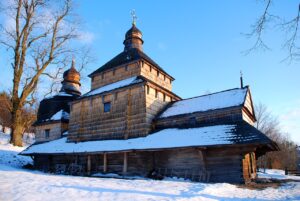
8 of 16, in Ukraine: The Wooden Churches of the Carpathians
The wooden churches of the Carpathian Mountains, called "tserkvas," are built of horizontally stacked logs, their roofs and walls covered in wooden shingles. Of the 16 churches inscribed as a UNESCO World Heritage Site jointly with Poland in 2013, 8 are in Ukraine. This article covers the four architectural types, the lineup of the 8 churches, and the wartime conservation challenges described in a 2024 report.
-

Three Companies Partnering with Ukrainian Businesses — An Interview with Operator Ryo Horiki
System development, cybersecurity, trade. We asked Ryo Horiki, who runs three companies working with Ukrainian businesses, how it started, how communication has gone since the war began, and what fields he wants to expand into next. Ryo HorikiRepresentative Director and CEO, Kinobo Co., Ltd.; Representative, Vyshytech LLC; Representative, illnoa LLCWorks on business in partnership with Ukraine through each of these companies. The Background and Business Strategy Behind Partnering with Ukraine ― What was your image of Ukraine before you started working together? The partnership began before the Russian military’s invasion…
Published in
-
A Town Planned in 1986 for Nuclear Plant Workers: Slavutych
Slavutych was established by a construction decision in October 1986, following the Chornobyl accident, as a town where the power plant's staff and their families could live. Eight Soviet republics took part in its construction, and the town is divided into 14 districts. Using materials from the city, the power plant, and the statistics service, this article traces the commute to the plant, changes in population, and the March 2022 occupation.