
No Sketch, Just a Cat-Hair Brush: The Floral Decorative Painting of Petrykivka
The decorative painting that grew up in the town of Petrykivka, in Dnipropetrovsk Oblast, began as paintings on the white walls of farmhouses and became a single picture on paper. The technique of laying down flowers with a cat-hair brush, without a preliminary sketch, was inscribed on UNESCO's Representative List of the Intangible Cultural Heritage of Humanity in December 2013 — the first Ukrainian element ever inscribed. This article covers the brushwork, the imaginary flowers, and the painters.
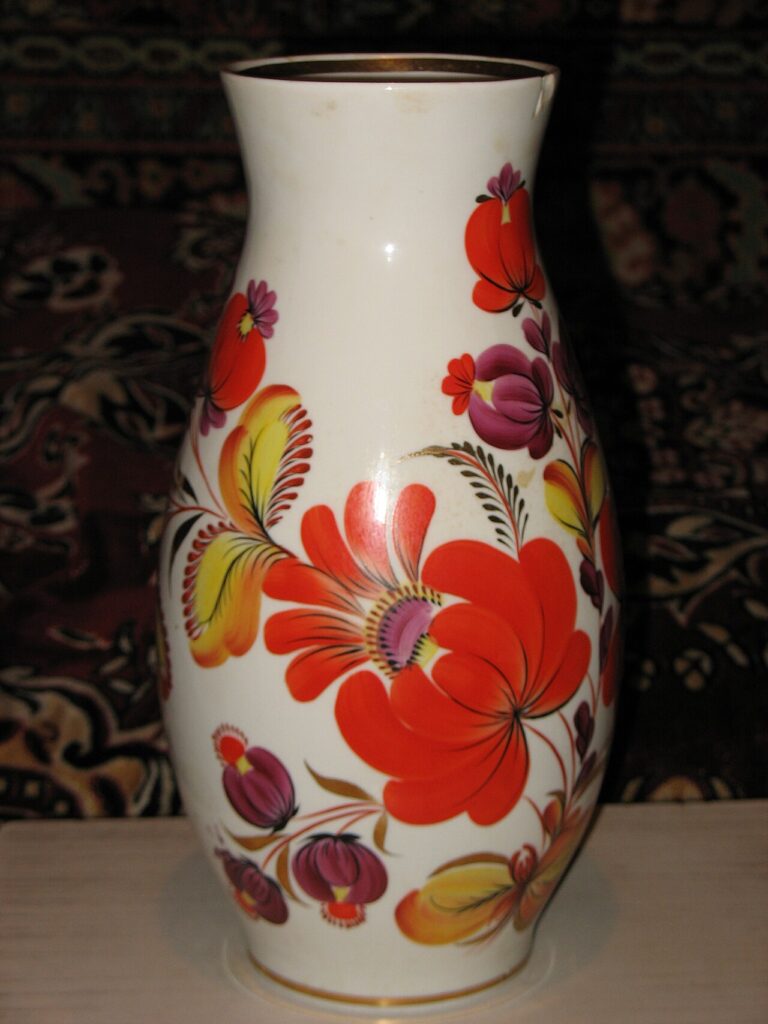

The brush is made from cat hair. No sketch is drawn first. No tool is used to measure proportions. Painters of Petrykivka decorative painting (Ukrainian: Петриківський розпис, Petrykivskyi rozpys), the folk-art tradition that grew up in the town of Petrykivka in central Ukraine, lay down flowers stroke by stroke directly onto white paper or board.
In December 2013, the Intergovernmental Committee for the Safeguarding of the Intangible Cultural Heritage, meeting in Baku, Azerbaijan, inscribed this decorative painting on the Representative List of the Intangible Cultural Heritage of Humanity (the Representative List). As of September 2026, it is the earliest of the seven Ukrainian elements on UNESCO’s lists to have been inscribed.
From Wall Paintings in a Town Near Dnipro
Petrykivka is a town in Dnipropetrovsk Oblast. The Internet Encyclopedia of Ukraine (published by the Canadian Institute of Ukrainian Studies at the University of Alberta — CIUS; hereafter IEU) writes that it began in the mid-18th century as a settlement of Cossacks and peasants that grew up around the estate of a man named Petryk. After the 2020 reorganization of raions (districts), it became the center of the Petrykivka hromada (municipality), which belongs to Dnipro Raion.
According to IEU’s entry on “Petrykivka painting,” it was originally folk art painted on the white walls of peasant houses. It decorated stoves, house facades, and window and door frames, using chalk, local clay, soot, and pigments taken from plants, mixed with egg yolk, milk, or cherry-tree resin as a binder. By the 19th century, Petrykivka had become the center of this kind of painting.
As demand grew, village painters began painting on translucent paper that could be pasted to walls and selling it at markets. In this way, the wall decoration became independent as a single picture on paper. Ukraine’s nomination file submitted to UNESCO likewise explains that the tradition began with murals and the decoration of household items, that professional painters later emerged, and that they painted chests, folk instruments, and paper pictures, which were sold at markets and carried to other regions.
Sources differ on when this style took shape. IEU dates it to the 19th century; the nomination file says “the late 19th to early 20th century”; and the Ministry of Culture’s national inventory describes it as decorative painting spanning the “19th to 21st centuries.” The nomination file also puts forward the view that the tradition is connected to the artistic culture of the 18th-century Zaporozhian Sich (the Cossack stronghold), and that the fact that residents were not enserfed after the Sich was abolished helped folk art develop there.
Four Brush Strokes, and a Brush Made of Cat Hair
IEU lists four traditional brush strokes used in Petrykivka decorative painting.
| Name (Ukrainian pronunciation) | Brush movement | What it depicts |
|---|---|---|
| Hrebinchyk (“comb”) | Pressed down to begin, then drawn out to a fine point | Round-shaped flowers, leaves, grasses |
| Zerniatko (“seed”) | Begun lightly, then pressed down to finish | Leaves with jagged edges |
| Horishok (“nut”) | A variation of the hrebinchyk | Flower pistils, buds |
| Color-blending stroke | Painted with several colors loaded onto one brush | Petals and leaves with gradations of color |
The same entry states that painters traditionally use a brush of cat hair and paint directly onto the paper without a preliminary sketch. The record card in the Ministry of Culture of Ukraine’s national inventory is more detailed, noting that no sketch lines or measuring tools are used, that plant stems and pieces of wood are used alongside the brush, and that some berries and flowers are painted with a fingertip.
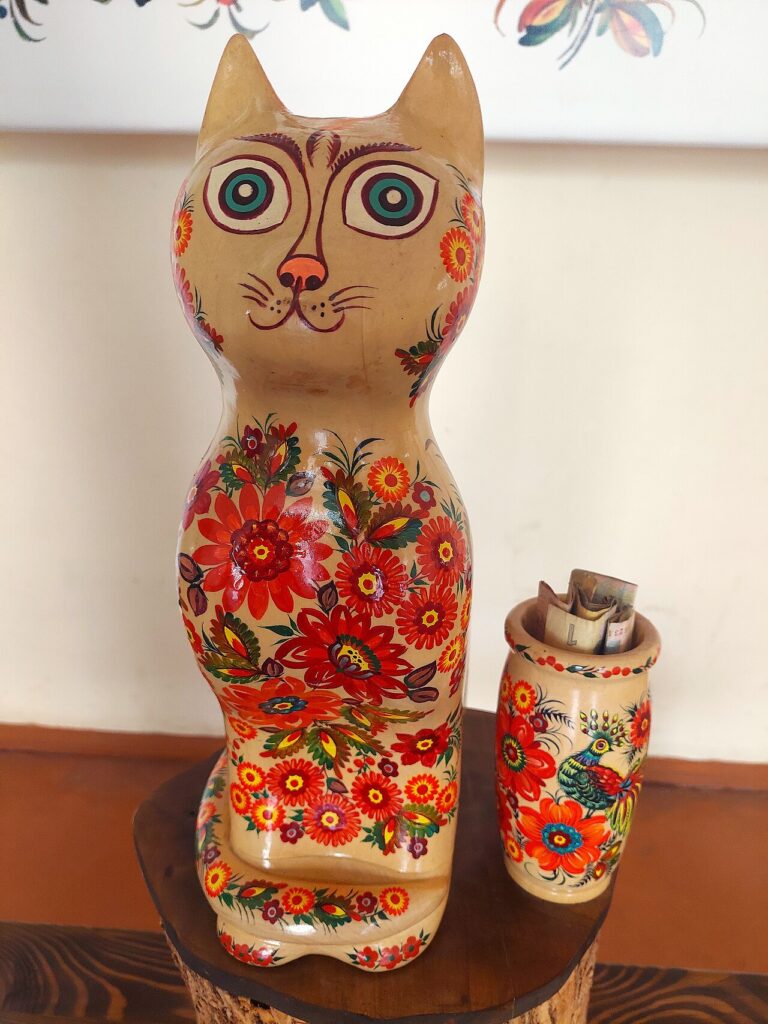

According to the record card, the paints traditionally used are egg tempera, gouache, and oil over a ground, and there is also a technique of painting under a layer of lacquer. Red and green are the dominant colors, and the main compositions are the “flowerpot,” the “bouquet,” the “branch,” and the “frieze” (a band-like pattern). Other traits it lists include that the lines of stems and branches never cross, that animals are painted in profile, and that flowers are painted face-on.
Flowers That Do Not Exist
UNESCO’s inscription text describes this decorative painting as characterized by “imaginary flowers and other natural elements drawn from careful observation of local plants and animals.” The record card likewise notes that, alongside garden flowers such as dahlias, asters, and roses, wildflowers such as chamomile and cornflower, and fruits such as strawberries and grapes, painters have created imaginary flowers that do not exist in nature, called “luchka” and “kucheriavka.”
On the meaning of the images, UNESCO’s inscription text states: “The art form is rich in symbolism: the rooster represents fire and spiritual awakening, while the bird represents light, harmony, and happiness. According to folk belief, paintings protect people from sorrow and evil.” This is taken directly from the explanation given by the Ukrainian side in the nomination file. UNESCO’s documents do not contain a fuller list of what other motifs mean.
The Painters
IEU names more than a dozen well-known painters, including Tetiana Pata, Marfa Tymchenko, and Fedir Panko.
- Tetiana Pata (1884–1976). Born and died in Petrykivka. She decorated houses and chests with plant motifs and also designed shop murals, kilims (woven textiles), books, and postcards. She taught at Petrykivka’s school of decorative painting and trained many painters (IEU). The nomination file states that Pata founded the Petrykivka art school established in 1936.
- Marfa Tymchenko (1922–2009). Born in Petrykivka. She studied under Pata from 1936 to 1938 and later painted vessels and vases at a porcelain factory in Kyiv. She is known for her works painted on paper and cardboard (IEU).
At the time the nomination file was submitted in 2012, the Petrykivka Center of Folk Art brought together 24 members of the National Union of Artists of Ukraine and 6 Honored Folk Artists of Ukraine. The file states that more than 500 children (about 41% of enrolled children) at four kindergartens in the district attended decorative-painting classes, and that 69 students were studying at the art school.
Since the Inscription
UNESCO’s Intergovernmental Committee decision (8.COM 8.29) cited, among its reasons for inscription, that the decorative painting is passed down from generation to generation through education both inside and outside school, giving painters a “sense of belonging.” Within Ukraine, the Ministry of Culture established a national inventory of intangible cultural heritage by Order No. 1521 of December 14, 2012, and registered Petrykivka decorative painting on it. In the inventory published by the Ministry of Culture in 2024, its registration number is “004.нкс.”
Ukrainian elements on UNESCO’s lists also include the pysanka, inscribed in 2024 (see our article, Pysanka — Ukraine’s Eggs “Written” with Beeswax, and Their 2024 UNESCO Inscription). As with the egg motifs, any account claiming that each flower carries a fixed meaning needs its source checked. The painter Maria Prymachenko of Kyiv Oblast (see The 14 Works Carried Out of a Burning Museum: The Painter Maria Prymachenko) was likewise a folk painter of imaginary flowers and animals, but she belonged to a separate tradition from the Petrykivka school.
Sources and article record
Sources and references
- Petrykivka decorative painting as a phenomenon of the Ukrainian ornamental folk art2013 inscription on the Representative List; inscription text: imaginary flowers, the symbolism of the rooster and bird, painters by family, education in schools
Published by UNESCO Intangible Cultural Heritage · Checked: 2026-09-24 - Decision of the Intergovernmental Committee: 8.COM 8.29the inscription decision; reasons under criteria R.1–R.5
Published by UNESCO Intangible Cultural Heritage · Checked: 2026-09-24 - Nomination file No. 008938th session of the Intergovernmental Committee, Baku, December 2013; formation in the late 19th–early 20th century; link to the Sich; from murals to paper; Pata's 1936 school; the Center of Folk Art's 24 and 6 members; over 500 children (about 41%) at four kindergartens; 69 students at the art school
Published by UNESCO Intangible Cultural Heritage (Ukraine) · Checked: 2026-09-24 - ICH inventory: Order of the Ministry of Culture of Ukraine of 14.12.2012 No. 1521, and record cardno sketch, no measuring tools; cat-hair brush; stems, wood, and fingers; egg tempera, gouache, oil, and painting under lacquer; red and green; four compositions; lines that never cross; animals in profile, flowers face-on; luchka and kucheriavka; garden and wild flowers
Published by UNESCO Intangible Cultural Heritage (Ukraine) · Checked: 2026-09-24 - Elements on the Lists of Intangible Cultural Heritage: UkraineUkraine's seven elements and their inscription years
Published by UNESCO Intangible Cultural Heritage · Checked: 2026-09-24 - Національний перелік елементів нематеріальної культурної спадщини Україниitem No. 4, 004.нкс; Order No. 1521 of December 14, 2012; Order No. 105 of February 12, 2018
Published by Ministry of Culture of Ukraine · Checked: 2026-09-24 - Petrykivka paintingpaintings on white walls; where they were used; pigments and binders; the 19th-century center; paper pictures; the 1936 school; four brush strokes; the cat-hair brush and no sketch; painters' names. An entry from volume 3, published 1993
Published by Internet Encyclopedia of Ukraine (CIUS) · Checked: 2026-09-24 - Petrykivkathe settlement's beginnings in the mid-18th century; Dnipropetrovsk Oblast. An entry from volume 3, published 1993
Published by Internet Encyclopedia of Ukraine (CIUS) · Checked: 2026-09-24 - Pata, Tetianaborn March 4, 1884; died July 7, 1976; her works; her teaching at the school
Published by Internet Encyclopedia of Ukraine (CIUS) · Checked: 2026-09-24 - Tymchenko, Marfaborn 1922; died March 26, 2009; studied under Pata 1936–38; the porcelain factory in Kyiv
Published by Internet Encyclopedia of Ukraine (CIUS) · Checked: 2026-09-24 - Декоративний розписN. O. Hlukhenka, 2007; the formation of the folk-decorative-painting school in the village of Petrykivka; painters' names
Published by Encyclopedia of Modern Ukraine · Checked: 2026-09-24 - Постанова Верховної Ради України № 807-IX «Про утворення та ліквідацію районів»July 17, 2020; the Petrykivka hromada's inclusion in Dnipro Raion
Published by Verkhovna Rada of Ukraine (zakon.rada.gov.ua) · Checked: 2026-09-24
If you find an error in this article, please tell us via Corrections. Once we have checked it, we will record in the article what was corrected and why.
Related articles
-
The Man Who Designed Ukraine’s First Banknotes and Stamps ── Heorhii Narbut
9 March 2026 marked 140 years since the birth of the graphic designer Heorhii Narbut (1886–1920), who designed the first banknotes and postage stamps of the Ukrainian People's Republic, taught at the Academy of Arts founded in Kyiv in 1917, and later served as its rector. This article covers his work on banknotes, the coat of arms, lettering and books, and his 34 years of life.
-
Refugee, IDP, Evacuee — Words That Don’t Mean the Same Thing
"Refugee," "internally displaced person," "temporary protection," and "evacuee" are each terms defined by a different system, in a different way. Mixing them up describes a real person's status in a way that doesn't match the facts. This article works from the primary sources — the Refugee Convention, the UN's Guiding Principles, EU law, and Japan's Immigration Control Act — to set out what each term actually means, and a procedure writers can follow to check.
-
Repair Money for a Damaged Home, a Housing Certificate for a Lost One: Ukraine’s “єВідновлення”
The Ukrainian state pays compensation for housing damaged or destroyed by Russian attacks. Under a 2023 law, No. 2923-IX, people can apply through Diia: for damaged housing, funds for repair; for housing that is lost, either a housing certificate to buy a new home or funds to rebuild. Only Ukrainian citizens who own the housing can receive it, and housing in territory that was already occupied when the full-scale invasion began is excluded.