
The Ravine Whose Monument Didn’t Say “Jews”: Kyiv’s Babyn Yar
On September 29 and 30, 1941, Nazi German forces shot Jews at Babyn Yar, a ravine in occupied Kyiv. The killing continued for two years, and the monument the postwar Soviet Union built in 1976 made no mention of Jews. This article traces where the death-toll figures come from, the reserve established after independence, and events up to Russia's missile strike of March 1, 2022.
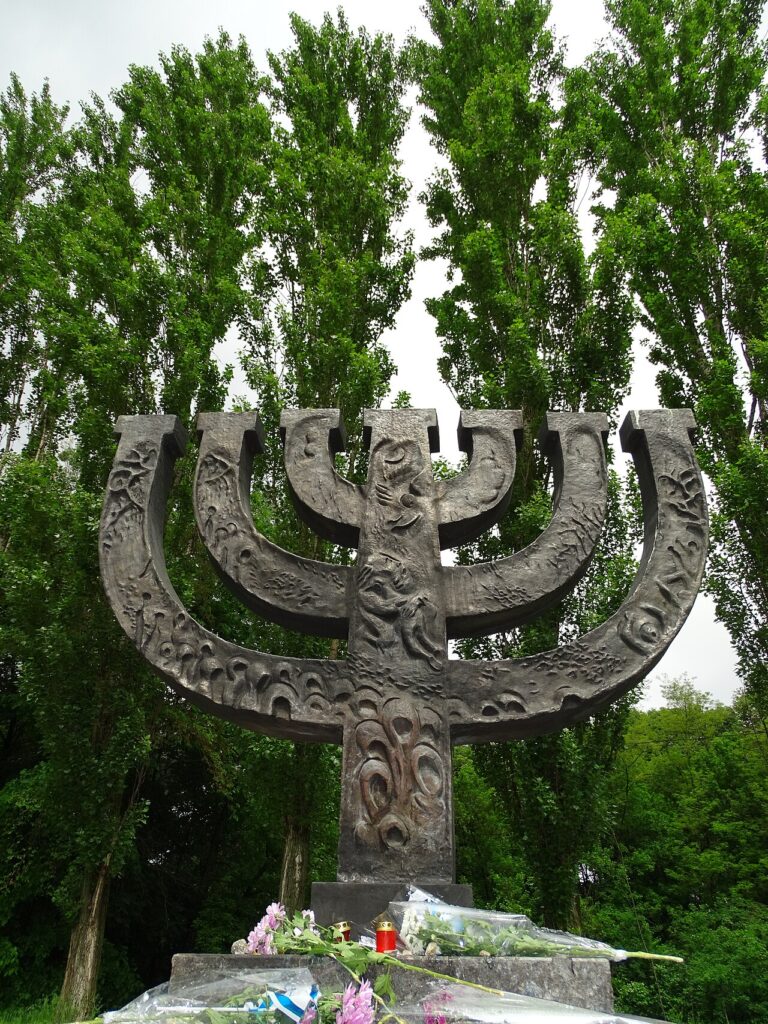
.jpg)
The park and green space near Kyiv’s Dorohozhychi metro station was once a large ravine called Babyn Yar (Бабин Яр). On September 29 and 30, 1941, Nazi German forces shot Kyiv’s Jews here. The United States Holocaust Memorial Museum (USHMM) describes it as one of the largest mass shootings of Jews in German-occupied Europe.
Killings at the ravine continued for two more years after that. And in the postwar Soviet Union, even speaking of what happened here and who was killed was long suppressed. This article follows the events of 1941 and the path that memory of them has taken, drawing on the records of museums, memorial institutions, and the Ukrainian government.
Two Days, Ten Days After the Occupation
German forces entered Kyiv on September 19, 1941. According to USHMM, before the German invasion, about 160,000 Jews lived in Kyiv, but about 100,000 had left the city or joined the army, leaving about 60,000 remaining at the time of the occupation — many of them women, children, the elderly, and the sick. Yad Vashem, Israel’s Holocaust remembrance institution, estimates that between 60,000 and 70,000 remained.
In the first week of the occupation, a large explosion on Khreshchatyk Street in the city center destroyed the German command headquarters and other buildings. USHMM writes that the explosion was caused by mines left behind by retreating Soviet forces, but that Germany used it as a pretext to proceed with killing the Jews remaining in the city.
According to Yad Vashem, on September 28, notices in Russian, Ukrainian and German were posted around the city. They ordered Jews to gather by 8 a.m. on September 29 at an intersection near a cemetery, bringing documents, money, valuables and warm clothing, and stated that anyone who did not comply would be shot — wording that suggested resettlement. Yad Vashem also notes that September 29 that year fell on Yom Kippur, the Jewish Day of Atonement.
Those who gathered were taken to the ravine, stripped, and shot in small groups. According to USHMM, this was carried out by SS and German police units and their auxiliary forces under the direction of Einsatzgruppe C, with the shooting done by Sonderkommando 4a, commanded by Paul Blobel. Yad Vashem writes that local auxiliary police marched the Jews to the ravine, and that Wehrmacht units and local collaborators under the occupation also took part in the killing.
Where the Figure of 33,771 Comes From
The figure of 33,771 is often cited for the number of victims over these two days. Both USHMM and Yad Vashem present this number explicitly as coming “according to the Einsatzgruppen report” — a figure the perpetrators reported to headquarters in Berlin, not an independently verified count.
The killing did not end after two days. Yad Vashem states that, according to various estimates, more than 50,000 Jews were shot between September 29 and October 11. Estimates of the total number killed at the ravine vary widely by source.
| Number | Scope | Source |
|---|---|---|
| 33,771 | Jews killed on September 29–30, 1941 | Einsatzgruppen report (cited by USHMM and Yad Vashem) |
| More than 50,000 | Jews shot between September 29 and October 11, 1941 | Yad Vashem (“according to various estimates”) |
| About 100,000 | People (Jews and others) killed at Babyn Yar under the occupation | 1943 Soviet investigation (cited by USHMM) |
| 70,000–100,000 | Total number killed at Babyn Yar | Yad Vashem |
| About 100,000–150,000 | Total number killed at Babyn Yar | National Historical Memorial Reserve “Babyn Yar” (as “the figure cited by most researchers”) |
The Reserve’s materials state that the exact number is still unknown. In 1943, before withdrawing from Kyiv, Germany exhumed and burned the bodies in an attempt to destroy the evidence (USHMM, Yad Vashem).
People Killed Besides Jews
According to USHMM, the ravine remained a site of killing for the following two years, continuing until just days before Soviet forces retook Kyiv (on November 6) in the fall of 1943. Jews were not the only victims. USHMM lists patients from a local psychiatric hospital, Roma, Soviet prisoners of war, and non-Jewish civilians.
Yad Vashem writes that the first people killed at this site were patients of a Kyiv psychiatric hospital, on September 27, 1941, and that in November of that year about 300 Jewish patients from the same hospital were killed near the ravine. After Germany’s attitude shifted, members of the Organization of Ukrainian Nationalists (OUN) were also shot. According to the Reserve’s materials, in February 1942 the poet Olena Teliha and her comrades were shot here.
In 1942, the Syrets concentration camp was built right next to the ravine (USHMM dates it to May 1942). In August 1943, Germany forced camp prisoners to exhume and burn the bodies. According to Yad Vashem, on September 29, the 327 prisoners doing this work staged an uprising and tried to escape; only 18 survived.
The Words Left Off the Monument
After the war, memory of this site was long suppressed. According to the Reserve’s materials, the Kyiv city executive committee decided in 1950 to fill the ravine with slurry from a nearby brick factory. The slurry was mixed with water and pumped into the ravine, but on the morning of March 13, 1961, the dam holding back the accumulated slurry collapsed, and a wave of mud struck the Kurenivka district below. A government commission of inquiry’s report states that 145 people died in the disaster area, but the Reserve’s materials state that the exact number of victims can no longer be confirmed.
The monument was erected on July 2, 1976, 35 years after the massacre. According to the Reserve’s materials, its name was “Monument to Soviet Citizens and Soldiers and Officers of the Soviet Army Taken Prisoner, Shot by the German Fascists at Babyn Yar.” USHMM writes that the inscription referred to about 100,000 victims, without indicating that at least a third of them were Jews killed in September 1941.
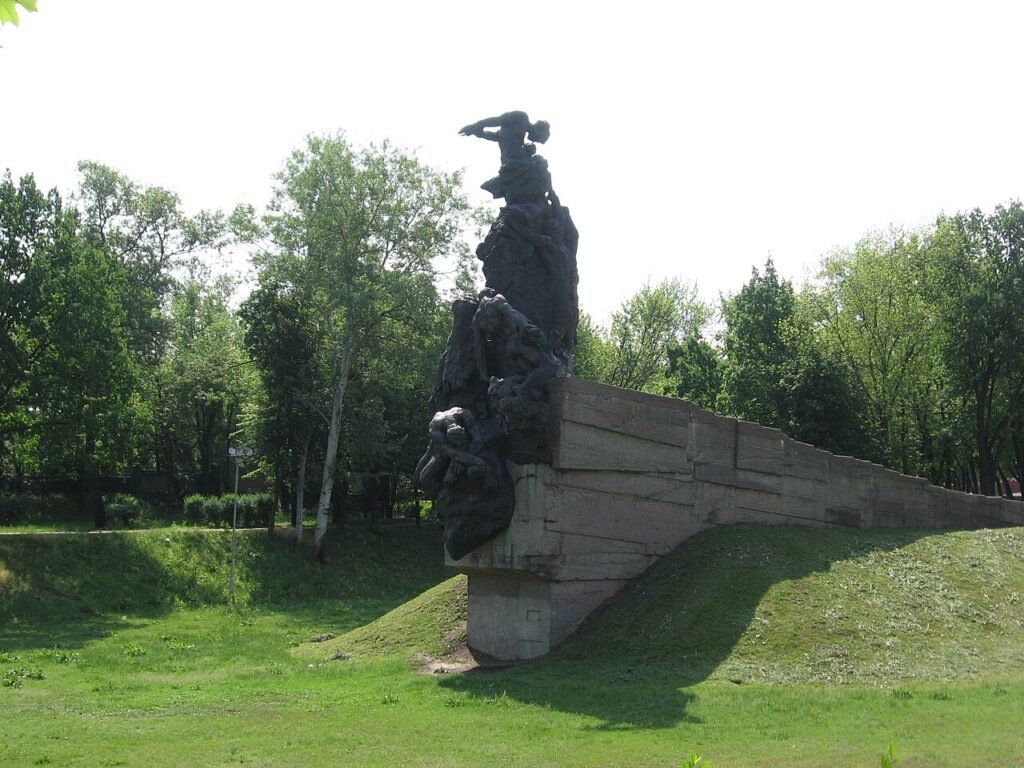

A monument marking Jewish victims was not erected until September 29, 1991. Just after Ukraine declared independence that August, on this 50th anniversary of the massacre, the “Menorah” monument, shaped like the seven-branched Jewish candelabrum, was erected (USHMM, the Reserve’s materials). Since then, monuments to various other victims have been added — OUN members, Syrets camp prisoners, hospital patients, murdered children, and others.
Made a National Reserve
After independence, Ukraine placed this site under state management. By Resolution No. 308 of March 1, 2007, the Cabinet designated the memorials in the Babyn Yar area a “historical memorial reserve” under the jurisdiction of the Ministry of Culture and Tourism. The resolution’s preamble states its purpose as “honoring and perpetuating the memory of the victims of war and political repression.” On February 24, 2010, by Presidential Decree No. 258 of President Viktor Yushchenko, it was given “national” status, becoming known as the “National Historical Memorial Reserve ‘Babyn Yar.'”
March 1, 2022: The TV Tower Beside the Ravine
On March 1, 2022, the sixth day of Russia’s full-scale invasion, Russian forces struck Kyiv’s TV tower, adjacent to the Babyn Yar site, with a missile. According to an announcement by Ukraine’s Security Service (SBU) on August 7, 2025, Russian air forces attacked the TV tower with a Kh-101 cruise missile, killing 5 civilians and wounding 6. The SBU has notified a Russian army general and colonel, in absentia, of suspicion of war crimes (Criminal Code Article 438) for their involvement in preparing and carrying out the attack. This “suspicion” is at the investigative stage and has not been confirmed by any court.
On the day of the attack, Yad Vashem issued a statement strongly condemning “Russia’s deadly attack near the Holocaust memorial site of Babi Yar.” The statement called on the international community to protect civilian lives and historic sites, and reiterated its call to stop abusing and distorting the memory of the Holocaust.
History must be remembered accurately. Its moral lessons must be honestly implemented by all.
From Yad Vashem’s statement (March 1, 2022). Translated from English.
The events of 1941 and the postwar Soviet era are covered in our article on the seventy years as a Soviet republic, and Japan during that time, and the course of the invasion since 2022 in our timeline of Ukraine’s independence and Russia’s invasion.
Sources and article record
Sources and references
- Kyiv and Babyn Yarthe occupation of September 19, 1941; the approximately 160,000, 100,000 and 60,000 figures; the explosion and its use as a pretext; Einsatzgruppe C, Sonderkommando 4a, and Blobel; the reported figure of 33,771; the killings through the fall of 1943 and the types of victims; the approximately 100,000 figure from the 1943 Soviet investigation; the Syrets camp [May 1942]; the inscription on the 1976 monument; the September 29, 1991 Menorah
Published by United States Holocaust Memorial Museum (Holocaust Encyclopedia) · Checked: 2026-09-24 - History of the Jews of Kiev: Holocaust and the Tragedy of Babi Yarthe 60,000–70,000 figure; the September 28 notice; Yom Kippur; the auxiliary police and collaborators; the Einsatzgruppe C report's 33,771; the more than 50,000 shot September 29–October 11; the psychiatric hospital patients of September 27, 1941; the approximately 300 patients in November; the OUN; the September 29, 1943 uprising [327 and 18]; the total of 70,000–100,000
Published by Yad Vashem · Checked: 2026-09-24 - Yad Vashem's Reaction to News of the Attack Endangering the Historical Site of the Babi Yar Massacrethe statement of March 1, 2022
Published by Yad Vashem · Checked: 2026-09-24 - Історико-архітектурна довідка [Historical-Architectural Reference]the establishment of the reserve in 2007; the 100,000–150,000 figure cited by most researchers; the 1950 decision to fill the ravine; the March 13, 1961 dam collapse and the 145 figure; the name of the July 2, 1976 monument; the September 29, 1991 Menorah; the February 1942 shooting of Teliha and others [the 1992 cross]; the various monuments
Published by National Historical Memorial Reserve "Babyn Yar" · Checked: 2026-09-24 - Постанова КМУ від 01.03.2007 № 308 «Про Державний історико-меморіальний заповідник "Бабин Яр"» [Cabinet Resolution No. 308 of March 1, 2007, "On the State Historical Memorial Reserve 'Babyn Yar'"]
Published by Cabinet of Ministers of Ukraine (zakon.rada.gov.ua) · Checked: 2026-09-24 - Указ Президента України від 24.02.2010 № 258/2010 «Про надання державному історико-меморіальному заповіднику "Бабин Яр" статусу національного» [Presidential Decree No. 258/2010 of February 24, 2010, "On Granting the State Historical Memorial Reserve 'Babyn Yar' National Status"]
Published by President of Ukraine (zakon.rada.gov.ua) · Checked: 2026-09-24 - СБУ заочно повідомила про підозру генералу та полковнику армії рф, які командували ракетним ударом по Київській телевежі [The SBU Has Notified, In Absentia, a General and a Colonel of the Russian Army Who Commanded the Missile Strike on the Kyiv TV Tower, of Suspicion]August 7, 2025; the March 1, 2022 attack; the Kh-101; 5 dead, 6 wounded; suspicion under Criminal Code Article 438(2)
Published by Security Service of Ukraine · Checked: 2026-09-24
If you find an error in this article, please tell us via Corrections. Once we have checked it, we will record in the article what was corrected and why.
Related articles
-
“The World Tried to Catch Me, But Could Not”: The Philosopher Skovoroda
Hryhorii Skovoroda (1722–1794), the figure portrayed on the 500-hryvnia banknote, was a philosopher who, after being dismissed from his teaching post, spent 25 years walking from place to place and writing poems and dialogues while staying with friends. Drawing on encyclopedias, this article traces his life and works and his idea of "congenial work," and records how the museum dedicated to him was destroyed by a Russian missile in 2022, the year of his 300th birth anniversary.
-
Nearly 30% of the EU’s Organic Grain Imports Come from Ukraine: Its Organic Laws and Certification
In 2025, 27.7% of the organic grain the EU imported came from Ukraine, the largest share of any single country. Ukraine has a 2018 law and a national “organic” logo, but most of its organic exports have been certified under EU or US standards. A new law adopted in 2026 will replace the old one in July 2029.
-
Generation, Transmission, Distribution, Retail: How Electricity Reaches Homes in Ukraine
Electricity in Ukraine reaches households through four kinds of companies: generation, transmission, distribution, and retail. The 2017 Law on the Electricity Market established this division, and trading on the new wholesale market began on July 1, 2019. This article sets out the roles of the state-owned Ukrenergo, the regional distribution companies, the retail suppliers that contract with households, and the regulator that sets tariffs.