
Section
Business & Recovery
Industries and companies, and the work and challenges of recovery and reconstruction.
-
Nearly 30% of the EU’s Organic Grain Imports Come from Ukraine: Its Organic Laws and Certification
In 2025, 27.7% of the organic grain the EU imported came from Ukraine, the largest share of any single country. Ukraine has a 2018 law and a national “organic” logo, but most of its organic exports have been certified under EU or US standards. A new law adopted in 2026 will replace the old one in July 2029.
-
Ukrainian-Language Books Approach 90%: Ukraine’s Publishing Industry in Numbers
Ukraine published 15,069 books and pamphlets in 2025, with Ukrainian-language titles accounting for close to 90% of them. Drawing on statistics from the Book Chamber of Ukraine and the text of the relevant laws, this article covers the drop in the number of titles published to less than half in 2022, the ban on importing books from Russia and Belarus that took effect in 2023, and support measures such as the “єКнига” (yeKnyha) book-purchase grant for 18-year-olds and rent subsidies for bookshops.
-

7 Well-Known Ukrainian Companies | Their Features and Main Services Explained
Did you know that Ukrainian companies have become world-famous in recent years? Ukraine is home not only to rapidly growing IT companies, but also to many well-known companies in the long-established food and mining industries. This time, we’ll cover seven well-known Ukrainian companies and explain their features and main services. Japanese companies looking to form partnerships should take Ukraine’s technical capabilities as a reference point. Well-Known Ukrainian Company #1: Grammarly Grammarly is a company that provides tools for checking grammar and style in writing. It was founded in the capital,…
Published in
-
Ukraine’s Export Rankings | Its Main Trading Partners, and Current Challenges
This article was published in July 2024, and the figures in it have not been updated since. The weight of each industry in wartime is covered in Ukraine’s Industries in Wartime — The Weight of Agriculture, Manufacturing, Services, and Energy, and the assumptions to keep in mind when reading economic statistics are covered in Ukraine’s Economic Figures in Wartime — Telling Apart Scope, Exchange Rates, and Estimates. Ukraine is a country with abundant resources and vast farmland, and the industries supporting its economy are wide-ranging. Ukraine’s exports are highly regarded…
Published in
-
When Officials Announce That “Recovery Has Progressed,” What Has Actually Been Completed?
Most articles reporting that "recovery has progressed" are simply relaying an announcement from a government or international body. An announcement is evidence that an announcement was made — not evidence that construction is finished. The difference between an estimated amount, a pledged amount, and a disbursed amount; who did the counting; whether there is trackable public data or an independent audit. This article sets out six questions for reading announcements and results separately.
-
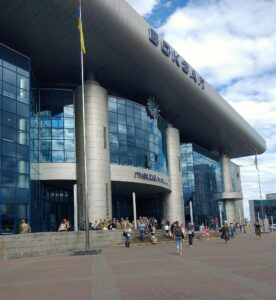
The Railway That Carried 4 Million People West Is Now Starting to Link Up with the EU’s Track Gauge
In the first year of the full-scale invasion, Ukraine's railways carried 4 million people to the west of the country. According to the State Statistics Service, freight fell to less than half its previous level in 2022 and stood at 161.3 million tonnes in 2025. This article draws on official announcements as of September 2026 to describe a business kept running by freight revenue despite passenger losses, and the first EU-gauge track, opened in 2025.
-

The Summer Odesa’s Port Was Shut Down by Attacks — Where Is Ukraine’s Grain Leaving From?
In July 2026, continued Russian attacks on ports and ships effectively stopped merchant vessels from entering Black Sea ports such as Odesa — ports that have carried about 90% of Ukraine's agricultural exports. Exports diverted in September to Danube ports, rail, and trucks reached only around 44% of normal, per the Ministry of Agrarian Policy and Food's own estimate. This article traces the shift in export routes since 2022, and the current figures.
-
Five Rounds of Cost Estimates for Reconstruction, from $348.5 Billion to $587.7 Billion
The “Rapid Damage and Needs Assessment (RDNA),” compiled jointly by the World Bank, the Government of Ukraine, the European Commission and the United Nations, has been published five times since 2022. The amount needed for reconstruction and recovery over the next ten years has grown from $348.5 billion in the first edition to $587.7 billion in the fifth. This article looks at what the damage, loss, and needs figures each actually count, along with the breakdown by sector and oblast.
-

In a Country Where Power Plants Keep Being Targeted, Electricity Gets Made in Small Pieces
Russia has repeatedly attacked Ukraine's power plants and grid since 2022. According to the International Energy Agency (IEA), generating capacity that stood at roughly 38 gigawatts before the full-scale invasion had fallen to 12 gigawatts by spring 2024. Capacity restored through repairs was lost again in attacks over the winter of 2025–26. This article tracks, in numbers, the shift from large power plants toward gas generators and batteries spread across many sites.
-
9% on Dividends, Not Profit: The Corporate Tax Diia City Companies Can Choose
Resident companies of Diia City, Ukraine's legal regime for IT companies, can choose to pay 9% on money leaving the company, such as dividends, instead of the standard 18% corporate tax on profit. Salary and remuneration for people working there is taxed at 5% income tax up to the equivalent of 240,000 euros a year. This article explains the two systems and their conditions, based on the provisions of the Tax Code.