The 1,111 Shot at Sandarmokh in Autumn 1937, and the “Executed Renaissance”
From October 27 to November 4, 1937, in a forest in Karelia, northwestern Russia, 1,111 prisoners from the Solovki camp were shot by the Soviet secret police. Among them were people who had shaped Ukrainian culture in the 1920s, including theater director Les Kurbas and playwright Mykola Kulish. Sources disagree on how many came from Ukraine, ranging from 201 to about 300. This article covers the course of events, the figures, and what happened after the site was found.

From October 27 to November 4, 1937, 1,111 people were shot at Sandarmokh, a clearing in a forest in Karelia, northwestern Russia. All of them were prisoners held at the camp on the Solovetsky Islands (Solovki) in the White Sea. An encyclopedia from a Ukrainian state research institute lists among them the theater director Les Kurbas, the playwright Mykola Kulish, the poet Mykola Zerov, and the writer Valerian Pidmohylny.
The killing was carried out by the Soviet People’s Commissariat for Internal Affairs (NKVD). The Internet Encyclopedia of Ukraine (published by the Canadian Institute of Ukrainian Studies at the University of Alberta; hereafter IEU) writes that this mass shooting was “timed to coincide with the 20th anniversary of the October Revolution.” Many of those who had brought Ukrainian-language literature and theater into flower in the 1920s lost their lives here.
The Name “Executed Renaissance”
In 1920s Soviet Ukraine, Ukrainian-language poetry, fiction, theater and scholarship all searched for new forms at once. The term “Executed Renaissance” (Розстріляне відродження, Rozstriliane Vidrodzhennia) refers to that flowering being cut short by the repression of the 1930s.
According to the Encyclopedia of the History of Ukraine, published by the Institute of History of Ukraine of the National Academy of Sciences of Ukraine, the term has two meanings. One is the title of an anthology edited by the literary critic Yurii Lavrinenko, published in Paris in August 1959. It was compiled at the urging of Jerzy Giedroyc, who led the Polish émigré publishing house Kultura, and gathered works published in Soviet Ukraine up to 1933 that were later banned. The other use of the term refers to the policy of the Communist Party regime in Moscow, which physically erased Ukraine’s intelligentsia of the 1920s–30s and even forbade speaking of their work. The same encyclopedia states that Lavrinenko had used the term since 1944–45, and that it spread through his 1959 book.
Which book to start with is also touched on in our article on where to start with Ukrainian literature — Japanese translations by genre and era.
From the Solovki Camp to the Forests of Karelia
Solovki was originally a monastery island, and the Soviet Union used it as a camp from the 1920s. According to IEU, it was reorganized in 1937 into the “Solovetsky Special Prison.” From the late 1920s through the 1930s, peasants driven out by agricultural collectivization, activists of the Ukrainian Autocephalous Orthodox Church, and Ukrainian writers and scholars were sent there one after another.
The entry “The Solovki Shootings, 1937–1938” in the Encyclopedia of the History of Ukraine (written by the historian Yurii Shapoval) describes the course of events as follows.
- On August 16, 1937, NKVD chief Yezhov issued Order No. 59190, directing that “counter-revolutionary elements” among camp prisoners be dealt with within two months. A quota of 1,200 people was assigned to the Solovki camp
- The camp sent documents on 1,116 people to Leningrad. No interrogation was conducted; the documents were compiled based on denunciations among the prisoners
- The “Special Troika” of the Leningrad Oblast NKVD sentenced 1,116 people to death in minutes No. 81–85 of October 9, 10 and 14
- The prisoners were taken by sea to Kem, then by rail to Medvezhya Gora (present-day Medvezhyegorsk), and, bound, transported to Sandarmokh
- Of the 1,116, 1,111 were actually shot. Captain Mikhail Matveev of the Leningrad Oblast NKVD personally shot 200 to 250 people a day
Materials published by the Ukrainian Institute of National Remembrance in October 2017 likewise cite the figure of 1,111, the dates October 27 and November 1–4, and Matveev’s name. The shooting of Solovki prisoners did not end here. According to the same encyclopedia, a further 509 people were killed in January 1938, and the final group was shot on the Solovetsky Islands themselves under minutes from February 1938. The Institute of National Remembrance puts the number of Solovki prisoners sentenced to death by the troika from October 1937 to February 1938 at 1,825.
How Many of the 1,111 Came from Ukraine?
This figure differs by source. This is because of differences in how the count is made (“prisoners who came from Ukraine” versus “ethnic Ukrainians”) and in when the count was made; this article cannot determine which is correct.
| Source | Ukrainians among the 1,111 | Total victims at Sandarmokh |
|---|---|---|
| Encyclopedia of the History of Ukraine, “Sandarmokh” (Institute of History of Ukraine, NAS of Ukraine; written by Shapoval) | 201 (prisoners who came from Ukraine) | more than 9,500, 58 nationalities |
| Ukrainian Institute of National Remembrance (October 26, 2017) | about 300 | about 7,000, 60 nationalities (of whom more than 677 were ethnic Ukrainians) |
| Kharkiv Human Rights Protection Group (October 27, 2012) | 290 | not stated |
Even within the same Institute of History’s encyclopedia, the entry “Sandarmokh” gives the period of the shootings as “October 24 to November 4,” while “The Solovki Shootings” gives “October 27 to November 4.” The Institute of National Remembrance and the Kharkiv Human Rights Protection Group both give October 27 as the start.
Those Who Were Shot
IEU’s biographical entries give the following people’s date of death as November 3, 1937, and place of death as Sandarmokh (birth years also from IEU).
- Les Kurbas (born 1887). Theater director. Founded the Berezil theater company in Kyiv in 1922, and moved with it to Kharkiv, then the capital, in 1926. He is said to have remade Ukrainian theater with productions incorporating Expressionism and Constructivism. He was expelled from the company in October 1933 and arrested that December
- Mykola Kulish (born 1892). Playwright. Made his name with 97 (1924), and, working with Kurbas, wrote Narodnii Malakhii (1927), Myna Mazailo (1929), and other plays. IEU calls him “the most famous Ukrainian playwright of the 20th century.” He was arrested in December 1934
- Mykola Zerov (born 1890). A poet, translator of ancient Roman poetry, and literary historian, he was at the center of the Kyiv “Neoclassicists.” He was arrested in April 1935 and resentenced to death on October 9, 1937
- Valerian Pidmohylny (born 1901). Writer and translator, known for the novel The City, among others. He was arrested in 1934
- Pavlo Fylypovych (born 1891). Poet and literary scholar, a professor at Kyiv University. He was arrested in August 1935
- Mykhailo Yalovy (born 1895). Poet and writer. IEU writes that his arrest in May 1933 signaled the start of the repression of Ukraine’s intelligentsia
- Oleksa Slisarenko (born 1891). Poet and writer. He was arrested in 1934
According to the Institute of National Remembrance and the Encyclopedia of Modern Ukraine (National Academy of Sciences of Ukraine), many prominent Ukrainians were grouped together into a single case, “Case No. 103010/37.” The case name the Institute of National Remembrance cites is “On 134 Ukrainian Bourgeois Nationalists.”
It was not only writers. Materials from the Institute of National Remembrance also list the geographer Stepan Rudnytsky, the historian Matvii Yavorsky, and Volodymyr Chekhivsky, who led the government of the Ukrainian People’s Republic in 1918–19, among those killed at Sandarmokh.
The Site Found 60 Years Later
The site of the shootings was kept hidden for a long time. According to the Encyclopedia of the History of Ukraine, members of the Saint Petersburg research and information center Memorial began the first excavation on July 1, 1997. The Karelian local historian Yuri Dmitriev also joined the search, and 236 pits were found. The Institute of National Remembrance names the historian Veniamin Ioffe and Dmitriev as the ones who found the site.
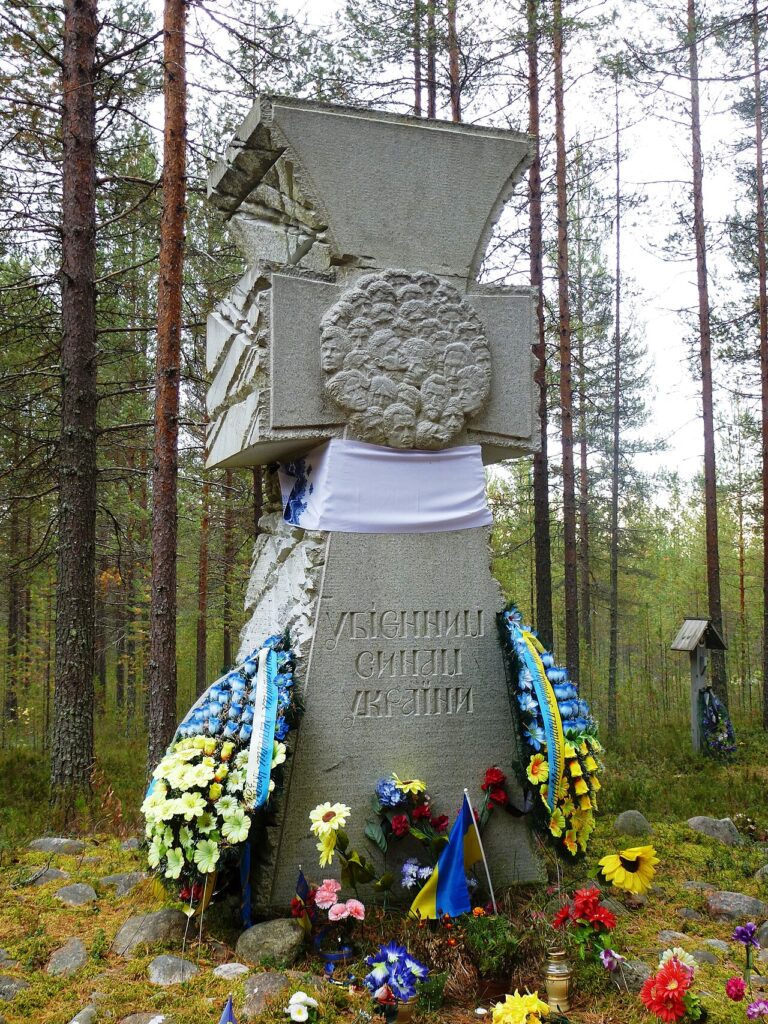
On October 27, 1997, the writer Yevhen Sverstiuk, who had himself been held in a Soviet camp, brought a wooden cross to Sandarmokh. A granite cross inscribed “To the Murdered Sons of Ukraine” was later erected there (the Institute of History’s encyclopedia dates its erection to October 2004, the Institute of National Remembrance to 2005). On August 22, 1998, a monument inscribed “People, do not kill one another” was also erected.
In Ukraine, Presidential Decree No. 431 of May 21, 2007 designated the third Sunday of May each year as “Day of Remembrance for the Victims of Political Repression.” The same decree calls for sending a Ukrainian delegation to the days of remembrance held every August at Sandarmokh and Solovki. According to an October 2017 account by the Institute of National Remembrance, the delegation visited Sandarmokh and Solovki every year from 1997 until Russia began its military invasion of Ukraine in 2014.
What Happened to the Man Who Found the Memorial Site
Sandarmokh lies within the Republic of Karelia, in the Russian Federation. Dmitriev, who found the site, has faced criminal proceedings in Russia since 2016. Special rapporteurs of the UN Human Rights Council, on February 1, 2021, expressed concern that the proceedings might be politically motivated. The statement said:
The Russian authorities are not only failing to uphold the right to truth for the victims, their families, and society as a whole. They are obstructing legitimate research and attempting to rewrite the history books to minimize the true scale of the crimes committed during the Great Terror.
Statement by special rapporteurs of the UN Human Rights Council (February 1, 2021, Office of the United Nations High Commissioner for Human Rights)
In 1930s Ukraine, the Holodomor of 1932–33 also occurred (our article on how many died in the Holodomor, and why estimates range from 2.6 to 5 million). The famine and the shooting of the intelligentsia both took place within the same decade.
Sources and article record
Sources and references
- САНДАРМОХ [SANDARMOKH]Yu. I. Shapoval; identifies all 1,111 by name, 201 of whom were prisoners from Ukraine; October 24 to November 4; more than 9,500 total, 58 nationalities; the July 1997 search and 236 pits; the October 2004 cross; the August 22, 1998 monument; the annual August 5 commemoration
Published by Institute of History of Ukraine, NAS of Ukraine (Encyclopedia of the History of Ukraine) · Checked: 2026-09-24 - СОЛОВЕЦЬКІ РОЗСТРІЛИ 1937–1938 [THE SOLOVKI SHOOTINGS, 1937–1938]Yu. I. Shapoval; Order No. 59190 of August 16, 1937 and the quota of 1,200; the documents on 1,116 people; minutes No. 81–85 of October 9, 10 and 14; no interrogation; 1,111 people; Matveev shooting 200–250 a day; the 509 killed in January 1938; minutes No. 303 of February 1938; the excavation beginning July 1, 1997
Published by Institute of History of Ukraine, NAS of Ukraine (Encyclopedia of the History of Ukraine) · Checked: 2026-09-24 - РОЗСТРІЛЯНЕ ВІДРОДЖЕННЯ [THE EXECUTED RENAISSANCE]O. S. Rublov; the August 1959 publication in Paris; Kultura and Giedroyc; works up to 1933; the term's second meaning; its use since 1944–45
Published by Institute of History of Ukraine, NAS of Ukraine (Encyclopedia of the History of Ukraine) · Checked: 2026-09-24 - До роковин розстрілів української інтелігенції в урочищі Сандармох [On the Anniversary of the Shootings of the Ukrainian Intelligentsia at Sandarmokh]October 26, 2017; about 7,000 people, 60 nationalities, more than 677 Ukrainians; 1,111; October 27 and November 1–4; 1,825; about 300; Kem and Medvezhya Gora; the discovery in the summer of 1997; the October 27, 1997 cross; the 2005 cross; the delegation; Rudnytsky, Yavorsky, Chekhivsky
Published by Ukrainian Institute of National Remembrance · Checked: 2026-09-24 - Sandarmokh 1937October 27, 2012; 290 Ukrainians among the 1,111; the October 27, 1997 cross
Published by Kharkiv Human Rights Protection Group · Checked: 2026-09-24 - Соловецькі концтабори [The Solovetsky Concentration Camps]S. I. Bilokin, May 2025; the special prison from February 20, 1937; the 1,825 sentenced by the troika; Case No. 103010/37 and the 134; the 1,111 shot at Sandarmokh October 27–November 4; the two remaining groups
Published by Encyclopedia of Modern Ukraine (Institute of Encyclopedic Research, NAS of Ukraine) · Checked: 2026-09-24 - Solovets Islandsthe 1937 reorganization into a special prison; the Ukrainians held there
Published by Internet Encyclopedia of Ukraine (CIUS) · Checked: 2026-09-24 - Kurbas, Lesborn 1887, died November 3, 1937 at Sandarmokh; Berezil, Kyiv 1922, Kharkiv 1926; the October 1933 dismissal and December arrest; the mass shooting timed to the 20th anniversary of the October Revolution
Published by Internet Encyclopedia of Ukraine (CIUS) · Checked: 2026-09-24 - Kulish, Mykolaborn 1892, died November 3, 1937 at Sandarmokh; 97, 1924; his works and their dates; the December 1934 arrest; "the most famous playwright of the 20th century"
Published by Internet Encyclopedia of Ukraine (CIUS) · Checked: 2026-09-24 - Zerov, Mykolaborn 1890, died November 3, 1937 at Sandarmokh; the April 1935 arrest; the October 9, 1937 resentencing
Published by Internet Encyclopedia of Ukraine (CIUS) · Checked: 2026-09-24 - Pidmohylny, Valeriianborn 1901, died November 3, 1937 at Sandarmokh; the 1934 arrest; the novel The City
Published by Internet Encyclopedia of Ukraine (CIUS) · Checked: 2026-09-24 - Fylypovych, Pavloborn 1891, died November 3, 1937 at Sandarmokh; the August 1935 arrest
Published by Internet Encyclopedia of Ukraine (CIUS) · Checked: 2026-09-24 - Yalovy, Mykhailoborn 1895, died November 3, 1937 at Sandarmokh; the May 1933 arrest and its significance
Published by Internet Encyclopedia of Ukraine (CIUS) · Checked: 2026-09-24 - Slisarenko, Oleksaborn 1891, died November 3, 1937 at Sandarmokh; the 1934 arrest
Published by Internet Encyclopedia of Ukraine (CIUS) · Checked: 2026-09-24 - Указ Президента України № 431/2007 «Про заходи у зв'язку з 70-ми роковинами Великого терору…» [Presidential Decree No. 431/2007, "On Measures in Connection with the 70th Anniversary of the Great Terror…"]May 21, 2007; the Day of Remembrance on the third Sunday of May; the August delegation to Sandarmokh and Solovki
Published by President of Ukraine (zakon.rada.gov.ua) · Checked: 2026-09-24 - Russia: UN experts raise fair trial concerns over case of Gulag historian Yuri Alexeevich DmitrievFebruary 1, 2021; the proceedings since 2016; the concern over political motivation; the quotation on rewriting history
Published by Office of the United Nations High Commissioner for Human Rights · Checked: 2026-09-24
If you find an error in this article, please tell us via Corrections. Once we have checked it, we will record in the article what was corrected and why.