
President Zelensky Was Set to Join Online — Then He Came to Hiroshima
President Zelensky was originally scheduled to take part in the May 2023 G7 Hiroshima Summit online. After he strongly requested to attend in person, he discussed Ukraine with G7 leaders in Hiroshima on the final day, May 21, and laid flowers at the Memorial Cenotaph for the Atomic Bomb Victims. Drawing on the Ministry of Foreign Affairs' records, this article traces the two days' events and the content of the leaders' statements.
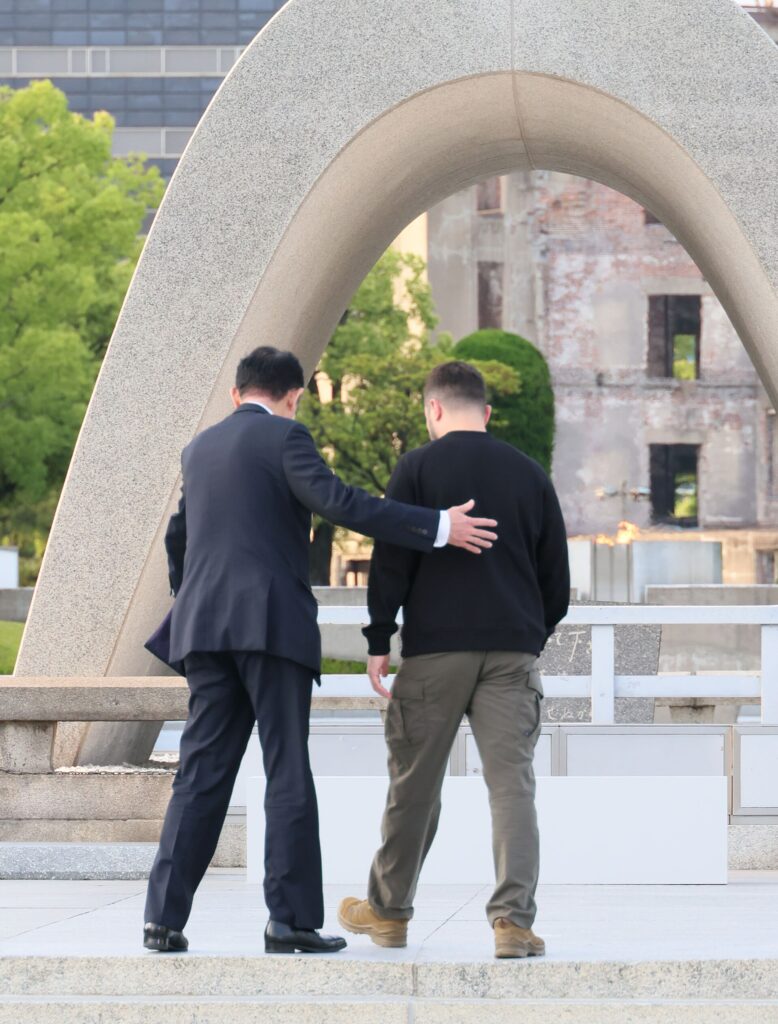

On May 21, 2023, at Hiroshima Peace Memorial Park, then Prime Minister Kishida Fumio and Ukrainian President Volodymyr Zelensky, led by Hiroshima Mayor Matsui Kazumi, walked to the Memorial Cenotaph for the Atomic Bomb Victims, laid flowers, and offered a moment of silence. President Zelensky then visited the Peace Memorial Museum and received an explanation of the exhibits (according to an announcement by the Ministry of Foreign Affairs of Japan, MOFA).
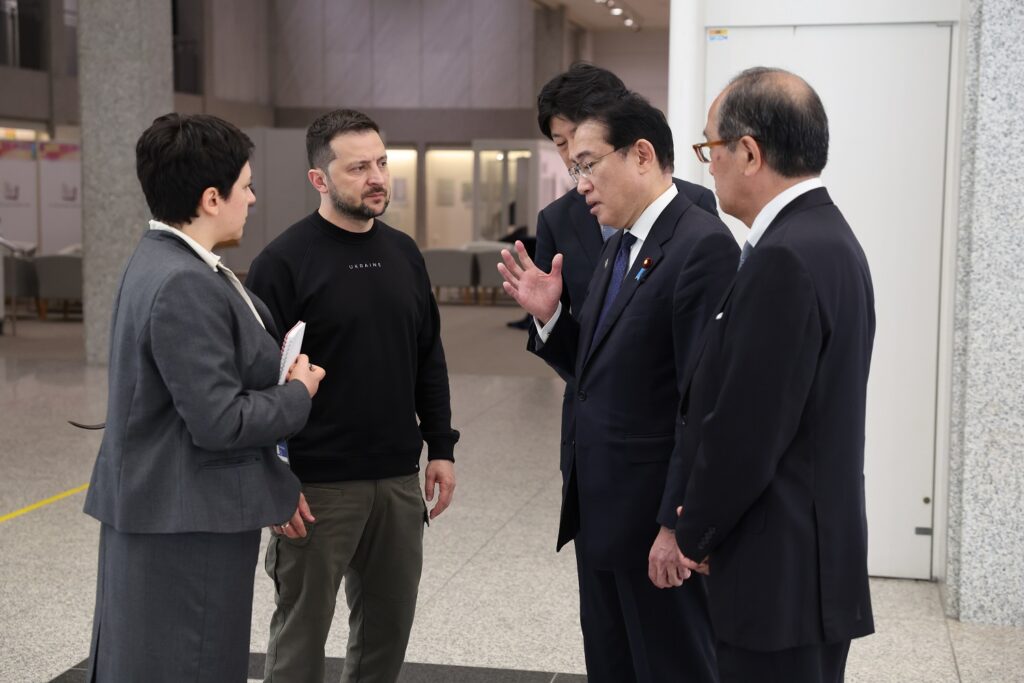

It had been one year and three months since Russia’s full-scale invasion began. This was the first time President Zelensky had taken part in a G7 summit in person (according to the president’s own remarks at the leaders’ meeting that day). Reading MOFA’s records, however, this visit was not decided from the start.
The Original Arrangement Was “Online Participation”
The G7 Hiroshima Summit was held in Hiroshima from May 19 to 21, 2023, chaired by Prime Minister Kishida. According to MOFA’s summary, in addition to the leaders of the G7’s seven member countries and the EU, the leaders of eight other countries (Australia, Brazil, Comoros, the Cook Islands, India, Indonesia, South Korea, and Vietnam) and the heads of seven international organizations were invited, and Ukraine was treated as a “guest country.”
An announcement MOFA issued on May 20 explains the background as follows. When Prime Minister Kishida visited Ukraine in March, President Zelensky had agreed to take part in the summit online. Afterward, the president expressed a strong wish to attend in person, and after carefully examining the summit’s overall agenda and schedule, the Japanese government decided to hold the session on Ukraine on the final day, the 21st, with the president attending in person.
The same announcement also states that, for the president’s security, no press opportunity would be arranged on the 20th. The time and means by which he arrived in Hiroshima are not stated in MOFA’s announcement.
The Three Sessions Where Ukraine Was on the Agenda
According to MOFA’s summary, over the three-day schedule, Ukraine was the central topic in the following three sessions.
| Date | Session | Attendance |
|---|---|---|
| May 19 | Session 2, “Ukraine” | G7 members |
| May 21 | Session 8, “Ukraine” (approx. 60 minutes from 10:45 a.m.) | G7 members, Ukraine |
| May 21 | Session 9, “Toward a Peaceful, Stable and Prosperous World” | G7 members, invited countries, Ukraine |
Session 2, on the first day, was held with only the G7 leaders present. According to the summary, the G7 leaders reaffirmed that they would continue strict sanctions against Russia and strong support for Ukraine, and stressed that “there can be no peace without the withdrawal of Russian forces.” It was after this session that the “G7 Leaders’ Statement on Ukraine,” discussed below, was issued.
President Zelensky joined Session 8 on the final day. Prime Minister Kishida paid tribute to the courage and endurance of the Ukrainian people, who had come through a harsh winter, and said he welcomed and supported the “Peace Formula” the president had presented. The G7 leaders agreed to steadily follow through on their pledge to provide diplomatic, financial, humanitarian, and military support “for as long as it takes.”
Leaders of invited countries such as India and Brazil also joined the following Session 9. According to MOFA’s summary, the president explained his own thinking on peace along with his resolve to stand up to Russian aggression. Leaders from the various countries expressed deep concern over the human toll of Russia’s aggression against Ukraine and its harmful effects on the global economy, including growing energy and food insecurity. On that basis, the leaders are said to have shared the understanding that all countries must uphold the principles of the UN Charter, such as respect for sovereignty and territorial integrity, and that unilateral attempts to change the status quo by force must not be allowed.
The “G7 Leaders’ Statement on Ukraine” of May 19
The leaders’ statement consists of 11 points, and MOFA has published both the original text and a provisional Japanese translation. The following draws on the provisional translation for its main points.
At the outset, the statement calls Russia’s war “Russia’s illegal, unjustifiable, and unprovoked war of aggression against Ukraine,” and states that “15 months of Russia’s aggression have cost thousands of lives and caused immense suffering to the people of Ukraine.” On that basis, the leaders reaffirmed that they would provide the financial, humanitarian, military, and diplomatic support Ukraine needs “for as long as it takes.”
On peace, the statement calls on Russia to withdraw its troops and military equipment “immediately, completely, and unconditionally” from the entire internationally recognized territory of Ukraine, stating that a just peace cannot be achieved without a complete and unconditional withdrawal.
Among the statement’s other points are the following.
- Nuclear safety: expressing “the most serious concern” over Russia’s seizure and militarization of the Zaporizhzhia Nuclear Power Plant, and supporting the IAEA’s efforts
- Recovery and reconstruction: welcoming the IMF’s approval of its Extended Fund Facility, and using the “Multi-agency Donor Coordination Platform for Ukraine” as the primary mechanism for coordinating support. Looking forward to the recovery conference to be held in London in June
- Sanctions: expanding export restrictions on items important to Russia’s aggression, preventing sanctions evasion, and maintaining the price cap on Russian oil. Cooperating on restricting trade in and use of Russian-origin diamonds as well
- Accountability for damage: keeping Russian state assets under G7 jurisdiction “immobilized” until Russia pays for the damage it has caused Ukraine
- Pursuing accountability: strongly condemning the “illegal deportation and transfer of Ukrainians, including children,” from occupied areas to Russia, closely watching the International Criminal Court’s (ICC) investigation, and continuing to call for the children’s return
The statement closes by saying that, from Hiroshima, “a symbol of peace,” the G7 will make every effort to bring about a comprehensive, just, and lasting peace for Ukraine.
The “G7 Hiroshima Leaders’ Communiqué,” issued the following day, May 20, likewise condemns Russia’s war of aggression “in the strongest possible terms” in its section on Ukraine, and commits to the actions set out in the leaders’ statement. The communiqué also calls on China to press Russia to stop its military aggression and withdraw its troops from Ukraine.
The Cenotaph and the Museum
On May 21, Prime Minister Kishida and President Zelensky laid flowers at the Memorial Cenotaph for the Atomic Bomb Victims. The president visited the Peace Memorial Museum and wrote the following in the guest book, in Ukrainian (MOFA has published both the original text and a provisional Japanese translation).
Глибоко вражений відвіданням Музею. Жодна держава світу не має пережити такий біль і руйнування. Ядерному шантажу не місце в сучасному світі.
President Zelensky’s entry in the guest book at the Peace Memorial Museum (published by MOFA, May 22, 2023)
MOFA’s provisional Japanese translation, rendered here in English, reads: “Deeply moved by the visit to the [Peace Memorial] Museum. No state in the world should have to go through such pain and destruction. Nuclear blackmail has no place in the modern world.”
The G7 leaders’ statement had likewise called Russia’s “irresponsible nuclear rhetoric” and its stated intention to deploy nuclear weapons in Belarus “dangerous and unacceptable,” and reaffirmed the position that any use of nuclear weapons by Russia, or even the threat of their use, is unacceptable. The final line the president wrote in a city that suffered an atomic bombing, and that faces its own nuclear threats, echoes that statement.
The Japan–Ukraine Summit Meeting That Evening
Starting just after 6:20 p.m. on the same day, the 21st, Prime Minister Kishida and President Zelensky held a summit meeting for about 50 minutes. According to MOFA’s summary, the president expressed his gratitude for being invited to take part “in person for the first time” at this summit, and praised Prime Minister Kishida’s leadership in inviting Global South countries as invited nations.
At this meeting, Prime Minister Kishida conveyed new Japanese support.
- In response to a Ukrainian request, providing around 100 Japan Self-Defense Forces vehicles, including trucks, and about 30,000 emergency food rations
- Accepting wounded Ukrainian soldiers at the Self-Defense Forces Central Hospital for the first time
- Having the Japan Bank for International Cooperation (JBIC) provide guarantees worth about ¥93 billion for yen-denominated Samurai bonds issued by Poland to support Ukrainian evacuees
Prime Minister Kishida also said Japan would steadily carry out the total of $7.6 billion in support it had already pledged, and that it would use the newly launched “Preparatory Conference on Economic Recovery and Reconstruction of Ukraine” to have the public and private sectors jointly push forward recovery and reconstruction. The following February, in 2024, the Japan–Ukraine Conference for Promotion of Economic Recovery and Reconstruction was held in Tokyo (see The 56 Cooperation Documents Unveiled in Tokyo, and What Followed).
What Followed Hiroshima
The leaders’ statement is a document that lays out directions for support and sanctions. It welcomes mechanisms to encourage private investment, such as the Support for Ukraine’s Reconstruction and Economy (SURE) Trust Fund set up at the Multilateral Investment Guarantee Agency (MIGA, part of the World Bank Group), and the Ukraine Investment Platform launched in Tokyo on May 12. At the time of this statement, however, how the immobilized Russian state assets would actually be used was still described only as keeping them “immobilized until Russia pays for the damage it has caused.” At the G7 Apulia Summit in June the following year, 2024, a lending framework was agreed that would use the proceeds generated by those assets to repay loans, and Japan too has extended yen loans under this framework (see Demining Machines, Rails, Generators: What JICA Has Sent to Ukraine).
Where these three days fit among other events in the Japan–Ukraine relationship can be checked in The Japan–Ukraine Timeline.
Sources and article record
Sources and references
- G7広島サミット(概要)令和5年5月26日。会期、出席者、招待国・招待機関、ゲスト国ウクライナ、各セッションの出席国と概要、成果文書の一覧
Published by 外務省 · Checked: 2026-09-24 - G7広島サミット(セッション8「ウクライナ」概要)令和5年5月21日。開始時刻と所要時間
Published by 外務省 · Checked: 2026-09-24 - G7広島サミット(ゼレンスキー・ウクライナ大統領の訪日)令和5年5月20日。オンライン参加の合意から対面参加への変更、20日の取材機会なし
Published by 外務省 · Checked: 2026-09-24 - ウクライナに関するG7首脳声明(2023年5月19日)仮訳
Published by 外務省 · Checked: 2026-09-24 - G7 Leaders' Statement on Ukraine(2023年5月19日)原文
Published by 外務省 · Checked: 2026-09-24 - G7広島首脳コミュニケ(2023年5月20日)仮訳前文、第4項「ウクライナ」、中国に関する項
Published by 外務省 · Checked: 2026-09-24 - 岐田内閣総理大臣とゼレンスキー・ウクライナ大統領による原爆死没者慮霊碑献花令和5年5月21日
Published by 外務省 · Checked: 2026-09-24 - ゼレンスキー・ウクライナ大統領による平和記念資料館訪問(記帳内容)令和5年5月22日。ウクライナ語原文と和文仮訳
Published by 外務省 · Checked: 2026-09-24 - 日・ウクライナ首脳会談令和5年5月21日。時刻、自衛隊車両・非常用粰食・負傷兵受入れ・JBICの保証・総計76億ドル
Published by 外務省 · Checked: 2026-09-24 - ウクライナに対する円借款「ウクライナのための特別収益前倒し融資」に関する書簡の署名・交換令和7年4月18日。2024年6月G7プーリア・サミットでのERA融資枠組みの立ち上げ合意、ロシア国家資産の凍結由来の特別な収益を返済原資とする仅組み、日本の円借款4,719億円
Published by 外務省 · Checked: 2026-09-24 - G7財務大臣・中央銀行総裁声明(仮訳)2024年10月25日。6月15日プーリアで発表されたG7首脳声明に沿いG7財務大臣がERAローン・イニシアチブの実施要領に合意したこと、約500億米ドル(450億ユーロ)
Published by 財務省 · Checked: 2026-09-24
If you find an error in this article, please tell us via Corrections. Once we have checked it, we will record in the article what was corrected and why.