From Bulletproof Vests to High-Mobility Vehicles: What Japan’s Self-Defense Forces Have Sent to Ukraine
On March 8, 2022, a transport aircraft loaded with Self-Defense Forces bulletproof vests and steel helmets departed for Poland. The government amended the operational guidelines for the Three Principles on Transfer of Defense Equipment and Technology that same day. This article traces the course of the transfers that followed — protective masks, drones, 131 SDF vehicles, and medical supplies — and the rule against sending anything with lethal capability.
_front_view_at_Camp_Akeno_November_4,_2017.jpg)
On March 8, 2022, the Ministry of Defense announced that one KC-767 aerial refueling and transport aircraft was scheduled to depart from the Air Self-Defense Force’s Komaki Base. At a press conference that night, Defense Minister Kishi revealed that it was carrying Self-Defense Forces bulletproof vests and steel helmets, bound for Poland, Ukraine’s neighbor. This was 12 days after Russia’s full-scale invasion of Ukraine began.
From this day through November 2025, the Ministry of Defense and the Self-Defense Forces have continued sending equipment and supplies to the government of Ukraine. What was sent, and which rules had to be changed to do it? This article traces what has been made public, as of September 2026, from the Ministry of Defense’s and the Cabinet Secretariat’s announcements and Diet records.
Items Were Listed on March 4, Decided on March 8
According to the Ministry of Defense’s announcement, the first move was at the National Security Council on March 4, 2022. It was decided to “coordinate and consider” providing Ukraine, via SDF aircraft and other means, with bulletproof vests, steel helmets, cold-weather clothing, tents, cameras, and also medical supplies, emergency food, generators, and the like. At an extraordinary press conference the same day, Defense Minister Kishi explained that this was based on a request from the government of Ukraine.
Four days later, on March 8, the Ministry of Defense announced that it would grant these as “non-lethal supplies,” within the scope of the Self-Defense Forces Act and the Three Principles on Transfer of Defense Equipment and Technology, and transport them by SDF aircraft and other means. On the same day, in Tokyo, Foreign Minister Yoshimasa Hayashi and Ukrainian Ambassador to Japan Sergiy Korsunsky signed an exchange of notes on the grant of SDF equipment and goods (per a House of Representatives written question of August 2022 and the government’s written answer to it).
The shipment was split into three flights. The Ministry of Defense announced that one KC-767 was scheduled to depart from Komaki Base on March 8, and one C-2 transport aircraft from Miho Base on March 10. On March 16, one U.S. military C-17 transport aircraft departed from Yokota Air Base carrying SDF equipment. At his press conference on March 8, Minister Kishi declined to explain how the equipment would be carried from Poland to Ukraine, citing the involvement of another country.
Only the Bulletproof Vests Counted as “Defense Equipment”
The basic rules for Japan transferring equipment abroad are the “Three Principles on Transfer of Defense Equipment and Technology,” decided by the Cabinet on April 1, 2014, and the “Operational Guidelines” the National Security Council decided the same day. The Operational Guidelines list the “cases that may be approved” for transfer overseas.
The March 8, 2022 announcement, jointly issued by the Cabinet Secretariat, the Ministry of Foreign Affairs, the Ministry of Economy, Trade and Industry, and the Ministry of Defense, states that, of the items being sent this time, only the bulletproof vests count as “defense equipment” under the Three Principles. Steel helmets, cold-weather clothing, tents, and the like are not included. The government therefore partially amended the Operational Guidelines the same day, adding the following item to the cases that may be approved.
The overseas transfer of defense equipment included among the equipment and other items that the Minister of Defense grants, under the provisions of Article 116-3 of the Self-Defense Forces Act, to Ukraine, which is undergoing aggression in violation of international law
Item added by the March 8, Reiwa 4 [2022] amendment to the “Operational Guidelines for the Three Principles on Transfer of Defense Equipment and Technology” (Ministry of Defense, “On the Deliberation Concerning the Transfer of Bulletproof Vests to Ukraine,” March 8, 2022)
After the amendment, the National Security Council’s Four Ministers’ Meeting confirmed that transferring the bulletproof vests “falls under a case that may be approved for overseas transfer.” The announcement cites, as reasons, that the transferred bulletproof vests are equivalent in performance to similar equipment used by other countries and private entities, and that the final end-user is the government of Ukraine, which is confronting Russian aggression.
At the March 4 press conference, Minister Kishi was asked about the relationship with the Three Principles’ ban on transfers to a party to a conflict. He replied that a “party to a conflict” under the Three Principles means “a country subject to measures the UN Security Council is taking to maintain or restore international peace and security following an armed attack,” and that the government considers Ukraine not to fall under this. Asked why nothing with lethal capability is being sent, he answered, “I think anything with lethal capability is basically not acceptable,” and “we cannot do it.”
The Basis: Article 116-3 of the Self-Defense Forces Act
The legal basis for granting equipment is Article 116-3 of the Self-Defense Forces Act. The article’s heading is “Special Provisions of the Public Finance Act Concerning the Grant of Unneeded Equipment, etc., to Governments of Developing Regions,” and its main points are as follows (confirmed via e-Gov Japanese Law Search in September 2026).
- It can be used when a government of a developing region abroad requests the grant of equipment for use in that region’s military’s activities such as emergency disaster response, information gathering, or education and training
- The covered “equipment, etc.” consists of equipment, vessels, aircraft, and supplies, excluding weapons (including ammunition)
- What can be granted is limited to items that were in use by the Self-Defense Forces and have been retired from use, or that have been declared unneeded
- An international agreement is concluded with the recipient government containing provisions to prevent use for any purpose other than that agreed, or transfer to a third party, without Japan’s consent
Weapons and ammunition cannot be granted under this article at all, from the outset. The exchange of notes of March 8 is likewise consistent with this article. According to the government’s written answer (August 15, 2022), under the exchange of notes, the government of Ukraine is to take the necessary measures to use the granted equipment and goods only for “activities by the government of Ukraine related to the defense of Ukraine, which is undergoing aggression in violation of international law,” and not to transfer them to any party other than the government of Ukraine without the Japanese government’s prior written consent. The written answer declines to address individual exchanges, citing relations with the other country.
How the Items Sent Have Changed Over Time
Laid out in date order, the Ministry of Defense’s announcements show the items expanding from protective gear to preparedness against chemical weapons, drones, and vehicles.
| Announcement date | Content |
|---|---|
| March 8, 2022 | Decided to grant and transport bulletproof vests, steel helmets, cold-weather clothing, tents, cameras, medical supplies, emergency food, and generators |
| April 19, 2022 | Decided to provide protective masks and protective clothing for responding to chemical weapons, and drones |
| August 4, 2022 | Newly provided civilian vehicles (vans). Also added small drones |
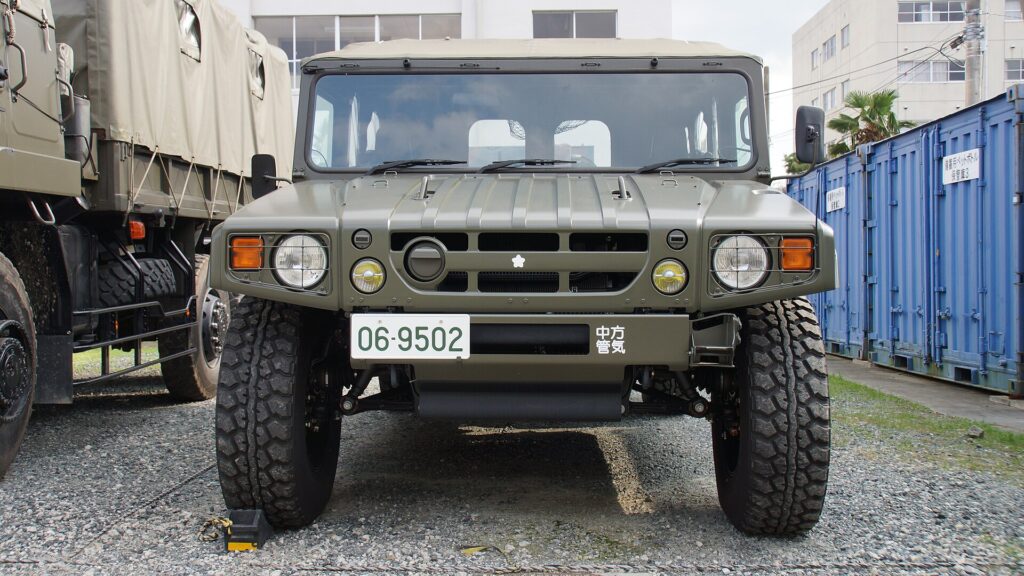
| May 21, 2023 | Decided to provide SDF vehicles (1/2-ton trucks, high-mobility vehicles, materiel transport vehicles) at a scale of about 100 vehicles in total. Also added about 30,000 servings of emergency food |
| May 24, 2023 | Handover ceremony for the vehicles at the Ministry of Defense. The first 2 of the 1/2-ton trucks were displayed, and Vice-Minister of Defense Ino presented Ambassador Korsunsky with the inventory |
| March 28, 2024 | Special Advisor to the Minister of Defense Takami informed the ambassador that preparations for shipping the final batch of vehicles, including the 101st, were complete |
| February 4, 2025 | Shipped 6 more 1/2-ton trucks, as an addition decided at the October 2024 defense ministers’ meeting. The addition is planned to total about 30 vehicles |
| October 14, 2025 | Shipment of the addition was fully completed. The breakdown was 28 1/2-ton trucks and 2 high-mobility vehicles, 30 in total |
| November 5, 2025 | Shipment of an addition of medical supplies, such as medical gloves and masks, was completed |
On vehicles, the Ministry of Defense’s announcement of February 4, 2025, states that 101 had been provided “by June 2024.” The announcement of March 28, 2024, states that support supplies for Ukraine are gathered in Poland and then, with that country’s support, provided into Ukraine. It was Defense Minister Nakatani who conveyed the policy of an additional vehicle provision to then-Defense Minister Umerov, at the defense ministers’ meeting in October 2024.
Most Quantities Have Not Been Published
The only quantities given in the Ministry of Defense’s announcements are the vehicles (101, plus an additional 30) and the roughly 30,000 servings of emergency food added in May 2023. The quantities of bulletproof vests, steel helmets, protective masks, drones, and the like are not stated in the Ministry of Defense announcements cited here. The Ministry of Defense’s “Ukraine-related” page has photos of bulletproof vests being prepared for shipment and medical supplies being loaded, but no quantities are given.
As for the type of drones, the announcements simply say “drones” in April 2022 and “small drones” in August of the same year. Which models were sent, and how many, cannot be determined from published materials.
What the Ministry of Defense Is Doing Besides Sending Equipment
The Ministry of Defense and the SDF’s support is not limited to sending items. In an announcement of May 18, 2023, it states that, based on a request from Ukraine, it decided to accept 2 wounded soldiers at the Self-Defense Forces Central Hospital for rehabilitation treatment. Since then, acceptance at the National Defense Medical College Hospital was announced in February 2025, and a transfer to the Self-Defense Forces Iruma Hospital in April of the same year.
The Ministry of Defense also joined two frameworks formed by willing countries, mainly in Europe, in December 2023: the “Demining Coalition” supporting mine clearance (led by Lithuania and Iceland), and the “IT Coalition” supporting the IT sector (led by Estonia, Luxembourg, and Ukraine). From November 3 to December 5, 2025, it dispatched 2 Ground Self-Defense Force instructors to humanitarian demining education and training for Ukrainian soldiers that Lithuania and five Nordic countries held in Lithuania. On December 3, 2025, it held a workshop sharing cybersecurity knowledge under the IT Coalition. On demining, the provision of equipment and training through JICA also continues, and is covered in our article on Ukrainian deminers learning to use Japanese mine detectors in Cambodia.
How the Rules Have Changed Since
The item added in March 2022 was an exception naming Ukraine specifically. According to a Cabinet Secretariat document, the December 22, 2023 amendment revised this provision into a form that “makes it possible to transfer, to a country that has undergone aggression or the like, equipment that does not fall under a weapon within the meaning of the Self-Defense Forces Act.”
On April 21, 2026, the Three Principles and the Operational Guidelines were revised more substantially. According to explanatory materials from the Cabinet Secretariat and others, the transfer of domestically made finished products had until then been limited to the “five categories” of rescue, transport, warning, surveillance, and minesweeping; after the revision, the transfer of all finished products, including fighter jets and destroyers, is permitted in principle, subject to case-by-case review.
Even so, the revised Operational Guidelines still, in principle, do not permit transferring a finished product that counts as a weapon under the Self-Defense Forces Act to “a country determined to currently be engaged in fighting as part of an armed conflict,” and permit it only “where there are special circumstances taking into account Japan’s security needs.” The item permitting transfer to a country undergoing aggression or the like also remains, but it excludes “weapons under the Self-Defense Forces Act and related technical information.” The text of Article 116-3 of the Self-Defense Forces Act likewise continues to exclude weapons and ammunition.
From the bulletproof vests of March 2022 to the vehicles and medical supplies of 2025, everything Japan has sent to Ukraine has fallen on this “not a weapon” side of the line. Other events in Japan-Ukraine relations are summarized in our Japan-Ukraine timeline.
Sources and article record
Sources and references
- 防弾チョッキのウクライナへの移転に係る審議について令和4年3月8日。運用指針の改正内容・四大臣会合の確認・提供品目の概要. March 8, Reiwa 4 [2022]; the content of the Operational Guidelines amendment, the Four Ministers' Meeting confirmation, an overview of the items provided
Published by 内閣官房・外務省・経済産業省・防衛省(防衛省掲載) · Checked: 2026-09-24 - 防衛装備移転三原則の運用指針 新旧対照表令和4年3月8日. March 8, Reiwa 4 [2022]
Published by 防衛省 · Checked: 2026-09-24 - ウクライナへの装備品等の提供について令和4年3月4日. March 4, Reiwa 4 [2022]
Published by 防衛省 · Checked: 2026-09-24 - ウクライナへの装備品等の提供について令和4年3月8日。KC-767の離陸. March 8, Reiwa 4 [2022]; the KC-767's departure
Published by 防衛省 · Checked: 2026-09-24 - ウクライナへの装備品等の提供に係るC-2の派遣について令和4年3月10日. March 10, Reiwa 4 [2022]
Published by 防衛省 · Checked: 2026-09-24 - ウクライナへの装備品等の提供に係る米軍機による輸送について令和4年3月16日. March 16, Reiwa 4 [2022]
Published by 防衛省 · Checked: 2026-09-24 - 防衛大臣臨時記者会見令和4年3月4日。紛争当事国の解釈・殺傷能力のあるもの. March 4, Reiwa 4 [2022]; the interpretation of "party to a conflict," items with lethal capability
Published by 防衛省 · Checked: 2026-09-24 - 防衛大臣臨時記者会見令和4年3月8日。到着先ポーランド. March 8, Reiwa 4 [2022]; the destination, Poland
Published by 防衛省 · Checked: 2026-09-24 - ウクライナへの装備品等の提供について令和4年4月19日。防護マスク・防護衣・ドローン. April 19, Reiwa 4 [2022]; protective masks, protective clothing, drones
Published by 防衛省 · Checked: 2026-09-24 - ウクライナへの装備品等の提供について令和4年8月4日。民生車両・小型ドローン. August 4, Reiwa 4 [2022]; civilian vehicles, small drones
Published by 防衛省 · Checked: 2026-09-24 - ウクライナへの装備品等の提供について令和5年5月21日。自衛隊車両100台規模・非常用糧食約3万食. May 21, Reiwa 5 [2023]; about 100 SDF vehicles, about 30,000 servings of emergency food
Published by 防衛省 · Checked: 2026-09-24 - ウクライナへの自衛隊車両の引き渡し式について2023年5月24日. May 24, 2023
Published by 防衛省 · Checked: 2026-09-24 - ウクライナに提供する自衛隊車両の発送について令和6年3月28日。101台目・ポーランド経由. March 28, Reiwa 6 [2024]; the 101st vehicle, via Poland
Published by 防衛省 · Checked: 2026-09-24 - ウクライナに対する自衛隊車両の追加提供について2025年2月4日. February 4, 2025
Published by 防衛省 · Checked: 2026-09-24 - ウクライナに対する自衛隊車両の追加提供について令和7年10月14日。追加30台の内訳. October 14, Reiwa 7 [2025]; the breakdown of the additional 30 vehicles
Published by 防衛省 · Checked: 2026-09-24 - ウクライナに対する衛生資材の追加提供について令和7年11月5日. November 5, Reiwa 7 [2025]
Published by 防衛省 · Checked: 2026-09-24 - ウクライナ負傷兵の自衛隊病院への受け入れについて2023年5月18日. May 18, 2023
Published by 防衛省 · Checked: 2026-09-24 - 我が国が参加する地雷除去コアリション等を通じたウクライナへの支援について2025年10月10日. October 10, 2025
Published by 防衛省 · Checked: 2026-09-24 - ITコアリションを通じたウクライナへの支援について2025年12月4日. December 4, 2025
Published by 防衛省 · Checked: 2026-09-24 - ウクライナ関連お知らせ一覧・写真。2025年の負傷兵受け入れ・転院の発表題名. List of notices and photos; the titles of the 2025 announcements on accepting and transferring wounded soldiers
Published by 防衛省 · Checked: 2026-09-24 - ウクライナに提供した装備品及び物品に関する質問主意書令和4年8月3日提出、第209回国会質問第16号。交換公文の署名. Submitted August 3, Reiwa 4 [2022], 209th Diet Session Question No. 16; the signing of the exchange of notes
Published by 衆議院 · Checked: 2026-09-24 - 同 答弁書令和4年8月15日、内閣衆質209第16号。交換公文の規定. Same, written answer, August 15, Reiwa 4 [2022], Cabinet document Shuushitsu 209 No. 16; the provisions of the exchange of notes
Published by 衆議院 · Checked: 2026-09-24 - 自衛隊法(昭和29年法律第165号)第116条の3Self-Defense Forces Act, Act No. 165 of Showa 29 [1954], Article 116-3
Published by e-Gov法令検索(デジタル庁) · Checked: 2026-09-24 - 防衛装備移転三原則について令和8年4月21日の改正. The April 21, Reiwa 8 [2026] amendment
Published by 内閣官房 · Checked: 2026-09-24 - 防衛装備移転三原則の運用指針令和8年4月21日一部改正。1(3)・武力紛争中の国への移転の扱い. Partial amendment of April 21, Reiwa 8 [2026]; item 1(3), the treatment of transfers to a country in armed conflict
Published by 内閣官房 · Checked: 2026-09-24 - 防衛装備移転三原則・運用指針の見直し見直しのポイント、2026年4月. Key points of the review, April 2026
Published by 内閣官房・外務省・経済産業省・防衛省 · Checked: 2026-09-24 - 防衛装備移転三原則及び運用指針の改正令和5年12月。ウクライナ特例の一般化. December, Reiwa 5 [2023]; generalizing the Ukraine-specific exception
Published by 内閣官房 · Checked: 2026-09-24
If you find an error in this article, please tell us via Corrections. Once we have checked it, we will record in the article what was corrected and why.