What Did Japan Say for Two Years on a Security Council Where the Aggressor Holds a Veto?
On February 25, 2022, Russia used its veto to kill a Security Council resolution calling for its own withdrawal. Japan was elected a non-permanent member that same year and, from 2023, spent two years condemning Russia's aggression from the Council floor. The Security Council did not adopt its first resolution on Ukraine until February 2025, after Japan's term had ended. This article follows the record chronologically, drawing on UN and Ministry of Foreign Affairs materials.
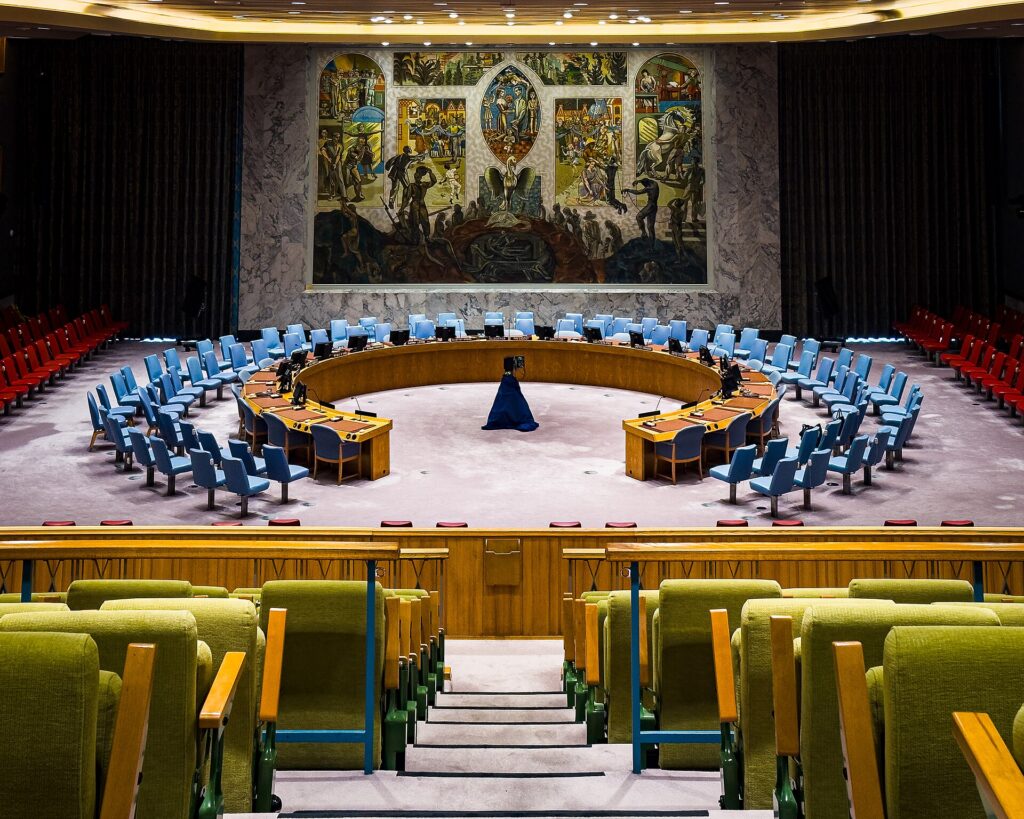

The United Nations Security Council is the body that, under the UN Charter, bears primary responsibility for maintaining international peace and security. It is made up of five permanent members and ten elected non-permanent members, and, except on procedural matters, no decision can be adopted if even one permanent member votes against it (per the Ministry of Foreign Affairs’ explanation, and Article 27 of the UN Charter). This is the so-called veto.
In Russia’s full-scale invasion of Ukraine, which began on February 24, 2022, the aggressor state itself was a permanent member holding this veto. Japan was elected a non-permanent member shortly afterward and served on the Council from January 2023 to December 2024. What could, and could not, the Security Council decide about Ukraine? This article follows the record chronologically, drawing on UN and Ministry of Foreign Affairs materials.
February 25, 2022: Russia Vetoes a Resolution Against Itself
According to UN News, on February 25, 2022 (New York time), the Security Council voted on a draft resolution calling on Russia to immediately halt its attack and withdraw all its forces. Of the 15 members, 11 voted in favor, China, India and the United Arab Emirates (UAE) abstained, and only Russia voted against. With a permanent member opposed, the draft resolution failed. UN News reports that the United States had taken part in drafting this resolution.
UN News reports that, at this meeting, Ukraine’s Ambassador to the UN, Sergiy Kyslytsya, pointed out that, under the rules of procedure, Russia’s ambassador should not have presided as chair of a meeting concerning his own country as agenda item.
Two days later, on February 27, the Security Council decided, 11 in favor, 1 against (Russia), 3 abstentions (China, India, UAE), to convene an emergency special session of the General Assembly, in which all 193 member states take part. According to UN News, because this was a procedural matter, the permanent members’ veto could not be used.
Using the Veto Means Explaining Yourself to the General Assembly
On April 26, 2022, the General Assembly adopted, without a vote (by consensus), a resolution providing that whenever a veto is cast in the Security Council, the General Assembly will automatically convene a meeting within ten working days. According to UN News, the draft resolution was submitted by Liechtenstein on behalf of 83 co-sponsoring countries. It does not restrict the veto itself, but a country that uses it must now answer for its reasons before all 193 members.
September 30, 2022: A Resolution on “Annexation” Also Vetoed
On September 30 of the same year, Russia unilaterally declared the “annexation” of four regions of Ukraine. According to UN News, that same day the Security Council voted on a draft resolution, put forward by the United States and Albania, that would have called this attempt a threat to international peace and security and demanded the immediate and unconditional reversal of the decision. Ten members voted in favor, Russia voted against, and Brazil, China, Gabon and India abstained. Russia’s veto meant this draft resolution, too, failed to pass. Under the April resolution, the General Assembly then had to convene a meeting on this veto.
| Date (New York time) | Vote in the Security Council | Result |
|---|---|---|
| February 25, 2022 | Draft resolution calling on Russia to halt its attack and withdraw | 11 in favor, 1 against (Russia), 3 abstentions (China, India, UAE). Failed due to Russia’s veto |
| February 27, 2022 | Convening an emergency special session of the UN General Assembly (procedural matter) | 11 in favor, 1 against (Russia), 3 abstentions. Adopted |
| September 30, 2022 | Draft resolution demanding the reversal of the attempted “annexation” of four regions | 10 in favor, 1 against (Russia), 4 abstentions (Brazil, China, Gabon, India). Failed due to Russia’s veto |
| February 24, 2025 | Draft resolution submitted by the United States (of three amendments by five European countries, two failed due to Russia’s veto) | 10 in favor, 5 abstentions. Adopted (Resolution 2774) |
The Day Japan Was Elected to the Council
Japan was elected a non-permanent member at the UN General Assembly on June 9, 2022 (New York time), winning 184 votes. This was the 12th time since Japan joined the UN in 1956, the most of any member state (Ministry of Foreign Affairs). Mozambique, Ecuador, Switzerland and Malta were also elected in the same election.
The Foreign Minister’s Statement issued the following day, in announcing the election, put it this way: “The Security Council currently finds itself unable to function effectively in the face of the aggression against Ukraine by Russia, a permanent member, and of North Korea’s nuclear and missile activities, which repeatedly violate Security Council resolutions and threaten the peace and security of our country, the region and the international community — a time that can be called a test.”
What Japan Said in the Security Council as a Member
On February 24, 2023, the first anniversary of the invasion, Foreign Minister Yoshimasa Hayashi (then in office) delivered a statement at the Security Council’s ministerial-level debate. According to the Ministry of Foreign Affairs’ published provisional Japanese translation, Minister Hayashi looked back at that day a year before: “Exactly one year ago today, in this very Security Council chamber, while discussion was under way on how to prevent aggression against Ukraine, Russia, a permanent member, launched its aggression against Ukraine before the eyes of every member of the Council.”
He went on to call this “an affront to this Council and to the United Nations as a whole,” and said Japan condemned Russia’s aggression “in the strongest possible terms.” He called on Russia to immediately halt the aggression, withdraw its forces and equipment from Ukraine, and respect Ukraine’s independence, sovereignty and territorial integrity within its internationally recognized borders, and also condemned attacks on critical infrastructure, Russia’s nuclear rhetoric, and the seizure and militarization of the Zaporizhzhia Nuclear Power Plant.
Near the end of Japan’s term, on November 18, 2024 (New York time), State Minister for Foreign Affairs Hisayuki Fujii attended a ministerial-level meeting on the situation in Ukraine convened by the United Kingdom, which held the Council presidency. According to the Ministry of Foreign Affairs, State Minister Fujii expressed solidarity with the people of Ukraine as the invasion reached its 1,000th day, and raised the deployment of North Korean soldiers to fight alongside Russia against Ukraine. The provisional Japanese translation of his statement includes the line, “Today’s Ukraine may be tomorrow’s East Asia,” and he said Japan condemned the military cooperation between Russia and North Korea “in the strongest possible terms.” Vice-Minister for Foreign Affairs Akahori also attended a Security Council meeting on September 24 of the same year.
The Ministry of Foreign Affairs’ Summary of the Term
The Foreign Minister’s Statement of January 10, 2025, issued after the term ended, summed up the two years as follows. On Ukraine, Japan strongly condemned Russia’s aggression through Security Council and General Assembly meetings, called for the immediate withdrawal of Russian forces, and urged a just and lasting peace for Ukraine based on the UN Charter. It also condemned North Korea’s dispatch of soldiers to Russia and Russia’s procurement and use of North Korean weapons and ammunition.
The same statement notes that Japan served as Council president for the month twice during its term. In January 2023 it hosted a ministerial-level open debate on the rule of law, and in March 2024 a ministerial-level meeting on nuclear disarmament and non-proliferation.
Three Years After the Invasion, the First Resolution
After Japan’s term ended, on February 24, 2025, the Security Council adopted a draft resolution submitted by the United States (Resolution 2774). UN News described this as the first Security Council resolution since the start of the full-scale invasion. Before the vote, five European countries — France, the United Kingdom, Denmark, Greece and Slovenia — put forward three amendments, none of which passed. According to the Security Council’s records, two of them received nine or more votes in favor but failed because of Russia’s veto, while the third received only six votes in favor and also failed. Russia, too, put forward two amendments of its own, neither of which received enough votes. The resolution was adopted in its original form, with 10 votes in favor, and the five European countries that had proposed amendments abstained.
According to UN News, Ukraine’s representative pointed out that the adopted resolution lacked language framing the war as aggression and lacked reference to the principles of the UN Charter. Russia’s representative described the adopted text as “a step in the right direction.”
Going by UN News’s own account, during the two years Japan sat on the Council, not a single Security Council resolution on Ukraine was adopted. What being a Council member allowed Japan to do was to call aggression aggression from the Council floor, and to leave that on the record. The flow of Russia’s veto and the General Assembly’s resolutions is also set out chronologically in A Timeline of Ukraine’s Independence and Russia’s Invasion.
Sources and article record
Sources and references
- 国連安全保障理事会(安保理)The United Nations Security Council — composition, the veto and Article 27 of the Charter, Japan's 12th term as a member 2023-24
Published by Ministry of Foreign Affairs of Japan (MOFA) · Checked: 2026-09-24 - Russia blocks Security Council action on Ukraineresult of the February 25, 2022 vote, Ambassador Kyslytsya's point about the chair
Published by UN News · Checked: 2026-09-24 - Security Council vote sets up emergency UN General Assembly session on Ukraine crisisFebruary 27, 2022, the veto could not be used on a procedural matter
Published by UN News · Checked: 2026-09-24 - UN General Assembly mandates meeting in wake of any Security Council vetoApril 26, 2022, adoption without a vote, 83 co-sponsoring countries
Published by UN News · Checked: 2026-09-24 - Russia vetoes Security Council resolution condemning attempted annexation of Ukraine regionsresult of the September 30, 2022 vote, sponsors
Published by UN News · Checked: 2026-09-24 - UN Assembly President calls for just and lasting peace in Ukraineadoption of the February 24, 2025 Security Council resolution, votes for and against, remarks by the Ukrainian and Russian representatives
Published by UN News · Checked: 2026-09-24 - 日本の国連安保理非常任理事国への選出について(外務大臣談話)On Japan's Election as a Non-Permanent Member of the UN Security Council — Foreign Minister's Statement, June 10, 2022 [Reiwa 4]. 184 votes, 12th term, countries elected
Published by Ministry of Foreign Affairs of Japan (MOFA) · Checked: 2026-09-24 - 林外務大臣のウクライナに関する国連総会緊急特別会合及び安保理閘僚級討論出席(令和5年2月22日~25日)Foreign Minister Hayashi Attends the UN General Assembly Emergency Special Session and the Security Council Ministerial-Level Debate on Ukraine, February 22-25, 2023 [Reiwa 5]
Published by Ministry of Foreign Affairs of Japan (MOFA) · Checked: 2026-09-24 - 安保理討論における林外務大臣ステートメントForeign Minister Hayashi's Statement in the Security Council Debate — provisional Japanese translation, February 24, 2023
Published by Ministry of Foreign Affairs of Japan (MOFA) · Checked: 2026-09-24 - 赤堀外務審議官のウクライナに関する国連安保理会合出席(令和6年9月25日)Vice-Minister Akahori Attends a UN Security Council Meeting on Ukraine, September 25, 2024 [Reiwa 6]
Published by Ministry of Foreign Affairs of Japan (MOFA) · Checked: 2026-09-24 - 藤井外務副大臣のウクライナ情勢に関する国連安保理閘僚級会合出席(令和6年11月19日)State Minister Fujii Attends a UN Security Council Ministerial-Level Meeting on the Situation in Ukraine, November 19, 2024 [Reiwa 6]
Published by Ministry of Foreign Affairs of Japan (MOFA) · Checked: 2026-09-24 - ウクライナ情勢に関する国連安保理ブリーフィング会合における藤井外務副大臣ステートメントState Minister Fujii's Statement at the UN Security Council Briefing on the Situation in Ukraine — provisional Japanese translation, November 18, 2024
Published by Ministry of Foreign Affairs of Japan (MOFA) · Checked: 2026-09-24 - 我が国の国連安保理非常任理事国任期総括(外務大臣談話)Japan's Summary of Its Term as a UN Security Council Non-Permanent Member — Foreign Minister's Statement, January 10, 2025 [Reiwa 7]
Published by Ministry of Foreign Affairs of Japan (MOFA) · Checked: 2026-09-24
If you find an error in this article, please tell us via Corrections. Once we have checked it, we will record in the article what was corrected and why.
Related articles
-
President Zelensky Was Set to Join Online — Then He Came to Hiroshima
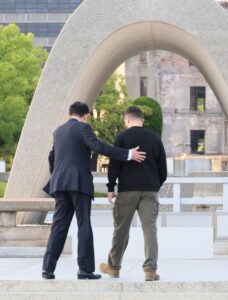
President Zelensky was originally scheduled to take part in the May 2023 G7 Hiroshima Summit online. After he strongly requested to attend in person, he discussed Ukraine with G7 leaders in Hiroshima on the final day, May 21, and laid flowers at the Memorial Cenotaph for the Atomic Bomb Victims. Drawing on the Ministry of Foreign Affairs' records, this article traces the two days' events and the content of the leaders' statements.
-
Kyiv Is 7 Hours Behind Japan, 6 in Summer: Ukraine’s Time and Daylight Saving
Under a 1996 Cabinet resolution, Ukraine moves its clocks on the last Sundays of March and October. The time difference with Japan is 7 hours in winter and 6 in summer. A law passed in 2024 to abolish daylight saving time has not been signed as of September 2026. This article also looks at how Ukraine broke from Moscow time in 1990, and at the clocks used in occupied territory.
-
How a 1932 Dam Drowned the Rapids and Turned the Dnipro into a Staircase
From Kyiv upstream to Kakhovka downstream, the Dnipro River was lined with six hydroelectric dams and reservoirs, one after another. The first dam, which started operating at Zaporizhzhia in 1932, submerged the river's rapids underwater. Drawing on encyclopedia entries and materials from the state hydropower company, this article sets out when and how large the six dams and reservoirs were built, the rapids that were lost, and the damage since 2022.