
Ukrainian Personal Names — Latin-Alphabet Spelling, Patronymics, and Forms of Address
The first stumbling block when working or reporting alongside people from Ukraine is the name itself. The Latin-alphabet spelling is fixed by the transliteration table of Cabinet of Ministers Resolution No. 55, but a person may use a different spelling of their own. This article works through giving priority to the person's own spelling, the patronymic, the forms a name takes when used to address someone, and what happens in input forms — a procedure for not getting a name wrong.
A name is the first piece of information you receive about someone, and it is also the first place mistakes happen. When Japanese speakers work or report alongside people from Ukraine, the places they trip up are fairly consistent: the Latin-alphabet spelling, a third name called a patronymic, the fact that a name changes shape when it is used to address someone, and names that do not fit into input forms. This article turns these four points into a checklist. First, one principle.
One: Give Priority to the Spelling the Person Actually Uses
This outlet’s writing standard states, for personal names, that “priority is given to the spelling the person actually uses officially or in their work.” For place names there is a table of current renderings, but no such table can be made for personal names. Even for the same Ukrainian name, how a given person writes it in the Latin alphabet differs from person to person.
The procedure is simple. Look for something the person has already written themselves — an email signature, a business card, the English page of their employer’s site, the author name on a paper — and if you cannot find one, ask. Do not fill it in by guessing. Everything below rests on this principle. Knowing the rules is not for correcting a person’s spelling; it is so that you do not panic when their spelling looks different from the rule.
Two: A Passport’s Latin-Alphabet Spelling Is Fixed by a Transliteration Table
Ukraine has an official transliteration table. It was approved by Cabinet of Ministers Resolution No. 55 of 27 January 2010, “On the Ordering of the Transliteration of the Ukrainian Alphabet into the Latin Script,” and, as of 23 September 2026, is in force (status “чинний,” in the version revised 12 January 2016). The State Migration Service (DMS) advises that the Latin-alphabet spelling of a name written on a passport application and on the passport itself follows this table.
| Letter | Latin rendering | Example given in the table of Resolution No. 55 |
|---|---|---|
| Г г | H h | Гадяч — Hadiach / Богдан — Bohdan |
| ג י | G g | גалаגан — Galagan / גорגани — Gorgany |
| Є є | Ye at the start of a word; ie elsewhere | Єнакієве — Yenakiieve / Гаєвич — Haievych |
| Ж ж | Zh zh | Житомир — Zhytomyr / Жанна — Zhanna |
| Ї ї | Yi at the start of a word; i elsewhere | Їжакевич — Yizhakevych / Кадиївка — Kadyivka |
| Й й | Y at the start of a word; i elsewhere | Йосипівка — Yosypivka / Стрий — Stryi |
| Х х | Kh kh | Харків — Kharkiv / Христина — Khrystyna |
| Щ щ | Shch shch | Щербухи — Shcherbukhy / Гоща — Hoshcha |
| Ю ю | Yu at the start of a word; iu elsewhere | Юрій — Yurii / Корюківка — Koriukivka |
| Я я | Ya at the start of a word; ia elsewhere | Яготин — Yahotyn / Костянтин — Kostiantyn |
Two notes are attached to the table. One: the letter sequence “зг” is written in Latin script as “zgh.” Two: the soft sign (ь) and the apostrophe (’) are not transliterated into the Latin alphabet. As a result of the latter, for example, Знам’янка becomes Znamianka. Since и is y and і is i, Київ is Kyiv and Харків is Kharkiv.
The Same Person Can Have Two Spellings
This is where it matters in practice. The State Migration Service advises that, on the person’s written request, the Latin-alphabet spelling can be recorded to match the spelling on a previously issued identity document. Also listed are matching the spelling on a birth or name-change certificate issued and authenticated by a foreign authority, or matching the spelling used for a child, parent, or (for a passport) spouse.
In a notice of 13 March 2023, the same service explains that a passport whose Latin-alphabet spelling of the name differs remains valid until its expiration date, and only becomes subject to invalidation or a change when the holder applies for issuance or exchange. One person can, lawfully, hold documents with different spellings at the same time. If a spelling reached by mechanically applying the transliteration table differs from the person’s own spelling, the person is not the one who is wrong. Use the person’s own spelling.
Three: The Patronymic (по батькові), a Third Name
Besides a surname and given name, there is a patronymic. Article 147, paragraph 1 of the Family Code of Ukraine (No. 2947-III) provides, “По батькові дитини визначається за іменем батька” (a child’s patronymic is determined from the father’s given name). Paragraph 2 of the same article provides that, where a child is born to a woman who is not married and paternity has not been established, it is determined from the given name of the man the mother has named as the father. As a statutory text, the Code consists of only these two paragraphs.
The form is built with a suffix. The table of variant forms in Ukrainian Orthography (2019 edition), §143, gives, for the masculine, given-name-and-patronymic pairs such as Ярослав Васильович (Олексійович, Ігорьович), and for the feminine Марія Василівна (Андріївна, Іллівна). The masculine suffix is -ович, the feminine -івна/ївна. That said, it is not a required field even as a matter of paperwork: the application items for birth registration in the Rules for State Registration of Civil Status Acts (Ministry of Justice Order No. 52/5 of 18 October 2000) are written as “прізвище; власне імя; по батькові (за наявності)” — surname, given name, and patronymic (if present).
In practice, it is enough to follow what the person has written. Note that this article could not confirm, from the public sources it opened this time, how often, at what generations, in what workplaces, or in what regions, given-name-plus-patronymic is used to address someone in everyday speech. It cannot state that “Ukrainians address each other this way.”
Four: A Name’s Form Changes When You Address Someone
Ukrainian has a vocative case (кличний відмінок). This is a case whose ending changes when addressing a person, and it changes given names too. The rules are set out in §74 (the first declension, to which many feminine names belong) and §87 (the second declension, to which many masculine names belong) of the 2019 edition of Ukrainian Orthography. In the forms printed there, Богдан becomes Богдане, Петро becomes Петре, Віталій becomes Віталію, Ігор becomes Ігорю, Марія becomes Маріє, and Соломія becomes Соломіє.
When addressing someone by given name and patronymic together, both go into the vocative. The note to §74 gives Оксано Іванівно, Маріє Василівно; the note to §87 gives Ярославе Андрійовичу.
However, not every name can be run through a single rule. The same §87 gives both Олеже and Олегу as vocative forms of Олег, and states that, when addressing someone with a surname, both друже Максименку and друже Максименко are possible. The Orthography itself allows for variation. When writing in Japanese — or English — the nominative form is sufficient. What this knowledge is for is so that, when a name’s form looks different at the top of a Ukrainian-language email, you do not mistake it for a different person.
Five: Do Not Swap a Russian Form and a Ukrainian Form Without the Person’s Consent
§144, item 1 of Ukrainian Orthography states that Belarusian and Russian names are traditionally not transliterated but written in their Ukrainian equivalent form, giving as examples Артем, Микола, Олександр, Семен, Віра, Катерина, and Світлана. The same item also notes that there are established, customary exceptions.
This is an orthographic rule about how to spell the names of Russian and Belarusian people within a Ukrainian-language text. It does not mean that a document a Ukrainian person has written for themselves may be rewritten, nor does it apply directly to us writing in Japanese or English. The practical conclusion is short. Use the form the person themselves uses. Do not change it from a Russian form to a Ukrainian one, or the reverse, without the person’s consent. Do not let the editorial side make the call to “correct” it.
Six: What to Confirm, and How, in Each Situation
- Email: copy the Latin-alphabet spelling in the signature exactly as it is. Do not retype it.
- Business cards, speaker introductions, credits: always confirm the katakana rendering with the person directly. Do not guess it from the Latin-alphabet spelling.
- Interviews: before publication, show the person the renderings that will appear in the article (katakana, Latin alphabet, title, affiliation) and get their confirmation.
- Forms of address: ask once what they would like to be called — given name only, given name plus patronymic, or a short form. Once you know, do not change it afterward.
These three questions are enough to ask: “How should we write your name in the article? Could you give us the Latin-alphabet spelling? We will draft a katakana rendering on our side and send it to you — could you check whether it’s correct?” “What would you prefer to be called normally? Is your given name alone all right?” “Could you also give us the Ukrainian spelling?”
The reason for asking the third question is that you cannot work backward from the Latin alphabet to the Ukrainian spelling. As the note to the transliteration table states, the soft sign and the apostrophe are not carried over into the Latin alphabet. If you will later need to cross-check against official sources, it is more reliable to get the original spelling up front.
Seven: What Actually Happens in Forms and CMSes
- Apostrophes: §7 of Ukrainian Orthography lists personal names containing an apostrophe, such as В’ячеслав, Дем’ян, Максим’юк, and Стеф’юк. An input field may reject the character, or auto-substitute a different one. Either way, you end up with a different string of characters.
- ג versus Г: in the transliteration table, ג is G and Г is H. §6 of the same book gives גалаגан, גудзь, and גонта as examples of Ukrainian surnames that use ג. Do not collapse one into the other.
- Compound surnames: Article 145 of the Family Code allows a child to be given a compound surname combining the two surnames of parents who have different surnames. Do not strip the hyphen.
- No field for the patronymic: before forcing it into a “middle name” field, ask the person how they would like it handled.
- Order of surname and given name: this varies by document. Label fields clearly as “surname” and “given name,” and if you are taking a single combined field, store it in the order the person wrote it.
- Women’s surnames: the note to §142 of the same book states that a woman’s surname ending in a consonant or in -o is not declined, giving Марії Сеник, Надії Балій as examples.
The design conclusion is one line. Make input fields UTF-8, pass apostrophes, hyphens, spaces, and Cyrillic characters through unchanged, and do not rewrite them through length limits or normalization. Store the string of characters the person wrote, exactly as they wrote it.
Finally: Do Not Infer From a Name
Do not infer a person’s ethnicity, religion, native language, or political stance from the form of their name, its Latin-alphabet spelling, or whether they have a patronymic. This outlet prohibits that. Neither “the name is in a Russian form, so they must be pro-Russian” nor “they used the Ukrainian form, so it must be some kind of statement” follows from a single piece of information like a name. The same goes for guessing pronunciation from appearance. Write a name as the person has written it, and read no more into it than that. If you want to know, ask the person. In the end, this article’s procedure always comes back to that one point.
Note that every Ukrainian-language spelling appearing in this article is an example printed in the cited public sources (the transliteration table of Cabinet of Ministers Resolution No. 55, the 2019 edition of Ukrainian Orthography, and statutory texts). None refers to any actual, identifiable individual.
Sources and article record
Sources and references
- On the Ordering of the Transliteration of the Ukrainian Alphabet into the Latin ScriptCabinet of Ministers Resolution No. 55 of 27 January 2010; status "чинний," version revised 12 January 2016; confirms the transliteration table's letter correspondences, examples, and 2 notes
Published by Cabinet of Ministers of Ukraine (version on zakon.rada.gov.ua) · Checked: 2026-09-23 - TABLE of transliteration of the Ukrainian alphabet into the Latin scriptthe same transliteration table, as posted on the Cabinet of Ministers' official site; cross-checked examples and notes via a separate route
Published by Cabinet of Ministers of Ukraine · Checked: 2026-09-23 - TransliterationFAQ; confirms that a passport's Latin-alphabet spelling follows Resolution No. 55, and that it can be matched to a previously issued document's spelling
Published by State Migration Service of Ukraine (DMS) · Checked: 2026-09-23 - In What Cases and How Can Transliteration Be Changed?confirms the conditions for changing the spelling on written request, and the supporting documents required
Published by State Migration Service of Ukraine · Checked: 2026-09-23 - Issuance of a Passport of a Citizen of Ukraine for Travel Abroadconfirms that the name entered on the application and on the passport follows the transliteration table of Resolution No. 55
Published by State Migration Service of Ukraine · Checked: 2026-09-23 - Passports With Differing Transliteration Will Be Recognized as Invalid Only After the Person Applies to Obtain or Exchange Documentsnotice of 13 March 2023; confirms that a passport with a different transliteration remains valid until its expiration date
Published by State Migration Service of Ukraine · Checked: 2026-09-23 - Ukrainian Orthography2019 edition; approved by Cabinet of Ministers Resolution No. 437 of 22 May 2019; confirms §6 on ג, §7 on the apostrophe, §74 on the vocative of the first declension, §87 on the vocative of the second declension, §§141–144 on the spelling and declension of personal names, and the table of given-name-and-patronymic variants in §143
Published by Ukrainian National Commission on Orthography (PDF posted on testportal.gov.ua) · Checked: 2026-09-23 - Family Code of Ukraine No. 2947-IIIconfirms Article 145 on determining the surname, Article 146 on determining the given name, Article 147 on determining the patronymic, and that Article 147 consists of 2 paragraphs
Published by Verkhovna Rada of Ukraine · Checked: 2026-09-23 - Rules for State Registration of Civil Status Acts in UkraineMinistry of Justice Order No. 52/5 of 18 October 2000; confirms that the birth-registration application items include "по батькові (за наявності)"
Published by Ministry of Justice of Ukraine · Checked: 2026-09-23
Corrections and updates
- Retitled the article (former title: Starting From "How Do You Write Your Name?" — Not Getting Names Wrong in Interviews and Work)
If you find an error in this article, please tell us via Corrections. Once we have checked it, we will record in the article what was corrected and why.
Related articles
-
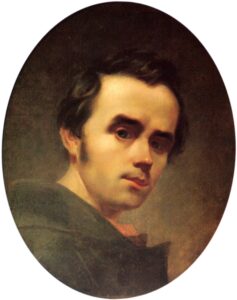
Taras Shevchenko: The Poet the Tsar Forbade to Write or Paint
Born a serf, Shevchenko had his freedom bought with the proceeds of a portrait raffle and was also a painter trained at the Academy of Arts. After his arrest in 1847, he spent 10 years under the Tsar's order forbidding him to write or paint — and still wrote poems and made pictures. This is the life of the poet who made Ukrainian the language of modern literature.
-
The Procedures and Contact Points for Importing Ukrainian Food Into Japan
Importing food from Ukraine to Japan runs through the Food Sanitation Act, the Plant Protection Act, the Act on Domestic Animal Infectious Diseases Control, the Food Labeling Act, the Customs Act, and the Foreign Exchange and Foreign Trade Act, each at a different checkpoint. This article lays out, statute by statute and against public materials, how to file an import notification, what became of the provisional limit set after the Chornobyl accident, why an EPA tariff rate is not available, and whether exporting-country certificates can be obtained in wartime. Item-specific requirements must be confirmed with the competent authorities.
-
Designated Activities (1 Year) or Complementary Protection? The Status-of-Residence Procedures for Evacuees
Ukrainians who entered Japan on Temporary Visitor status can change to the employable status “Designated Activities (1 year)” (特定活動(1年)), renewable for as long as the situation in Ukraine is recognized as not having improved. In December 2023, a system for recognizing persons eligible for complementary protection began; once recognized, a person is in principle granted “Long-Term Resident” status. This article walks through where to apply, what documents are needed, deadlines, and where to get advice, following the guidance of the Immigration Services Agency.