
Taras Shevchenko: The Poet the Tsar Forbade to Write or Paint
Born a serf, Shevchenko had his freedom bought with the proceeds of a portrait raffle and was also a painter trained at the Academy of Arts. After his arrest in 1847, he spent 10 years under the Tsar's order forbidding him to write or paint — and still wrote poems and made pictures. This is the life of the poet who made Ukrainian the language of modern literature.
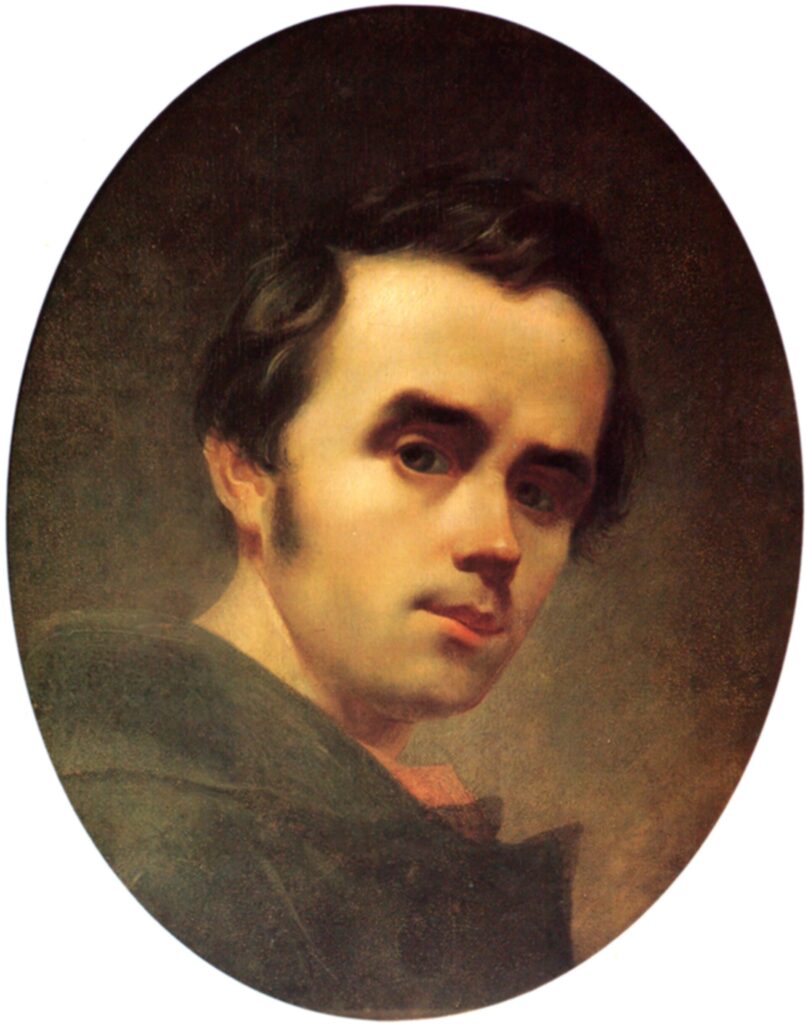


In 1847, Russian Tsar Nicholas I, in sentencing a poet to military service, forbade him to write or to paint. The poet’s name was Taras Shevchenko (Тарас Шевченко, 1814–1861), the man Ukraine calls its “national poet.”
Shevchenko was also a painter, trained at the Imperial Academy of Arts. He was born a serf, and it was a single portrait that led to his gaining freedom. This article traces his life through both his poetry and his art.
Japanese translations of Shevchenko’s poetry collections are introduced in Where to Start Reading Ukrainian Literature.
Freedom Bought Through a Portrait Raffle
According to the entry “Shevchenko, Taras” (revised 2004) in the Internet Encyclopedia of Ukraine (published by the University of Alberta’s Canadian Institute of Ukrainian Studies, CIUS; hereafter IEU), Shevchenko was born a serf on March 9, 1814, in the village of Moryntsi, Zvenyhorodka county, Kyiv province. Orphaned at 12, he learned to read and write from the village precentor, but was reportedly often beaten for “wasting time” drawing.
At 14, he became a houseboy on the estate of his landowner, Engelhardt, and was taken to Vilnius and then to St. Petersburg. Noticing his talent for drawing, the landowner sent him for a four-year apprenticeship under a painter. In his spare time, Shevchenko sketched the statues in a summer garden, where he met the Ukrainian-born painter Ivan Soshenko. Through this connection, he came to know the renowned painter and professor Karl Briullov.
According to the same entry, Briullov offered a portrait he had painted of the Russian poet Vasily Zhukovsky as the prize for a raffle, and the proceeds were used to buy Shevchenko’s freedom. This was on May 5, 1838.
Soon after, he entered the Imperial Academy of Arts and studied under Briullov. His 1838 narrative poem “Kateryna” was dedicated to Zhukovsky in commemoration of having bought his freedom.
The 1840 Kobzar, and Three Journeys Home
In 1840, his first poetry collection, Kobzar, was published in St. Petersburg. It was a book of 8 Romantic poems. The title’s kobzar refers to the often-blind minstrels who traveled about narrating epic tales while playing the bandura (kobza).
While living in St. Petersburg, Shevchenko traveled to Ukraine three times, in 1843, 1845, and 1846. IEU writes that these journeys deeply affected him. He visited siblings and relatives who were still serfs and witnessed tsarist oppression firsthand. After completing the Academy in 1845, he joined the Kyiv Archaeological Commission, sketching historical sites and buildings around the country and gathering folk material. In 1844, he produced Picturesque Ukraine, a set of etchings recording historical sites and cultural monuments of his homeland.
It was during this period that he wrote poems bitingly satirizing the tsarist regime, such as “The Dream” (1844) and “The Caucasus” (1845). He copied these into a handwritten album titled “Three Years,” placing “Testament” (Заповіт, 1845) at its end.
10 Years Forbidden to Write or Paint
In 1846, in Kyiv, Shevchenko joined the secret Brotherhood of Saints Cyril and Methodius. According to IEU, he was arrested with the other members on April 5, 1847, and received an especially severe punishment because anti-tsarist satirical poems were found in the confiscated “Three Years” album: military service as a private soldier in the Orenburg Special Corps, on the frontier near the Caspian Sea.
IEU writes that Nicholas I himself ordered that Shevchenko, while in exile, be forbidden to write, to sketch, or to paint. The Encyclopaedia Britannica likewise records that, in 1847, when the Brotherhood of Saints Cyril and Methodius was suppressed, he was sentenced to exile and military service for writing poetry satirizing tsarist Russia’s oppression of Ukraine, and was forbidden to write or paint.
Even so, he wrote and drew. According to IEU, he hid poems he wrote in secret in small handmade booklets (1847–50), and many of the pictures he drew during his exile depict the life of the Kazakh people. His skill as an artist got him included in the Aral Sea survey expedition (1848–49). Confinement grew stricter at Novopetrovske Fortress, where he was transferred in 1850 (now Fort-Shevchenko, Kazakhstan), but he still left more than 100 watercolors and pencil drawings, and wrote novellas in Russian.
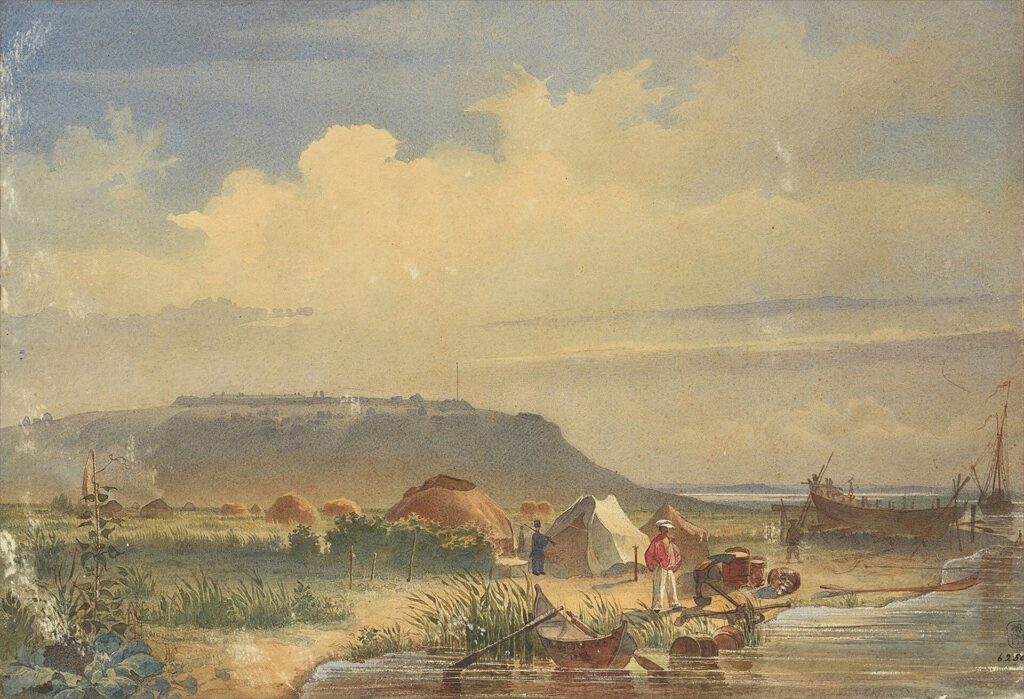


In the cycle of poems “In the Fortress,” written in the spring of 1847 amid his arrest and interrogation, there is this appeal to his comrades and countrymen. Translated from the English translation IEU quotes (translation by the editorial team).
Love Ukraine, / love her … in the hardest hour, / in the last, hardest moment, / pray to God for Ukraine.
From the cycle “In the Fortress” (1847). Retranslated from the English translation given in IEU’s “Shevchenko, Taras”
His exile was lifted in 1857, two years after the death of Nicholas I. Even so, he was not permitted to live in Ukraine; he spent six months in Nizhny Novgorod before moving to St. Petersburg. In 1859 he was allowed to visit relatives and friends in Ukraine, but was detained and interrogated there and sent back to St. Petersburg. He remained under police surveillance until his death.
| Date | Event |
|---|---|
| March 9, 1814 | Born a serf in the village of Moryntsi, Kyiv province |
| May 5, 1838 | Freedom bought with the proceeds of a raffle for Zhukovsky’s portrait |
| 1840 | Poetry collection Kobzar (8 poems) |
| 1843, 1845, 1846 | Three journeys to Ukraine |
| 1845 | Completed the Academy of Arts. Wrote “Testament” |
| April 5, 1847 | Arrested with the other members of the Brotherhood of Saints Cyril and Methodius |
| 1847–57 | In exile as a private soldier. Forbidden to write or paint |
| September 2, 1860 | Granted the title of Academician of Engraving by the Academy of Arts |
| March 10, 1861 | Died in St. Petersburg |
| May 22, 1861 | Reburied on Chernecha Hora near Kaniv |
Shevchenko the Painter
Shevchenko is known as a poet, but IEU also positions him as “an accomplished artist,” stating that 835 of his works survive and another 270 known works have been lost. More than 150 are portraits, of which 43 are self-portraits.
Though classically trained at the Academy, he did not confine himself to the standard subjects of history and mythology, and painted peasant life realistically. IEU writes that works such as Peasant Family (1844) express a covert critique of the absence of personal, social, and national freedom under the tsarist regime. He also recorded buildings such as the Vydubychi Monastery in Kyiv (1844), the Dormition Cathedral in Pereiaslav (1845), and the Pochaiv Monastery (1846).
He was also skilled in watercolor, aquatint, and etching, and on September 2, 1860, the Imperial Academy of Arts granted him the title of Academician of Engraving. In other words, the same country’s Academy of Arts that had forbidden him to write or paint recognized his skill as a printmaker three years after his exile ended.
Making Ukrainian a Literary Language
IEU writes that Kobzar opened a new era in the development of Ukrainian literature and the modern Ukrainian language, and that Shevchenko, through his own poetry, legitimized Ukrainian as a language of modern literature.
According to the same entry, he incorporated the style and meter of folk songs while transforming them in complex ways. Building on the verse structure of the kolomyika folk song (4+4+6 syllables), he abandoned regular stanzas and freely used mid-line breaks, enjambment, and alliteration. His skill at bringing folk elements into his poetry was such that some of his own poems, in turn, came to be sung as folk songs.
A well-known example is “Testament.” According to IEU, this poem has been translated into more than 60 languages, and after H. Hladky set it to music in the 1870s, it attained a status second only to the national anthem. Parts of Kobzar had been translated into more than 100 languages by the 1990s.
Shortly before his death, he self-published a Ukrainian-language primer (1861) for Sunday schools. Afterward, once the 1863 Valuev Circular and the 1876 Ems Ukase halted Ukrainian-language publishing within the Russian Empire, his works came to be published in Austrian-ruled Galicia and abroad. This background is also covered in our article on the Ems Ukase.
Resting on a Hill in Kaniv
Shevchenko died in St. Petersburg on March 10, 1861. He was buried there initially, but, in accordance with his own wish, his body was carried to Ukraine.
According to the Vernadsky National Library of Ukraine, the coffin was first brought to Kyiv and then, on May 20, 1861, carried by steamship to Kaniv. After lying for two days at the Dormition Cathedral, he was buried on May 22 on Chernecha Hora (“Monk’s Hill”). The first people’s museum on this hill, “Taras’s Room,” was built in 1884, and it became a state museum and reserve in August 1925. IEU writes that this grave has since become a “sacred” site visited by millions of Ukrainians.
Sources and article record
Sources and references
- Shevchenko, Taras生没・農奴としての生い立ち・1838年5月5日の買い取りとブリュロフの肖像画の抽選・1840年の『コブザール』・三度の帰郷・1847年4月5日の逮捕と流刑・描くことの禁止・アラル海調査・ノヴォペトロフスコエ要塞・1857年の解放・画業(835点・270点・150点超・43点)・1860年9月2日の称号・文学語への影響・コロミーカの韻律・「遺言」の翻訳数と作曲・初等読本・改葬。2004年改訂。執筆:Myroslav Antokhii, Daria Darewych, Marko Robert Stech, Danylo Husar Struk. Birth and death; his upbringing as a serf; the May 5, 1838 purchase of freedom and the raffle of Briullov's portrait; the 1840 Kobzar; the three journeys home; the April 5, 1847 arrest and exile; the ban on painting; the Aral Sea survey; Novopetrovske Fortress; the 1857 release; his artistic output (835 works, 270 works, more than 150, 43); the September 2, 1860 title; his influence on the literary language; kolomyika meter; the translation count and musical setting of "Testament"; the primer; the reburial. Revised 2004. Authors: Myroslav Antokhii, Daria Darewych, Marko Robert Stech, Danylo Husar Struk
Published by Internet Encyclopedia of Ukraine(CIUS) · Checked: 2026-09-24 - Taras Hryhorovych Shevchenko生没年月日の新旧暦・1838年の解放・1847年の流刑と兵役・書くことと描くことの禁止・1857年の解放. Old- and New-Style birth and death dates; the 1838 release; the 1847 exile and military service; the ban on writing and painting; the 1857 release
Published by Encyclopaedia Britannica · Checked: 2026-09-24 - Kobzarsコブザールの意味・シェウチェンコが詩集を『コブザール』と名づけたこと。2026年改訂。執筆:Victor Mishalow, Mykola Mushynka. The meaning of kobzar; Shevchenko naming his collection Kobzar. Revised 2026. Authors: Victor Mishalow, Mykola Mushynka
Published by Internet Encyclopedia of Ukraine(CIUS) · Checked: 2026-09-24 - День перепоховання Тараса Шевченка у Каневі1861年5月20日のカニウへの移送・5月22日の埋葬・1884年の博物館・1925年8月の博物館保護区. The May 20, 1861 transfer to Kaniv; the May 22 burial; the 1884 museum; the August 1925 museum reserve
Published by ウクライナ国立ヴェルナツキー図書館 · Checked: 2026-09-24
If you find an error in this article, please tell us via Corrections. Once we have checked it, we will record in the article what was corrected and why.