
60,000 Children Screened in Kyiv and Korosten: Japan’s Cooperation After Chornobyl
From 1991 to 1996, a Japanese foundation screened more than 60,000 children in Kyiv and Korosten. The Japanese government contributed to the fund covering the sarcophagus, and the year after the Fukushima accident it signed an agreement with Ukraine, switching to the side learning from Chornobyl's experience. This article traces developments, using published materials, through to the aftermath of a 2025 drone strike.

In May 1991, a Japanese private foundation began screening children in Kyiv, Ukraine, and in Korosten, Zhytomyr Oblast. Targeting children who were between 0 and 10 years old at the time of the Chornobyl Nuclear Power Plant accident on April 26, 1986, the screening involved thyroid ultrasound examinations, blood tests, and measurement of radiation levels in the body. According to the records of the Sasakawa Health Foundation (then the Sasakawa Memorial Health Cooperation Foundation), 30,814 people in Kyiv and 33,554 people in Korosten had been screened by 1996.
The course of the accident itself is covered in Half a Century of Postwar Ukraine. This article instead traces, in order, what the Japanese government and private sector have done with Ukraine since then, drawing on published materials from the foundation, the Ministry of Foreign Affairs (MOFA), the European Bank for Reconstruction and Development (EBRD), and the Ukrainian government.
1990: A Request from the Soviet Union
In a 2021 booklet the foundation published, From Chernobyl to Fukushima, Kinokuni Kenzo and Maki Koko describe the origin of the program as follows. In February 1990, when Sasakawa Yohei, then chairman of the Nippon Foundation, led an economic mission to the Soviet Union, the Soviet side made an informal request that private organizations provide medical cooperation for people affected by the accident. In response, the foundation launched a humanitarian aid effort.
The foundation had had no prior involvement in radiation medicine, and consulted Shigematsu Itsuzo, chairman of the Radiation Effects Research Foundation. In August of the same year, a team led by Shigematsu, including specialists from Hiroshima University and Nagasaki University, visited the affected areas. According to the booklet, the Soviet Ministry of Health designated five areas across Russia, Ukraine, and Belarus, and the foundation signed agreements directly with medical institutions in each area without going through the Ministry of Health. This, the booklet says, is why the screening could continue even after the Soviet Union dissolved in 1991 and the three countries became independent.
The screening vehicles carried a whole-body counter to measure radiation levels throughout the body, a blood analysis device, and thyroid ultrasound equipment. Training for local doctors, nurses, and technicians was led by, among others, Professor Yamashita Shunichi of Nagasaki University (title as of the time).
| Country | Screening center | Period | Children screened |
|---|---|---|---|
| Ukraine | Kyiv | 1991–1996 | 30,814 |
| Ukraine | Korosten (Zhytomyr Oblast) | 1991–1996 | 33,554 |
| Belarus | Gomel | 1991–1996 / 1998–2000 | 30,732 / 39,286 |
| Belarus | Mogilev | 1991–1996 | 29,212 |
| Russia | Klintsy (Bryansk Oblast) | 1991–1996 | 34,683 |
Over the five years of screening, childhood thyroid cancer was found most often in Gomel, Belarus, and screening continued there alone, with the program ending in March 2001. The foundation’s booklet puts the number of children screened at about 200,000, the number of Japanese specialists dispatched at a cumulative 450, and the number of medical workers trained in Japan and locally at a cumulative 230. Elsewhere in the same booklet, however, a different figure, 165,000, is also used.
The foundation later provided funding, together with the European Union (EU), to launch the “Chernobyl Tissue Bank” in 1998. This is a mechanism for storing thyroid cancer tissue removed during surgery under ethical procedures and providing it to researchers worldwide; according to the foundation’s booklet, in Ukraine the Institute of Endocrinology and Metabolism handles the ethical review for this.
Government Contributions: The Fund for the Sarcophagus, and a UN Fund
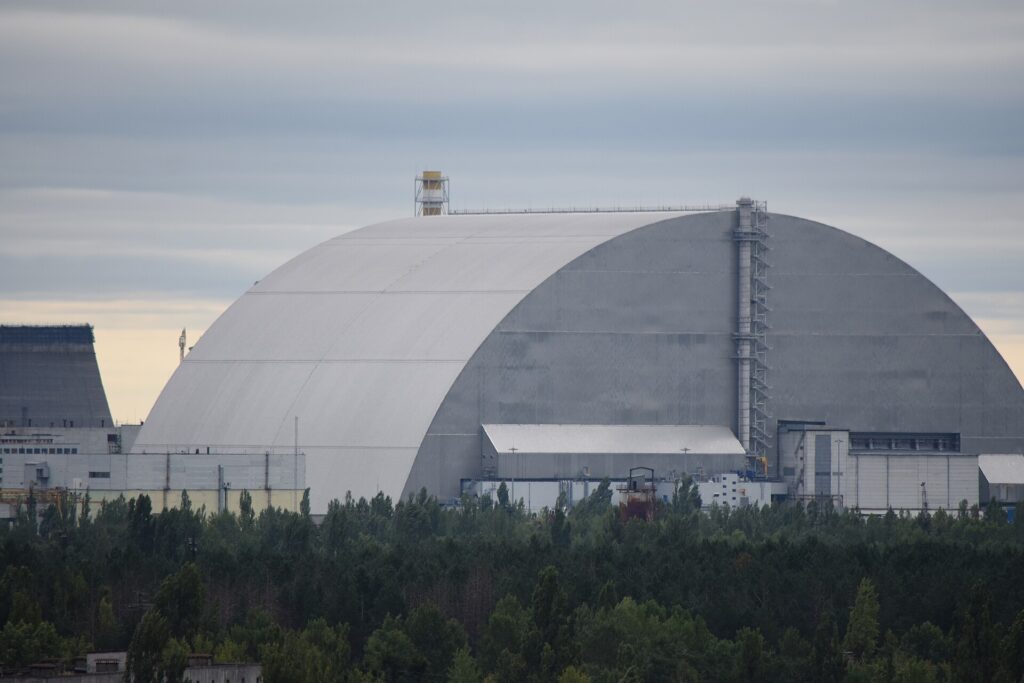
The largest-scale government cooperation has been contributions toward the structure covering the destroyed Reactor No. 4. According to the EBRD, the establishment of the Chornobyl Shelter Fund was announced at the 1997 G7 Denver Summit, and the EBRD set it up that same year. This fund supported construction of the New Safe Confinement (NSC), built to further cover the “sarcophagus” hastily constructed immediately after the accident. The NSC was moved into position in 2016 and became fully operational, being handed over to Ukraine, in 2019. By the end of 2023 the fund had received more than €1.6 billion from 45 contributors, and the EBRD lists Japan among them.
On the amount Japan has contributed, a speech by then State Secretary for Foreign Affairs Takahashi Chiaki, dated April 19, 2011 and posted by MOFA (in a provisional English translation), states that Japan has contributed a total of about €73 million to the Shelter Fund and the Nuclear Safety Account combined. The breakdown between the two funds, and any additional contributions made since 2011, cannot be determined from this speech.
Support for daily life in the affected areas was channeled through the UN Trust Fund for Human Security, which Japan took the lead in establishing at the United Nations. According to a MOFA announcement, on February 16, 2004, support of $1,214,249 was decided for a project the United Nations Development Programme (UNDP) was running in Ukraine’s affected areas. This project, aimed at helping residents become self-reliant by having local organizations handle the repair of schools and medical facilities, targeted about 20,000 people in 70 villages. On November 18, 2008, support of $2,610,478.20 (about ¥294.98 million) was decided for an information-provision project run in Ukraine, Belarus, and Russia by UNDP, the International Atomic Energy Agency (IAEA), the World Health Organization (WHO), and the United Nations Children’s Fund (UNICEF).
2011: The Roles Reverse
2011 marked 25 years since the accident. The joint statement from the Japan–Ukraine summit meeting of January 18 touched on the need to support recovery in the affected areas, and noted Japan’s intention to take part in an international conference to be held in Kyiv in April. In between, on March 11, the accident at Tokyo Electric Power Company’s Fukushima Daiichi Nuclear Power Plant occurred.
On April 19, State Secretary Takahashi, attending the Kyiv Summit, touched on Japan’s past contributions to Chornobyl at the start of his speech, then devoted most of it to explaining the Fukushima Daiichi accident.
The following year, on April 18, 2012, Foreign Minister Genba Koichiro and Ukraine’s Minister for Emergency Situations Viktor Baloha signed, in Tokyo, the “Agreement between the Government of Japan and the Government of Ukraine on Cooperation for Promoting Further Response to Nuclear Power Plant Accidents.” MOFA’s announcement states that this agreement allows “the knowledge Ukraine has gained from its response to the Chornobyl Nuclear Power Plant accident” to be put to use for recovery from the Fukushima Daiichi accident. The agreement was concluded in May 2012.
- Areas of cooperation: the effects of the accidents on people and the environment, the measures taken in response and their evaluation, and other areas the two governments agree on (Article 1)
- Methods of cooperation: exchange of information, exchange of experts such as researchers and engineers, and holding joint seminars and the like (Article 2)
- Establishing a joint committee, meeting in principle once a year, alternately in Japan and Ukraine (Article 3)
The agreement’s preamble states that “Japan can learn a great deal from the knowledge Ukraine has gained” from the Chornobyl accident — a reversal from the 1990s, when Japan sent screening vehicles to Ukraine, to Japan now being the one to learn. On December 15 of the same year, an agreement of the same name was signed with Belarus, in Koriyama.
What Was Discussed at the Joint Committee
According to MOFA, the first meeting of the Japan–Ukraine Joint Committee for Cooperation on Post-Accident Response was held in Tokyo on July 26, 2012. The Japanese side comprised about 30 people from MOFA, the Cabinet Office, the Ministry of Education, Culture, Sports, Science and Technology, the Ministry of Agriculture, Forestry and Fisheries, the Ministry of the Environment, the Ministry of Health, Labour and Welfare, and the University of Tokyo; the Ukrainian side comprised 8 people, including Volodymyr Kholosha, head of the State Agency of Ukraine on Exclusion Zone Management under the Ministry of Emergency Situations. The agenda covered the exclusion zone and protection of residents, decontamination, monitoring, risk management including radiation education and information-sharing with residents, and academic cooperation.
The second meeting was held in Kyiv on July 17, 2013, attended by 17 people from the Japanese side, including the Reconstruction Agency, Tokyo Electric Power Company, and Nagasaki University, and 23 from the Ukrainian side. Nuclear damage compensation was added to the agenda. Both countries welcomed a plan, being advanced by the University of Tokyo with Ukraine’s State Space Agency and others, to observe Fukushima and Chornobyl using multiple micro-satellites. Whether a third meeting or later meetings were held could not be confirmed for this article.
The February 2025 Attack and the 2026 Joint Statement
According to the EBRD, on February 14, 2025, a Russian drone struck the NSC, opening a 15-square-meter hole in its inner and outer cladding and damaging about 200 square meters of paneling. Repairs are estimated to require at least €500 million. The International Chornobyl Cooperation Account (ICCA), set up by the EBRD in 2020, is raising funds for the repair, but Japan’s name does not appear among the current contributors listed on the EBRD’s page (the European Commission, France, Norway, the UK, Canada, Germany, and others; confirmed September 2026).
On April 26, 2026, 40 years after the accident, an international conference on Chornobyl held in Kyiv issued a joint statement supporting the repair of the NSC and condemning Russian attacks on nuclear-related facilities. The list of participating countries published by Ukraine’s Ministry of Energy includes Japan among 26 countries. The statement says participants will continue to consider the possibility of financial contributions, but whether Japan indicated a contribution amount cannot be determined from the statement.
From the 1991 screening centers, to the 2012 agreement, to the 2026 joint statement: cooperation between Japan and Ukraine has continued, with the two sides trading places between supporting and learning. And the aftermath of the accident now carries new problems brought on by war.
Sources and article record
Sources and references
- チェルノブイリ医療協力事業―ウクライナでの活動キーウ30,814人・コロステン33,554人、1991〜1996年
Published by 笠川保健財団 · Checked: 2026-09-23 - チェルノブイリ医療協力事業―ベラルーシでの活動ゴメリ・モギリョフの児童数と期間
Published by 笠川保健財団 · Checked: 2026-09-23 - チェルノブイリ医療協力事業―ロシアでの活動クリンツィ34,683人
Published by 笠川保健財団 · Checked: 2026-09-23 - チェルノブイリから福島へ2021年。事業の経緯・検診車の装備・約20万人・延べ450人と230人・1998年の甲状腺組織バンク
Published by 笠川保健財団 · Checked: 2026-09-23 - Chornobyl Shelter Fund1997年の設立・G7デンバー・拠出者一覧・2023年末で16億ユーロ超・45拠出者
Published by European Bank for Reconstruction and Development · Checked: 2026-09-23 - Making Chornobyl safe2025年2月14日の攻撃・15平方メートルの穴と約200平方メートルの損傷・修復費5億ユーロ以上・NSCの2016年移動と2019年引き渡し・ICCAの拠出者
Published by European Bank for Reconstruction and Development · Checked: 2026-09-23 - Speech by Mr. Chiaki Takahashi, State Secretary for Foreign Affairs of Japan, at Kyiv Summit on Safe and Innovative Use of Nuclear Energy, 19 April 2011約7,300万ユーロ
Published by 外務省 · Checked: 2026-09-23 - 人間の安全保障基金によるウクライナにおけるチェルノブイリ被災民に対する支援について平成16年2月16日
Published by 外務省 · Checked: 2026-09-23 - 人間の安全保障基金「チェルノブイリ事故被災地域におけるICRINを通じたコミュニティと住民の人間の安全保障促進」への支援について平成20年11月18日
Published by 外務省 · Checked: 2026-09-23 - 日本・ウクライナ・グローバル・パートナーシップに関する共同声明仮訳、2011年1月18日
Published by 外務省 · Checked: 2026-09-23 - 「原子力発電所における事故へのその後の対応を推進するための協力に関する日本国政府とウクライナ政府との間の協定」の署名平成24年4月18日
Published by 外務省 · Checked: 2026-09-23 - 原子力発電所における事故へのその後の対応を推進するための協力に関する日本国政府とウクライナ政府との間の協定条約本文
Published by 外務省 · Checked: 2026-09-23 - 同名の日本国政府とベラルーシ共和国政府との間の協定2012年12月15日、郡山で作成
Published by 外務省 · Checked: 2026-09-23 - 第1回日ウクライナ原発事故後協力合同委員会の開催平成24年7月26日
Published by 外務省 · Checked: 2026-09-23 - 第2回日ウクライナ原発事故後協力合同委員会の開催平成25年7月18日
Published by 外務省 · Checked: 2026-09-23 - Joint Statement of the International Conference on Chornobyl, Kyiv, 26 April 2026/Countries joining the Joint Statement on Chornobyl on April 26, 2026
Published by ウクライナエネルギー省 · Checked: 2026-09-23
If you find an error in this article, please tell us via Corrections. Once we have checked it, we will record in the article what was corrected and why.
Related articles
-
Minpaku’s Ukrainian Embroidery and Clothing Arrived During the Soviet Era
A search for "Ukraine" in the specimen catalog of the National Museum of Ethnology (Minpaku) in Osaka turns up 120 items — embroidered shirts, sashes, towels, and aprons. The region field for 119 of them reads "USSR, Ukraine," and 104 were acquired together in fiscal 1981. This article traces the database's records, including a bandura and a medal related to Chornobyl that fall outside the catalog search itself.
-
What Happened in Kakhovka the Day the Russian-Controlled Dam Broke
In the early hours of June 6, 2023, the dam of the Kakhovka Hydroelectric Power Plant on the Dnipro River—under Russian military control since February 2022—collapsed in an explosion. Downstream, at least 80 settlements were flooded; upstream, the reservoir that was the drinking-water source for more than 700,000 people began to dry up. The United Nations and the Ukrainian government estimate the damage and losses at nearly $14 billion.
-
Ukrainian Sign Language Is a “Language” in Law — But Has No Law of Its Own Yet
The 2019 State Language Law defines Ukrainian Sign Language as a natural language with its own vocabulary and grammar, and enshrines the right of anyone to use it, learn it, and be educated in it. Yet the dedicated law meant to define the status of sign language has not been enacted, and a July 2026 survey found sign-language interpretation on only 2 of 36 national television channels.