
What Happened in Kakhovka the Day the Russian-Controlled Dam Broke
In the early hours of June 6, 2023, the dam of the Kakhovka Hydroelectric Power Plant on the Dnipro River—under Russian military control since February 2022—collapsed in an explosion. Downstream, at least 80 settlements were flooded; upstream, the reservoir that was the drinking-water source for more than 700,000 people began to dry up. The United Nations and the Ukrainian government estimate the damage and losses at nearly $14 billion.
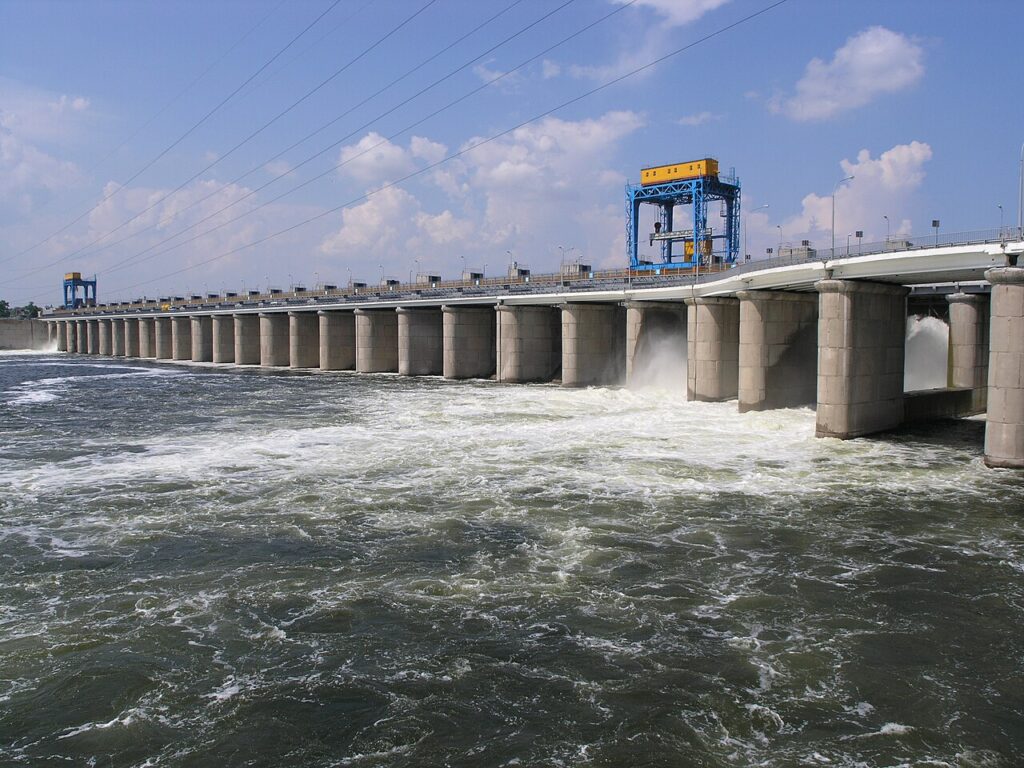


At around 3:00 a.m. on June 6, 2023, an explosion struck the dam of the Kakhovka Hydroelectric Power Station (Kakhovska HES) on the lower Dnipro River, and the concrete dam body collapsed. This is what the assessment report of the United Nations Environment Programme (UNEP) records. According to a report by the Office of the UN High Commissioner for Human Rights (OHCHR), the dam had been under Russian military control since February 24, 2022.
The collapse of the dam released 18 cubic kilometers of water over three to four days, flooding at least 80 settlements downstream. Upstream, the Kakhovka Reservoir—the source of drinking water for more than 700,000 people in the south—began to dry up. UN Under-Secretary-General for Humanitarian Affairs Martin Griffiths told the Security Council on the same day that this was one of the most serious cases of damage to civilian infrastructure since Russia’s full-scale invasion of Ukraine began.
The Dam That Was Under Russian Control
The dam and power plant are located in Nova Kakhovka, Kherson Oblast; the IAEA and others also call it the “Nova Kakhovka Dam.” According to the UNEP report, Russian forces took control of the dam in February 2022 and resumed water supply to Crimea, which had been halted since 2014. In November 2022 the dam’s gates were opened, and the reservoir’s water level fell to 14 meters, the lowest in 30 years. From February 2023 the water level rose again, and just before the collapse it reached 17.5 meters, the highest in 30 years, with water overflowing the top of the dam.
On the day of the collapse (in the afternoon, New York time), the UN Security Council held an emergency meeting at Ukraine’s request. Ukraine’s ambassador to the UN said Russia had controlled the entire dam and power plant for more than a year, that destroying it by shelling from outside was physically impossible, and that Russian occupiers had planted explosives and detonated them. Russia’s ambassador to the UN claimed that Ukraine had destroyed the dam. The UN reports cited above record that it was Russian forces who controlled the dam.
On June 6, 2024, Ukraine’s Office of the Prosecutor General announced that it had notified a Russian army colonel general, a former commander of the “Dnipro” troop grouping, of suspicion of violating the laws and customs of war (Article 438, Part 2 of the Criminal Code). According to the investigation, this person commanded engineering units and the 205th Separate Motorized Rifle Brigade to prepare the destruction of the dam, and had the detonation carried out on the night of June 6. A notice of suspicion is not a finding of guilt.
The Independent International Commission of Inquiry on Ukraine, established by the UN Human Rights Council, wrote in its October 2023 report to the UN General Assembly that it was investigating the cause of the dam’s collapse. It stated that, at that time, Russia had not responded to the Commission’s questions about the damage in the occupied areas.
What Happened Downstream
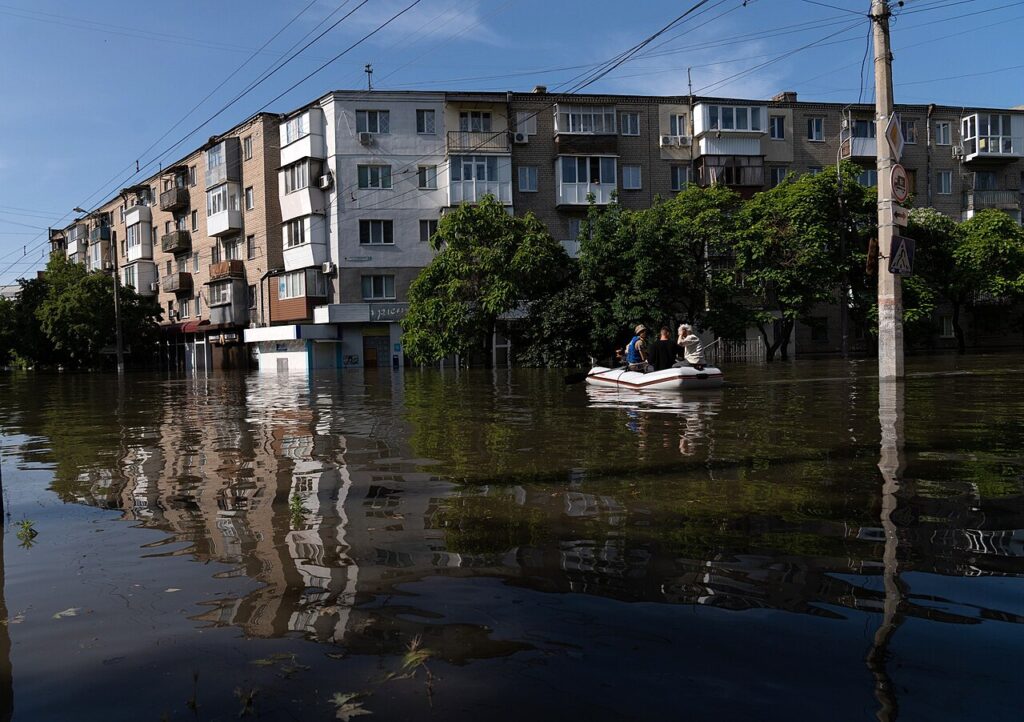
According to the Post-Disaster Needs Assessment (PDNA) compiled by the United Nations and the Ukrainian government in October 2023, 620 square kilometers were flooded across the four oblasts of Kherson, Mykolaiv, Dnipropetrovsk and Zaporizhzhia, directly affecting 100,000 people. More than 37,000 homes, 37 educational facilities and an estimated 11 medical facilities were damaged, and drinking water and sewage services were cut off for one million people.
.jpg)
On June 7, Ukraine’s Office of the Prosecutor General announced that the water level of the lower Dnipro River had risen by up to 12 meters and that 26 settlements on the right bank of Kherson Oblast, recaptured by Ukraine, had entered the flood zone. More than 42,000 people lived in this area. It said there was no accurate information on the occupied left bank.
UN humanitarian aid could not reach left-bank towns such as Oleshky. The UN Office for the Coordination of Humanitarian Affairs (OCHA) reported that it had not received security guarantees from Russia.
The number of people who died differs depending on which body reported it and when.
| Body that reported or recorded | Point in time | Details |
|---|---|---|
| Ukraine’s Ministry of Internal Affairs (cited in the OHCHR report) | Report through end of July 2023 | 34 civilians killed in areas recaptured by Ukraine (32 in Kherson Oblast, 2 in Mykolaiv Oblast) |
| Occupation authorities in Kherson Oblast (cited in the OHCHR report) | Same as above | 55 civilians killed in occupied areas |
| OHCHR | Same as above | Confirmed the identities of 15 civilians who died in occupied areas including Oleshky and Hola Prystan |
| UN Independent International Commission of Inquiry (based on information from the Ukrainian government) | October 2023 report | 33 dead, 28 injured, more than 40 missing |
| Ukraine’s Office of the Prosecutor General | June 6, 2024 | At least 35 civilians dead, 24 missing. 66 settlements flooded in Kherson and Mykolaiv oblasts |
What Happened Upstream
The Kakhovka Reservoir lost nearly 75% of its water volume within about three weeks of the collapse. According to OCHA, water supply was cut for nearly three weeks in the Pokrovske, Nikopol and Marhanets hromadas (basic municipalities) of Dnipropetrovsk Oblast, and an estimated 210,000 people in that oblast alone urgently needed drinking water. The only pumping station that supplied drinking water to the city of Mykolaiv was also flooded, in Kherson Oblast.
Water from the reservoir was also used to irrigate large areas of farmland in the south. OCHA reported that irrigation facilities suffered major damage and that agriculture in Dnipropetrovsk, Kherson and Zaporizhzhia oblasts would be affected for a long time.
The Zaporizhzhia Nuclear Power Plant also drew its cooling water from this reservoir. IAEA Director General Grossi explained on the day of the collapse that the reservoir’s water level had fallen 83 centimeters, from 10:00 a.m. to 8:00 p.m., to 15.44 meters. Below 12.7 meters, the plant would no longer be able to pump water from the reservoir. Even so, he said, the large cooling pond next to the plant was full, and since all six reactors were shut down, there were months’ worth of cooling water, so there was no short-term nuclear-safety danger. On the nuclear plant, see also Ukraine’s 15 reactors, six of them at an occupied plant.
Damage to Nature and the Economy
According to the PDNA cited by OHCHR, the flooding destroyed more than 11,000 hectares of forest and damaged five Ramsar-listed wetlands and 12 sites in Europe’s Emerald Network. UNEP’s initial estimate put the value of ecosystem services generated by the 333,000 hectares of damaged protected areas at $8.5 billion (in 2023 real dollars).
The flooded areas included chemical plants, sewage facilities and cemeteries. OCHA reported that landmines and explosives swept away by the floodwaters were endangering residents.
The PDNA estimated direct damage from the dam’s destruction at $2.79 billion and losses at more than $11 billion, for a combined total of nearly $14 billion. It put the amount needed for recovery and reconstruction at $5.04 billion, of which $1.82 billion would be needed in the short term, in 2023–2024. Estimates of the damage and reconstruction cost of the war as a whole are summarized in Five rounds of reconstruction-cost estimates, from $348.5 billion to $587.7 billion.
Investigation as “Ecocide”
Ukraine’s Office of the Prosecutor General is investigating the destruction of the dam on suspicion of ecocide (Article 441 of the Criminal Code) and violation of the laws and customs of war (Article 438, Part 1). A joint investigative team from the Security Service of Ukraine (SBU) and the National Police is handling the investigation, directed by the environmental prosecution unit of the Office of the Prosecutor General.
Article 441 of the Criminal Code punishes mass destruction of flora or fauna, poisoning of the atmosphere or water resources, and other acts that could cause an ecological catastrophe, with imprisonment of 8 to 15 years. The Office of the Prosecutor General has taken the position that destroying a “work containing dangerous forces” such as a dam is a war crime under Article 56 of Additional Protocol I to the Geneva Conventions.
In its June 2024 announcement, the Office of the Prosecutor General said that expert assessments to confirm the environmental impact were continuing, and that it would decide whether to prosecute for ecocide once it had their conclusions. On June 6, 2023, the day of the collapse, the Prosecutor General also sent information about the case to the Prosecutor of the International Criminal Court (ICC).
The sequence of events since the full-scale invasion can be checked in A Timeline of Ukraine’s Independence and Russia’s Aggression, 1991–2026.
Sources and article record
Sources and references
- Rapid Environmental Assessment of Kakhovka Dam Breach, Ukraine, 2023Russian military control from February 2022; the November 2022 opening of the floodgates and water level of 14m; 17.5m just before the collapse; the explosion at around 3:00 a.m. on June 6; protected areas of 333,000 ha and $8.5 billion
Published by UNEP · Checked: 2026-09-24 - Report on the Human Rights Situation in Ukraine, 1 February – 31 July 2023paragraphs 36–37 and notes; control since February 24, 2022; 18 km³; at least 80 settlements; identities confirmed for 15 people; Ukraine's Ministry of Internal Affairs 34 / occupation authorities 55; PDNA figures of 37,000 homes, 11,000 ha of forest, 5 Ramsar sites, 12 Emerald Network sites
Published by OHCHR · Checked: 2026-09-24 - Kakhovka Dam destruction inflicted US$14 billion damage and loss on Ukraine: Government of Ukraine–UN reportOctober 17, 2023; 620 km², 100,000 people; damage $2.79 billion, losses over $11 billion, needs $5.04 billion, short-term $1.82 billion
Published by United Nations in Ukraine · Checked: 2026-09-24 - Ukraine: Humanitarian Impact and Response Flash Update #2: Destruction of Kakhovka DamJune 7, 2023; drinking-water source for 700,000 people, the Mykolaiv pumping station, irrigation, hazardous facilities
Published by UN OCHA (ReliefWeb) · Checked: 2026-09-24 - Ukraine: Humanitarian Impact and Response Flash Update #6: Destruction of Kakhovka DamJune 14, 2023; no Russian security guarantees for aid to left-bank areas such as Oleshky
Published by UN OCHA (ReliefWeb) · Checked: 2026-09-24 - Ukraine: Humanitarian Impact and Response Flash Update #9: Destruction of Kakhovka DamJune 27, 2023; loss of nearly 75% of the reservoir, 210,000 people in Dnipropetrovsk Oblast
Published by UN OCHA (ReliefWeb) · Checked: 2026-09-24 - Update 161 – IAEA Director General Statement on Situation in UkraineJune 6, 2023; water level of 15.44m, the 12.7m threshold, the cooling pond
Published by IAEA · Checked: 2026-09-24 - Security Council, 9340th meeting, S/PV.9340June 6, 2023; statements by the Ukrainian and Russian representatives
Published by United Nations · Checked: 2026-09-24 - Report of the Independent International Commission of Inquiry on Ukraine, A/78/540October 19, 2023; paragraph 47
Published by United Nations General Assembly · Checked: 2026-09-24 - Руйнування дамби Каховської ГЕС: інформація станом на 7 червняJune 7, 2023; Articles 441 and 438(1), water level of 12m, 26 settlements / 42,000 people, Article 56 of Additional Protocol I
Published by Офіс Генерального прокурора · Checked: 2026-09-24 - Руйнування дамби Каховської ГЕС - повідомлено про підозру генерал-полковнику зс рфJune 6, 2024
Published by Офіс Генерального прокурора · Checked: 2026-09-24 - Андрій Костін підписав документ, яким МКС надається вся необхідна інформація стосовно підриву окупантами дамби Каховської ГЕСJune 6, 2023
Published by Офіс Генерального прокурора · Checked: 2026-09-24 - Кримінальний кодекс України № 2341-IIIArticles 438 and 441, version as of September 24, 2026
Published by Верховна Рада України (zakon.rada.gov.ua) · Checked: 2026-09-24
If you find an error in this article, please tell us via Corrections. Once we have checked it, we will record in the article what was corrected and why.