
October 1932: A Kharkiv Institute Splits the Lithium Nucleus
The Kharkiv Institute of Physics and Technology was founded in 1928, and on October 10, 1932, it succeeded in splitting a lithium nucleus using accelerated protons. This article traces its relationship to the Cambridge experiment of the same year, Landau's theoretical division, the arrests of the 1930s, and the damage to its "Neutron Source" facility since 2022, drawing on encyclopedias and IAEA statements.
On October 10, 1932, a Kharkiv institute succeeded in an experiment that split an atomic nucleus by firing accelerated protons at lithium. The lithium nucleus became a helium nucleus. The institute was then named the “Ukrainian Institute of Physics and Technology” (UFTI); it is today’s National Science Center “Kharkiv Institute of Physics and Technology” (NSC KIPT).
The Institute of History of Ukraine at the National Academy of Sciences of Ukraine’s Encyclopedia of the History of Ukraine (2021 supplementary volume) and the institute’s own history both cite this date, calling it a “remarkable achievement” just four years after its founding. However, an institute in England had succeeded in the same experiment first, earlier the same year.
1928: Researchers Who Came from Leningrad
According to the Internet Encyclopedia of Ukraine (IEU; Canadian Institute of Ukrainian Studies, CIUS, at the University of Alberta; revised 2022), the institute was created in Kharkiv in 1928 on the initiative of Abram Ioffe, who then headed the Physico-Technical Institute in Leningrad. The institute’s own history states that its purpose was to advance nuclear physics and solid-state physics, then at the cutting edge.
According to the IEU, its initial core was more than 20 researchers who moved from Leningrad, including Ivan Obreimov, Oleksandr Leipunsky, Kyrylo Synelnykov (born in Pavlohrad), and Dmytro Ivanenko (born in Poltava). In 1931 the physicist Alexander Weissberg-Cybulski also joined from Vienna. The first director was Obreimov (1928–32). Kharkiv was the capital of Soviet Ukraine during this period (see our article on Kharkiv as the capital).
The October 1932 Experiment and Four Researchers
The IEU’s biographical entries each describe the 1932 experiment this way: four researchers — Synelnykov, Heorhii Latyshev, Leipunsky, and Anton Walter — used accelerated protons to convert a stable nucleus (lithium) into another nucleus (helium), the first time this had been achieved in the Soviet Union. The high-voltage apparatus for the experiment was also, according to the IEU, built at the institute as the first of its kind in the Soviet Union.
| Name | Dates | Key points of the career, per the IEU |
|---|---|---|
| Kyrylo Synelnykov (Кирило Синельников) | 1901–1966 | Born in Pavlohrad. Studied under Rutherford at Cambridge, 1928–30. Joined the institute in 1930. Director from 1944 |
| Oleksandr Leipunsky (Олександр Лейпунський) | 1903–1972 | Worked at the institute 1929–41, also serving as director. In 1934, at Cambridge, obtained the first experimental evidence for the existence of the neutrino |
| Anton Walter (Антон Вальтер) | 1905–1965 | Joined the institute in 1930. Became a leading figure in particle accelerator design. Professor at Kharkiv University from 1937 |
| Heorhii Latyshev (Георгій Латишев) | 1907–1973 | Worked at the institute 1930–41. In 1958, organized the Institute of Nuclear Physics of the Kazakh Academy of Sciences |
“First in the Soviet Union” and “First in the World”
Splitting a lithium nucleus with accelerated protons had already been done in England, earlier the same year, 1932. John Cockcroft and Ernest Walton, at the Cavendish Laboratory in Cambridge, published a short report titled “Disintegration of Lithium by Swift Protons” in the British scientific journal Nature, in its issue of April 30, 1932 (the report itself is dated April 16).
The IEU’s entry on the institute states this relationship clearly: the British scientists were the first in the world, in 1932, to split a lithium nucleus with artificially accelerated protons, and the physicists at the Kharkiv institute were the first in the Soviet Union to reproduce this experiment. The entry on Synelnykov likewise states that it came “just a few months after” the world’s first experiment at Cambridge. When introducing the Kharkiv experiment, “first in the Soviet Union” is the phrasing consistent with the encyclopedias.
Landau’s Theoretical Division (1932–37)
According to the IEU, Lev Landau led the institute’s theoretical physics division from 1932 to 1937, and from 1935 to 1937 also held a chair in general physics at Kharkiv University (see our article on Kharkiv University). The IEU calls Landau’s school of theoretical physics in Kharkiv “the center of Soviet physics research” at the time, and cites work produced there such as the theories of diamagnetism and antiferromagnetism. Landau received the Nobel Prize in Physics in 1962, for his theory of superfluidity.
At Landau’s invitation, the Danish physicist Niels Bohr visited the institute in 1934 (IEU). The IEU also counts among the institute’s achievements the production of liquid hydrogen (1931) and liquid helium (1932), and, in 1938, the Soviet Union’s first three-dimensional radar (a device measuring position in three coordinates). According to the institute’s own history, a traveling session of the Soviet Academy of Sciences was held there in 1935, at which the physicist Sergei Vavilov stated that “the scientists of this institute account for more than a quarter of Soviet physics.”
The Arrests of 1935–38
According to the IEU, repression under the Stalinist system, from 1935 to 1938, badly depleted the institute’s staff. Sixteen staff members were arrested, of whom eight were shot. One of them was Lev Shubnikov, a pioneer of low-temperature physics who was also a professor at Kharkiv University; he was executed in 1937. All foreigners working at the institute were forced to leave the Soviet Union. The Encyclopedia of the History of Ukraine gives the same figures: 16 arrests and 8 shot. Landau moved to Moscow in 1937 and was imprisoned there in 1938–39 (IEU).
Changes in Name and Role
| Year | Event |
|---|---|
| 1928 | Founded as the Ukrainian Institute of Physics and Technology (UFTI) |
| October 10, 1932 | The lithium-splitting experiment |
| 1938 | Renamed the Kharkiv Institute of Physics and Technology (KhFTI) |
| 1946 | A secret “Laboratory No. 1” of the Soviet nuclear program is created, built on the institute |
| 1965 | Designs a 2-gigaelectronvolt linear electron accelerator |
| 1993 | Granted, by presidential decree, the status of Ukraine’s first “National Science Center” (its current name) |
| 2004 | Joins the Nuclear Physics and Energy Division of the National Academy of Sciences of Ukraine |
According to the IEU, from the 1950s the focus of research shifted from nuclear physics toward reactor materials, plasma physics, and controlled nuclear fusion. Since independence, the institute has carried out a state research program supporting the scientific basis for nuclear power plant safety, and it is subject to the safeguards of the International Atomic Energy Agency (IAEA) — the system for confirming that nuclear material is not being diverted to weapons. The IEU writes that, following Ukraine’s 2010 decision to give up its highly enriched uranium, the institute sent its stock of highly enriched uranium to Russia for processing, with the United States supplying low-enriched uranium for research in its place.
The “Neutron Source” Facility and Damage Since 2022
On the institute’s grounds is a facility called the “Neutron Source” (Джерело нейтронів). According to the Encyclopedia of the History of Ukraine, it was built jointly with researchers from Argonne National Laboratory in the United States, as well as from Germany, China, the United Kingdom, Switzerland, and France. According to the IAEA, it is a “subcritical” facility, one in which the fission chain reaction cannot sustain itself, and it has been used for research and development and for producing radioisotopes for medical and industrial use.
According to the IAEA, the facility was placed in a state deeply subcritical on February 24, 2022, the day Russia’s full-scale invasion began, and it is said to hold only a small amount of radioactive material. A report by the IAEA Director General dated September 9, 2022, states that although the facility had come under repeated shelling, no radiological impact had occurred and containment of radioactive material had not been lost. The IEU likewise writes that in March 2022 the institute’s facilities were repeatedly shelled by Russian forces, putting the safety of the nuclear facility at serious risk.
According to an IAEA announcement of April 4, 2024, IAEA experts who inspected the site in November 2022 confirmed that, although the facility had been badly damaged by shelling, there was no sign that radioactive material had leaked or that declared nuclear material had been removed. The same announcement, citing information from Ukraine’s regulator, reports that on that day the facility again lost external power because of shelling and was relying on emergency diesel generators, and that there had also been a week-long power outage from March 22 to 29, 2024. The facility’s condition as of September 2026 is not covered in this article. The state of Ukraine’s nuclear power plants is covered in our article on Ukraine’s reactors.
Sources and article record
Sources and references
- National Science Center Kharkiv Institute of Physics and Technology of the National Academy of Sciences of Ukrainewritten by Serhiy Bilenky and Lubomyr Onyshkevych; revised 2022. The 1928 founding and Ioffe, the name used until 1938, the first researchers, the 1932 experiment being first in the USSR rather than the world, the high-voltage apparatus, the 1935–38 arrests of 16 with 8 shot and Shubnikov, the 1938 renaming, the 1946 Laboratory No. 1, the 1965 accelerator, the 1993 status, the 2010 highly enriched uranium, the list of directors, and the shelling of March 2022
Published by Internet Encyclopedia of Ukraine (CIUS) · Checked: 2026-09-24 - Synelnykov, Kyrylowritten by Olexa Bilaniuk; 1993 print edition. Dates, Cambridge, the 1932 experiment's relation to Cockcroft and Walton, and directorship from 1944
Published by Internet Encyclopedia of Ukraine (CIUS) · Checked: 2026-09-24 - Leipunsky, Aleksandr1993 print edition. Dates, his time there and as director, the 1932 experiment, and the 1934 neutrino experiment
Published by Internet Encyclopedia of Ukraine (CIUS) · Checked: 2026-09-24 - Walter, Anton1993 print edition. Dates, arrival in 1930, the 1932 experiment, and professorship at Kharkiv University from 1937
Published by Internet Encyclopedia of Ukraine (CIUS) · Checked: 2026-09-24 - Latyshev, Georgii1993 print edition. Dates, his time there, the 1932 experiment, and the Kazakh institute of 1958
Published by Internet Encyclopedia of Ukraine (CIUS) · Checked: 2026-09-24 - Landau, Lev1993 print edition. His time leading the theoretical physics division, the chair at Kharkiv University, the research done at Kharkiv, the 1938–39 imprisonment, and the 1962 Nobel Prize
Published by Internet Encyclopedia of Ukraine (CIUS) · Checked: 2026-09-24 - ХАРКІВСЬКИЙ ФІЗИКО-ТЕХНІЧНИЙ ІНСТИТУТwritten by V. I. Onopriienko, 2021. 1928, October 10, 1932, Landau 1932–1937, the 1937 arrests of 16 with 8 shot, and the joint development of the "Neutron Source"
Published by Енциклопедія історії України. Додатковий том, кн. 1 (Institute of History of Ukraine, National Academy of Sciences of Ukraine) · Checked: 2026-09-24 - Історія – описthe purpose of its founding, October 10, 1932, Landau 1932–1937, the 1935 Academy of Sciences session, and 1993 and 2004
Published by ННЦ «Харківський фізико-технічний інститут» · Checked: 2026-09-24 - Cockcroft, J. D. & Walton, E. T. S. "Disintegration of Lithium by Swift Protons"issue of April 30, 1932; the report itself dated April 16
Published by Nature 129, 649 · Checked: 2026-09-24 - Nuclear Safety, Security and Safeguards in Ukraine, GOV/2022/52September 9, 2022. Paragraph 29: the shelling of the Neutron Source facility and the absence of radiological impact
Published by International Atomic Energy Agency · Checked: 2026-09-24 - Update 219 – IAEA Director General Statement on Situation in UkraineApril 4, 2024. The deeply subcritical state, the November 2022 inspection, the loss of external power, and the power outage of March 22–29, 2024
Published by International Atomic Energy Agency · Checked: 2026-09-24
If you find an error in this article, please tell us via Corrections. Once we have checked it, we will record in the article what was corrected and why.
Related articles
-
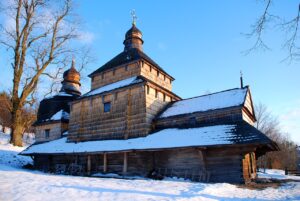
8 of 16, in Ukraine: The Wooden Churches of the Carpathians
The wooden churches of the Carpathian Mountains, called "tserkvas," are built of horizontally stacked logs, their roofs and walls covered in wooden shingles. Of the 16 churches inscribed as a UNESCO World Heritage Site jointly with Poland in 2013, 8 are in Ukraine. This article covers the four architectural types, the lineup of the 8 churches, and the wartime conservation challenges described in a 2024 report.
-
You Can Still Attend Junior High Past 15: Japan’s 69 Night Junior High Schools
A night junior high school (yakan chugaku) is a public junior high school for people who passed 15 without completing compulsory education; MEXT counts 69 of them nationwide as of April 2026. Tuition is free, and more than 60% of students are not Japanese nationals. This article covers example enrollment conditions, what classes cover, how many people attend, and where to ask.
-
1 Million Yen a Year for Up to Three Years: The Nippon Foundation’s Support for Ukrainian Evacuees Ended in March 2026
The Nippon Foundation paid about 2,000 Ukrainian evacuees with a guarantor in Japan a living allowance of 1 million yen per person per year, for up to three years. Including travel costs, a settling-in allowance, and support for those returning home, total payments came to about 5.38 billion yen. The program ended on March 31, 2026, and it is no longer possible to apply. This article organizes what was paid, to whom, and how much, based on the Foundation's own report.