
8 of 16, in Ukraine: The Wooden Churches of the Carpathians
The wooden churches of the Carpathian Mountains, called "tserkvas," are built of horizontally stacked logs, their roofs and walls covered in wooden shingles. Of the 16 churches inscribed as a UNESCO World Heritage Site jointly with Poland in 2013, 8 are in Ukraine. This article covers the four architectural types, the lineup of the 8 churches, and the wartime conservation challenges described in a 2024 report.
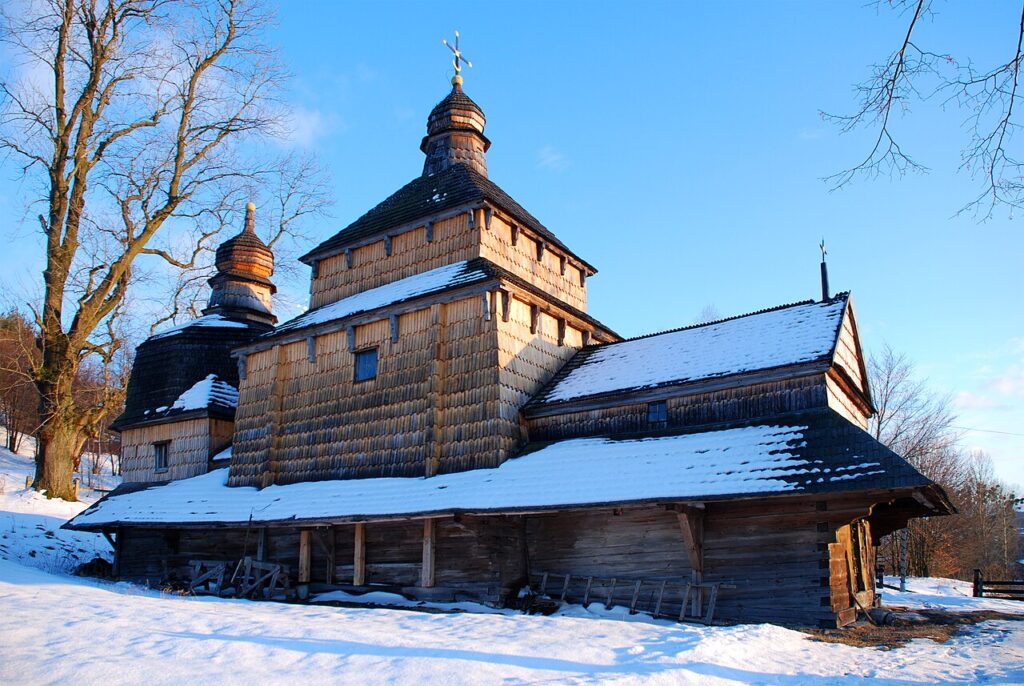

1502. This is the year the evaluation report of ICOMOS (the International Council on Monuments and Sites), UNESCO’s advisory body, gives for the construction of the Church of the Descent of the Holy Spirit in Potelych, Lviv oblast. The report describes it as among the oldest surviving examples in the region. Built of stacked logs, this wooden church is one of the sites making up the World Heritage property “Wooden Tserkvas of the Carpathian Region in Poland and Ukraine,” which spans both countries.
The English term “tserkva” is a direct transliteration of церква, the Ukrainian word for church. According to UNESCO’s description, these were built between the 16th and 19th centuries by communities of Orthodox and Greek Catholic believers, using horizontally stacked wooden logs.
2013: One World Heritage Site Across Two Countries
In 2013, at its 37th session held in Phnom Penh, Cambodia, the World Heritage Committee inscribed the 16 churches as a single World Heritage Site (Decision 37 COM 8B.37), meeting criteria (iii) and (iv). As justification, the decision cites that they represent a distinct church-building tradition weaving local architectural vocabulary into the mainstream Orthodox tradition, and that, as an ensemble of traditional log-built structures, they represent an important stage in the Carpathian region’s architectural history.
Of the 16 churches, 8 are in Poland and 8 in Ukraine. According to the ICOMOS evaluation report, the World Heritage area covers 3.29 hectares on the Polish side and 3.74 hectares on the Ukrainian side, with a buffer zone set around each church. Both countries placed this group of churches on their tentative lists in January 2010 (Ukraine on the 28th, Poland on the 29th).
Stacked Logs, Shingle-Covered
According to the decision’s description, the buildings are made of horizontal logs joined at the corners with complex notching. They rest on a wooden base set on a stone foundation, and the roofs and walls are covered in wooden shingles (thin overlapping boards). The floor plan is divided into three parts (the ICOMOS evaluation calls them the narthex, nave and sanctuary), topped with square or octagonal domes or towers. The iconostasis (a screen of icons separating the sanctuary), painted interiors, bell towers, cemeteries, gates, and the surrounding fences or walls are also counted as elements that constitute the World Heritage property.
The shingles covering the walls and roof need replacing every 20 to 30 years. The decision states that passing down the technique and craft knowledge for this is a condition for maintaining the buildings’ authenticity. It also notes that most churches retain their original doors and locks, and that the year of construction and the carpenter’s name are carved into the beam above the entrance.
Four Types
The decision and the ICOMOS evaluation divide the 16 churches into four types, according to the group of people who built them. The Boikos, Hutsuls and Lemkos are the names of ethnographic groups of Ukrainians who have lived in the Carpathian Mountains (Internet Encyclopedia of Ukraine).
- Halych type (6 churches): the northern Carpathians, on both sides of the border between the two countries. The older type places a two-tiered pyramidal roof over the nave; the 17th-century type places a near-spherical dome over each of the three parts
- Boiko type (3 churches): both sides of the border between the two countries, near the border with Slovakia. The tiered roofs can resemble an Asian pagoda, and the central dome over the nave is always the tallest
- Hutsul type (2 churches): the southeastern Carpathians in Ukraine. A cross-shaped plan with wings added on either side of the nave, topped in the center by a tall octagonal tent roof or dome
- Lemko type (5 churches): the western Carpathians in Poland. A tall post-and-beam bell tower, common in southern Poland’s Catholic wooden churches, is set above the narthex
All 5 Lemko-type churches are on the Polish side; the 8 churches in Ukraine are all Halych, Boiko, or Hutsul type. According to the ICOMOS evaluation, they were chosen as representative examples from among about 70 surviving Boiko-type and about 150 surviving Hutsul-type churches.
The 8 Churches in Ukraine
| Location | Church (World Heritage English name) | Type | Year built |
|---|---|---|---|
| Potelych (Lviv oblast) | Tserkva of the Descent of the Holy Spirit | Halych type (older type) | 1502 |
| Rohatyn (Ivano-Frankivsk oblast) | Tserkva of the Descent of the Holy Spirit | Halych type (older type) | early 16th century |
| Zhovkva (Lviv oblast) | Tserkva of the Holy Trinity | Halych type (later type) | 1720 |
| Drohobych (Lviv oblast) | Tserkva of Saint George | Halych type (later type) | late 17th century |
| Uzhok (Zakarpattia oblast) | Tserkva of the Synaxis of the Archangel Michael | Boiko type | 1745 |
| Matkiv (Lviv oblast) | Tserkva of the Synaxis of the Blessed Virgin Mary | Boiko type | 1838 |
| Nyzhnii Verbizh (Ivano-Frankivsk oblast) | Tserkva of the Nativity of the Blessed Virgin Mary | Hutsul type | 1808–10 |
| Yasinia (Zakarpattia oblast) | Tserkva of Our Lord’s Ascension | Hutsul type | 1824 |
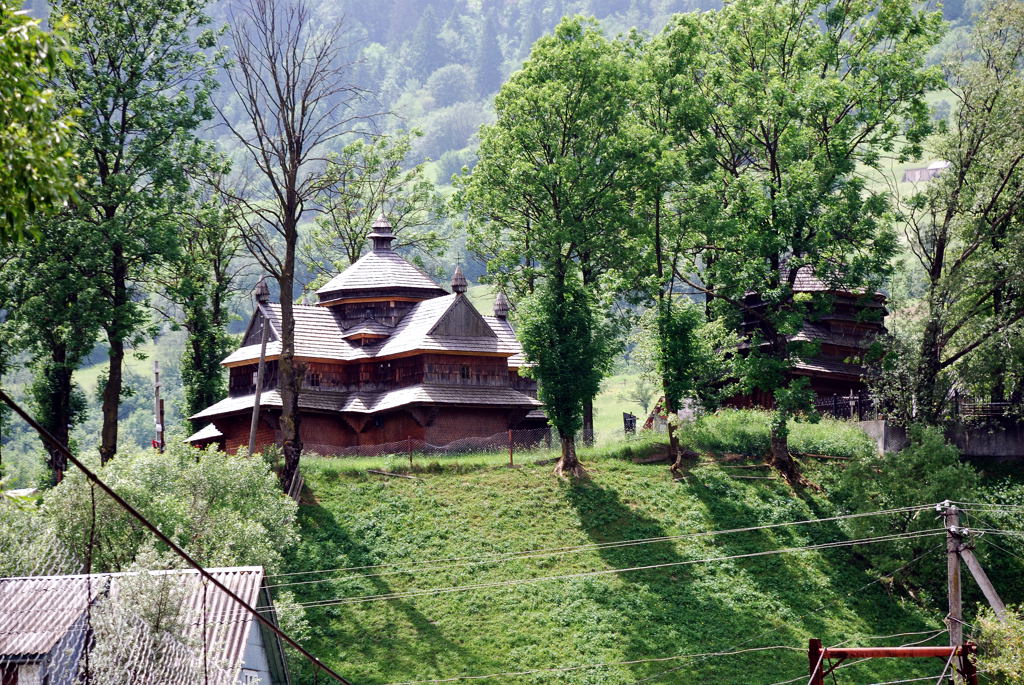
The evaluation praises the Tserkva of Saint George in Drohobych as the pinnacle of wooden dome-building technique, built as the church of the town’s Rus’ community. The Yasinia church is considered the best-preserved example of the cross-shaped, central-domed type, with its walls and ceiling (except the iconostasis) left unpainted, showing the wooden structure and fine joinery as they are. The Uzhok church is a rare example of a three-part church with a bell tower over the narthex, and the Matkiv church, standing on a hill, is considered the finest 19th-century example of this style for the beauty of its silhouette. The Nyzhnii Verbizh church was relocated from the village of Sheparivtsi in 1876.
_WLM%E2%97%A625_01.jpg)
According to the decision, 13 of the 16 churches are still used as churches, while the remaining 3 are preserved as museums. Two of those 3 museum churches, in Rohatyn and Drohobych, are on the Ukrainian side.
The year of construction can differ between sources. For example, the Internet Encyclopedia of Ukraine (Canadian Institute of Ukrainian Studies at the University of Alberta; its entry “Boikos” was first published in 1984) dates the Tserkva of Saint George in Drohobych to the “15th–16th century,” far from ICOMOS’s “late 17th century.” The table above follows the ICOMOS evaluation.
Conservation Under Wartime Conditions
The third-cycle periodic report, jointly prepared by Poland and Ukraine and published by UNESCO in 2024, describes the war’s impact on this World Heritage Site as follows.
- Russian forces are bombarding targets across Ukraine, creating a risk of stray rockets or debris striking the sites
- The war has moved people abroad or to the front, making it harder to secure specialists; the number of visitors has also fallen
- Monitoring has become thin, budgets are severely constrained, and joint activities between Poland and Ukraine are also restricted
- Spending on construction work at the Ukrainian component sites is not a priority, and under wartime conditions funding effectively does not exist
According to the same report, all but one of the churches have fire alarms, and all have fire extinguishers. Some component sites have protection plans for times of armed conflict or crisis. At the same time, the report also acknowledges that the management plans submitted at the time of inscription are outdated and need updating.
Ukraine’s World Heritage Sites as a whole are covered in our article “Ukraine’s Cities and World Heritage”, a stone church that is also a World Heritage Site, built in the 11th century, in our article on Kyiv’s St. Sophia Cathedral, and the differences among Ukraine’s churches in our article on the two Orthodox churches.
Sources and article record
Sources and references
- Wooden Tserkvas of the Carpathian Region in Poland and Ukrainethe overview; the inscription year 2013; criteria (iii) and (iv); the types and locations of the 16 churches
Published by UNESCO World Heritage Centre · Checked: 2026-09-24 - Decision 37 COM 8B.37the inscription decision; the statement of outstanding universal value; 13 churches vs. 3 museums; the 20–30 year shingle replacement; the door inscriptions
Published by UNESCO World Heritage Centre · Checked: 2026-09-24 - Advisory Body Evaluation (ICOMOS) No 14242013; the breakdown of 8 churches per country; the area; the tentative-list dates; each church's construction year, features and use; the number of surviving churches by type
Published by ICOMOS (published by UNESCO) · Checked: 2026-09-24 - Periodic Reporting Cycle 3, Section II: Wooden Tserkvas of the Carpathian Region in Poland and Ukrainepublished 2024; the list of component sites; the war's impact; funding; fire-prevention equipment; the updating of management plans
Published by UNESCO World Heritage Centre · Checked: 2026-09-24 - Boikosfirst published 1984; the Boiko ethnographic group; the "15th–16th century" dating of the Tserkva of Saint George in Drohobych
Published by Internet Encyclopedia of Ukraine (CIUS) · Checked: 2026-09-24 - Hutsulsfirst published 1989; the Hutsul ethnographic group and wooden architecture; the Yasinia church
Published by Internet Encyclopedia of Ukraine (CIUS) · Checked: 2026-09-24 - Lemkosfirst published 1993; an ethnographic group among Ukrainians; the features of their church architecture
Published by Internet Encyclopedia of Ukraine (CIUS) · Checked: 2026-09-24 - Yasiniathe 1824 wooden church in Yasinia
Published by Internet Encyclopedia of Ukraine (CIUS) · Checked: 2026-09-24
If you find an error in this article, please tell us via Corrections. Once we have checked it, we will record in the article what was corrected and why.
Related articles
-

From the End of Cossack Self-Rule to the Ban on Ukrainian-Language Publishing
This article traces the period from the Khmelnytsky Uprising of 1648, through the 1654 Pereiaslav Agreement (whose original document does not survive), the abolition of the office of hetman in 1764 and the destruction of the Sich in 1775, to the bans on Ukrainian-language publishing in 1863 and 1876, up to the eve of the First World War. The harm the Jewish community suffered during the uprising is presented through the divergence between different estimates, rather than a single figure.
-
Features of Ukraine’s Education System | From Kindergarten to University, and Underground Schools
Ukraine has a reputation for producing many talented people, so you might wonder what kind of education makes that possible. This time, we explain the features of Ukraine’s education system. There are many differences from Japan, such as music schools for children and continuous education, so if you’re interested in education, please read to the end. Education at Ukrainian Kindergartens Kindergarten education in Ukraine places emphasis on early childhood education. Ukraine has a distinctive kind of educational institution not found in Japan: music schools (art schools) for children. Music Schools…
Published in
-
What Did Yokohama-Odesa and Kyoto-Kyiv Actually Agree To As Sister Cities?
There is no legal definition of a "sister city." What agreement documents typically state is friendship and mutual understanding. What kind of documents formed the Yokohama-Odesa and Kyoto-Kyiv partnerships, who has carried them forward, and what has continued? A 2023 memorandum between Yokohama and Odesa was a more concrete document, spelling out both a purpose and a deadline.