
1011 or 1037? The Year Kyiv’s St. Sophia Cathedral Was Built
St. Sophia Cathedral in Kyiv was built in the time of Yaroslav the Wise and still preserves 11th-century mosaics and frescoes. But the year it was built differs by 26 years between the encyclopedia's date of 1037 and the Ukrainian government's 2011 celebration of the cathedral's 1000th anniversary. This article traces the origin of its Baroque exterior, its conversion to a museum in 1934, its inscription as a World Heritage site in danger in 2023, and the damage it suffered in 2025.


On June 10, 2025, following a Russian attack, damage was found on the eastern outer wall of St. Sophia Cathedral in Kyiv. The next day, June 11, UNESCO expressed “grave concern,” announcing that a preliminary inspection by UNESCO’s Ukraine representative, who visited the site, had confirmed damage to the eastern façade. UNESCO calls this building “a cornerstone of Eastern Christian architecture and monumental art dating back to the early 11th century.”
St. Sophia Cathedral was built as the central church of the capital of Kyivan Rus, and is one of the first buildings in Ukraine inscribed on the UNESCO World Heritage List. This article traces, through UNESCO’s listing and the entry in the Internet Encyclopedia of Ukraine (Canadian Institute of Ukrainian Studies, or CIUS, at the University of Alberta), when it was built, what remains inside it, why its exterior is Baroque, and how it has been treated during the war.
The Year It Was Built Differs Depending on the Source
Every source agrees that the cathedral was built by Yaroslav the Wise (Yaroslav Mudryi), Grand Prince of Kyiv. UNESCO writes that it was built as the principal church of the capital of Kyivan Rus during the reign of Yaroslav the Wise, with local builders joined by Byzantine craftsmen.
Yet there is no single agreed year for when it was built. The entry in the Internet Encyclopedia of Ukraine (first published in the 1993 print edition) dates the construction to between 1037 and 1044, adding that “a date of 1017–37 has also been proposed.”
The Ukrainian government, meanwhile, celebrated the “1000th anniversary of its founding” in 2011. Presidential Decree No. 682/2010 of June 11, 2010, “On the Commemoration of the 1000th Anniversary of the Founding of St. Sophia Cathedral,” refers to a resolution of the 35th session of the UNESCO General Conference marking the 1000th anniversary of the founding in 2011, and instructs the Cabinet of Ministers to hold commemorative events and an international academic conference, to publish a complete collection of the cathedral’s graffiti, and to restore the gilding of the dome. Counting back from 2011 places the founding in 1011, a gap of 26 years from 1037.
In other words, while sources agree that the cathedral dates to the first half of the 11th century, under Yaroslav the Wise, scholarly debate over the exact year continues to this day. In its inscription description, UNESCO limits itself to writing “the early 11th century.”
11th-Century Mosaics and Frescoes
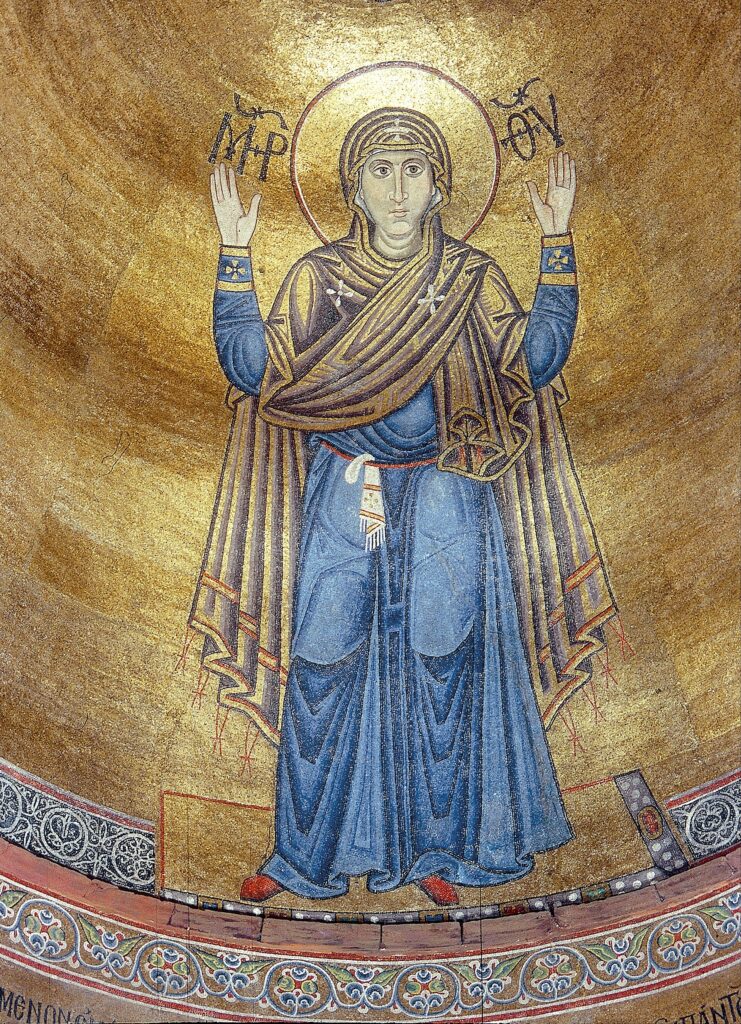
The first value UNESCO cites for World Heritage status is the interior decoration. The cathedral retains its 11th-century interior, and UNESCO writes that it holds the largest surviving collection of mosaics and frescoes from that period. The works cited as representative are Christ Pantokrator, the Orans (Virgin at Prayer), the Communion of the Apostles, the Deesis, and the Annunciation. The staircase towers also preserve frescoes depicting secular, non-religious scenes.
According to the Internet Encyclopedia of Ukraine, the building has a cross-shaped plan with five naves, and originally rose in a pyramid-like arrangement of thirteen domes in total: one large central dome surrounded by twelve smaller ones. The Virgin Orans in the central apse, also known as the “Indestructible Wall,” is considered the most famous of the mosaics. The outer walls were built using a technique alternating brick and stone.
The same entry also introduces the theories on the building’s architectural origins. Alongside theories that it directly copies a Byzantine model, or that it shows Romanesque or Armenian-Georgian influence, it writes that the theory holding the most weight is that it arose from a mixture of local and Byzantine traditions — since features such as the large number of domes, the aim for height, a body wider than it is deep, and the combined use of mosaic and fresco are barely seen in buildings that predate Kyivan Rus. The entry’s view is that, despite sharing a name, what it borrowed from Hagia Sophia in Constantinople amounts to little more than the name and a few general characteristics.
Besides frescoes, the walls also preserve graffiti carved by people in the medieval period. It was this graffiti that the presidential decree mentioned above called to have published as a complete collection. A stringed instrument depicted in an 11th-century fresco in the cathedral is regarded as the oldest recorded instrument in the bandura family (see The Traveling Blind Bards Called Kobzari, and Their Instrument, the Bandura).
The Internet Encyclopedia of Ukraine writes that Yaroslav the Wise established Ukraine’s first library at this cathedral, and that he himself was buried here. His sarcophagus survives to this day.
The Baroque Exterior Is the Result of 17th- and 18th-Century Restoration
The cathedral’s present white walls and pear-shaped domes are not its 11th-century appearance. According to the Internet Encyclopedia of Ukraine, after Prince Andrei Bogoliubsky of Suzdal sacked Kyiv in 1169, the city and the cathedral entered a 460-year period of decline, and by 1585 the roof had deteriorated to the point of collapse. This period’s sack of Kyiv is also touched on in What Was Happening in Kyiv, from Heian-kyo to the Onin War.
From 1610 to 1633, a short period, the cathedral was under the Uniate (Eastern-rite Catholic) Church. It was then that the Orthodox Metropolitan of Kyiv, Petro Mohyla, regained control and carried out a large-scale restoration over 24 years.
The decisive restoration was the one funded from 1690 to 1707 by the Hetman (head of the Cossack state) Ivan Mazepa. Part of the building was raised, the walls were plastered and turned white, all the domes — including six newly added — were covered with pear-shaped roofs, and the central dome was gilded. The same entry writes that this, following the newly developing style of Ukrainian Baroque, created the building’s present exterior. In the mid-18th century, under Metropolitan Rafail Zaborovsky, a carved wooden iconostasis was installed, and the Zaborovsky Gate (1746–48) was built in the wall around the grounds.
UNESCO likewise describes the monastic buildings surrounding the cathedral — the bell tower, the Metropolitan’s residence, the refectory, and the Zaborovsky Gate among them — as “17th–18th-century Ukrainian Baroque.” The overlapping of an 11th-century interior with a 17th–18th-century exterior in a single building is a defining feature of this cathedral.
Becoming a Museum in 1934
According to the Internet Encyclopedia of Ukraine, all religious activity at the cathedral was halted in 1934 and it was turned into a museum. Many important items were confiscated by the state, and many of these were destroyed, lost, or sold abroad. From 1941 to 1943, most of the confiscated items held in Kyiv’s museums and libraries were looted by Nazi Germany.
According to UNESCO’s listing, the cathedral and its monastic buildings were designated a State Historical and Cultural Reserve in 1934. The restoration work received the “European Gold Medal for the Preservation of Historical Monuments” in 1987. It is now managed by the national reserve “Sofia Kyivska,” and is used as a museum for education and as a venue for state occasions. On December 15, 2018, the cathedral also hosted the “Unification Council” that established the Orthodox Church of Ukraine (OCU) (see Both Translate Literally as “Orthodox Church of Ukraine”: The OCU, the UOC, and the 2024 Law).
From World Heritage to World Heritage in Danger
In 1990, the cathedral was inscribed on the World Heritage List together with the Kyiv Pechersk Lavra, as a single property: “Kyiv: Saint-Sophia Cathedral and Related Monastic Buildings, Kyiv-Pechersk Lavra.” It is a property made up of two separate locations, inscribed under criteria (i) through (iv), with a total area of 28.52 hectares.
| Date | Event |
|---|---|
| 1990 | Inscribed on the World Heritage List |
| February 24, 2022 | Russia’s full-scale invasion of Ukraine |
| September 15, 2023 | The World Heritage Committee, meeting in Riyadh, adds the property to the List of World Heritage in Danger, together with the historic center of Lviv |
| June 10, 2025 | UNESCO confirms damage to the cathedral’s eastern façade following a Russian attack |
| June 15, 2026 | An attack on the Kyiv Pechersk Lavra, a component of the same World Heritage property, is reported, and UNESCO condemns it |
As its reason for adding the property to the List of World Heritage in Danger, the World Heritage Committee stated that the optimal conditions fully guaranteeing the protection of its outstanding universal value were no longer met, and that it was exposed to potential dangers from the war. It is said to be vulnerable not only to direct attack but also to the shockwaves from bombing elsewhere in the city. A full list of Ukraine’s World Heritage properties and those in danger is compiled in Ukraine’s Cities and World Heritage.
In its statement of June 15, 2026, UNESCO says that significant damage has been reported to the exterior and interior of the Dormition Cathedral, the centerpiece of the Lavra. This cathedral was nearly destroyed in the Second World War and rebuilt in 1999–2000. UNESCO’s statement describes the damage as “reported,” and does not state that it has independently confirmed the extent of the damage.
Japan is also involved in this protection effort. In a June 2025 announcement, UNESCO writes that, since 2022, Japan’s support has helped fund emergency-preparedness planning for the “Sofia Kyivska” reserve, advanced digital recording of the buildings, and emergency-response training for conservation staff. It adds that it is also supporting the restoration of the cathedral’s murals through the World Heritage Fund.
A building holding murals nearly a thousand years old still lies within reach of the shockwaves of air raids. As of September 2026, the cathedral remains on the List of World Heritage in Danger.
Sources and article record
Sources and references
- Kyiv: Saint-Sophia Cathedral and Related Monastic Buildings, Kyiv-Pechersk LavraProperty page. Inscribed 1990, criteria (i)–(iv), 28.52 ha; the statement of outstanding universal value [Yaroslav the Wise, local builders and Byzantine craftsmen, representative mosaics, secular frescoes in the staircase towers, 17th–18th-century Ukrainian Baroque monastic architecture]; the 1934 reserve designation; the 1987 European Gold Medal; use as a museum and for state occasions; the 1999–2000 reconstruction of the Dormition Cathedral; World Heritage in Danger from 2023
Published by UNESCO World Heritage Centre · Checked: 2026-09-24 - Ukraine: UNESCO sites of Kyiv and L’viv are inscribed on the List of World Heritage in DangerSeptember 15, 2023. The Riyadh committee, the reasons for inscription, shockwaves
Published by UNESCO World Heritage Centre · Checked: 2026-09-24 - Kyiv: UNESCO is deeply concerned about threats to World Heritage in Ukraine’s capitalJune 11, 2025. The June 10 attack, damage to the eastern façade, cooperation supported by Japan since 2022, support for restoring the cathedral's murals through the World Heritage Fund
Published by UNESCO World Heritage Centre · Checked: 2026-09-24 - UNESCO statement on UkraineJune 15, 2026. The attack on the Kyiv Pechersk Lavra, and reported damage to the Dormition Cathedral
Published by UNESCO · Checked: 2026-09-24 - Saint Sophia CathedralWritten by: Walter Daschko. First published in the print edition, vol. 4, 1993. The 1037–44 construction date and the 1017–37 theory, the plan and domes, the Orans, scholarly theories, the decline from 1169, 1610–33, Mohyla, Mazepa's restoration, the Zaborovsky Gate, the 1934 conversion to a museum, the library and sarcophagus
Published by Internet Encyclopedia of Ukraine (Canadian Institute of Ukrainian Studies, University of Alberta) · Checked: 2026-09-24 - Указ Президента України № 682/2010 «Про відзначення 1000-річчя заснування Софійського собору»June 11, 2010. The reference to a resolution of the 35th session of the UNESCO General Conference, the 1000th anniversary of the founding in 2011, the publication of a complete collection of graffiti, and other matters
Published by Президент України (zakon.rada.gov.ua) · Checked: 2026-09-24
If you find an error in this article, please tell us via Corrections. Once we have checked it, we will record in the article what was corrected and why.
Related articles
-

What Kind of Country Is Ukraine? A 3-Minute Refresher on Its Culture and History
How much do you know about Ukraine?This article brings together basic facts about Ukraine along with its culture and history. Let’s deepen our understanding of Ukraine. What Kind of Country Is Ukraine? Ukraine is a country in Eastern Europe with a rich culture and history.Here we explain it in terms of the following three points. Ukraine’s Land and Population Ukraine is a country in Eastern Europe.It borders Belarus, Russia, Poland, Slovakia, Hungary, Romania, and Moldova. It’s one of the larger countries by land area, at about 600,000 square kilometers —…
Published in
-
From Six Grocery Stores to 1,320: ATB, the Supermarket Chain Born in Dnipro
ATB, a food supermarket chain headquartered in Dnipro, says it began in 1993 with six grocery stores and, by early 2026, had 1,320 stores across 22 oblasts. This article separates the company's own claim of being “Ukraine's largest” chain from the figures in the state company register, the store counts that differ between versions of its own history, and the revenue and profit recorded in that register, based on materials available as of September 2026.
-
Public Libraries Are Free by Law, but a Library Card Requires an Address Check
Japan's Library Act requires public libraries to be free for entry and for using materials. To borrow a book, you register for a library card at a library in the city, town, or ward you live in, showing a document that confirms your name and address. Using Yokohama and Kobe as examples, this article covers the registration conditions and gives examples of libraries that hold books in Ukrainian.