
From the Transfer of Crimea to Giving Up Nuclear Weapons: Half a Century of Postwar Ukraine
This article traces the period from the 1946 famine through the 1954 transfer of Crimea, the 1986 Chornobyl nuclear disaster, the 1991 independence and referendum, the 1994 Budapest Memorandum, and the inflation and currency reform of the 1990s. On the 1954 transfer of Crimea, it presents the two officially stated reasons separately from the motives researchers have inferred. In the referendum of December 1, 1991, a majority of those who voted favored independence in all 27 administrative units.
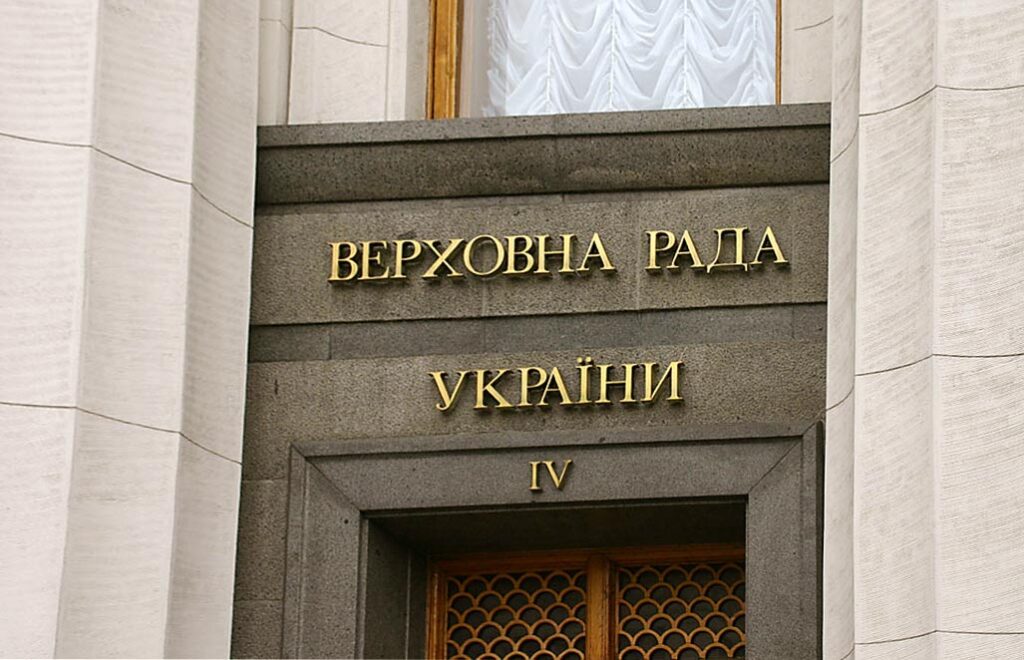

This is the fourth in a four-part series tracing the history of the land of Ukraine. It covers the period from the end of the Second World War, which Ukraine met as a Soviet republic, through independence in 1991, to the 1990s, when a new constitution and currency were created.
The Famine of 1946–47
After the war, many residents of central and eastern Ukraine experienced hunger. The Internet Encyclopedia of Ukraine (published by the Canadian Institute of Ukrainian Studies, University of Alberta, CIUS) writes that although drought worsened the wartime collapse of agriculture, the Soviet government refused to lower the procurement quotas it imposed on peasants. The same encyclopedia also states that “the Soviet regime did not acknowledge that a famine had occurred in Ukraine in 1946–47.”
A death toll cannot be stated. The same encyclopedia says “estimates of the death toll vary greatly, ranging from 100,000 to over one million.” The Encyclopedia of the History of Ukraine, published by the Institute of History of Ukraine at the National Academy of Sciences of Ukraine, gives a figure of over one million, while qualifying that figure itself as being “according to extremely incomplete data.”
When Did the UPA’s Resistance End?
The UPA’s anti-Soviet resistance in western Ukraine ended in stages. On September 3, 1949, Roman Shukhevych ordered the dissolution of the command structure and the remaining combat units, moving members into an underground network. After Shukhevych’s death (March 5, 1950), the underground continued the armed struggle under Vasyl Kuk’s leadership, and organized resistance ended when he was captured in a special operation by the security services in 1954.
The Encyclopedia of the History of Ukraine gives the number of people specially resettled from the western oblasts to remote areas of the Soviet Union between 1944 and 1952 as 203,662, of whom 182,543 were family members of OUN and UPA members and their sympathizers.
The 1954 Transfer of Crimea: Tracing the Procedure by Date
The decision to transfer Crimea was made by the Presidium of the Supreme Soviet of the USSR on February 19, 1954. However, the decision passed through several bodies before reaching that point. The collection of documents Mark Kramer, of Harvard University’s Cold War Studies Program, published at the Wilson Center lists the following dates among the documents it contains: on January 25, 1954, the Presidium of the Soviet Communist Party approved the transfer; on February 5, a decision of the Council of Ministers of the Russian Republic and the minutes of the Presidium of the Supreme Soviet of the Russian Republic; on February 13, a decision of the Presidium of the Supreme Soviet of Ukraine; and on February 19, the Presidium of the Supreme Soviet of the USSR. Each document carries a fond (collection) number from the State Archive of the Russian Federation (GARF).
Two official reasons were given. As Kramer quotes them, the first was that the transfer was a “noble act on the part of the Russian people” marking the 300th anniversary of the 1654 Treaty of Pereiaslav, demonstrating “the boundless trust and love that the Russian people feel for the Ukrainian people.” The second reason was “the geographic proximity of Crimea to Ukraine, the commonality of their economies, and the close agricultural and cultural ties between Crimea Oblast and the Ukrainian republic.” Omitting the first reason would fail to convey the official explanation of the time accurately.
Kramer himself, however, writes that “neither of these ostensible justifications withstands scrutiny,” and cites as the real motives the tightening of control after the end of armed resistance in western Ukraine, the power struggle with Malenkov, and the securing of Kirichenko’s support. The officially stated reasons and the motives researchers infer need to be read separately.
No procedure was carried out to ask the residents’ will. On this point, Professor J. Gordon Hylton of Marquette University Law School states that the approval of the residents concerned was required under the Soviet constitution but was never obtained (this is from the professor’s blog post, not a peer-reviewed paper). At the time, in 1954, Crimean Tatars were in forced-resettlement locations in Central Asia and were barred from returning. The Internet Encyclopedia of Ukraine records that a decision of April 28, 1956 banned their return, that this ban remained in effect until 1988, and that this was still the case even after a decision of September 5, 1960 cleared them of the suspicion of collaboration with Germany.
Around the time of the Soviet Union’s dissolution, Russia and Ukraine signed documents containing provisions on their border. Article 6 of the treaty of November 19, 1990 provided that “the two contracting parties recognize and respect the territorial integrity of the Ukrainian Soviet Socialist Republic and the Russian Soviet Federative Socialist Republic within the borders currently existing within the framework of the USSR.” The Treaty on Friendship, Cooperation and Partnership of May 31, 1997, in its Article 2, has the two countries respect each other’s territorial integrity and confirm the inviolability of existing borders. However, the 1990 treaty was terminated by the 1997 treaty, and the 1997 treaty was in turn terminated by a law of December 6, 2018. It cannot be written that “a treaty still in force guarantees the border.”
After the Thaw: The Dissident Movement, and Its Cost
The generation that began writing in the late 1950s and reached its peak in the early 1960s is called the “Shistdesiatnyky” (people of the sixties). Lina Kostenko and Vasyl Symonenko are considered its first representatives. The movement lasted only about a decade before being silenced by arrests from 1965 to 1972.
There were two waves of arrests: 1965–66, and January to April 1972. In the latter, Viacheslav Chornovil, Ivan Dziuba, Vasyl Stus, and others were arrested, on the charge of “anti-Soviet agitation and propaganda.” The repression was not limited to imprisonment. The Internet Encyclopedia of Ukraine records that “at the same time, repression also took the form of dismissals, expulsions, and evictions from housing; at Lviv University, 23 students were expelled and 27 lecturers dismissed.”
Committal to psychiatric hospitals was also a real practice. The same encyclopedia writes that in the “special psychiatric hospitals” placed directly under the Ministry of Internal Affairs, security took priority over medical judgment, and the abuse of psychiatry for political purposes was common; it notes that Ukraine had one such hospital, in Dnipro (then Dnipropetrovsk).
Dziuba finished writing “Internationalism or Russification?” at the end of 1965 and submitted it to the party’s First Secretary; it was published in the West in 1968 (do not confuse the writing with the publication). He was sentenced to five years’ imprisonment in April 1973, and released in November of the same year in exchange for a public recantation. Stus died on the night of September 3–4, 1985 in a punishment cell of a special-regime camp in Kuchino, Perm Oblast, and was reburied at Baikove Cemetery in Kyiv on November 19, 1989.
The Ukrainian Helsinki Group was formed in Kyiv on November 9, 1976. The names of its 10 founders match between the Internet Encyclopedia of Ukraine and the Encyclopedia of the History of Ukraine from the Institute of History of Ukraine at the National Academy of Sciences of Ukraine: Mykola Rudenko as chair, Oles Berdnyk, Petro Hryhorenko, Ivan Kandyba, Levko Lukianenko, Myroslav Marynovych, Mykola Matusevych, Oksana Meshko, Nina Strokata, and Oleksa Tykhy. Arrests began in February 1977, and within two years all the founding members had been sentenced to 7 to 10 years’ imprisonment and exile.
Russification: Whose Figures Are These?
All the figures in this section come from the Internet Encyclopedia of Ukraine (Canadian Institute of Ukrainian Studies), not from Soviet official statistics themselves. According to the encyclopedia, the share of schools teaching in Ukrainian fell from 85.3% in 1955–56 to 81.1% in 1967–68. In 1987, only 16% of schools in the capital and oblast centers were Ukrainian-language schools, and Chernihiv, Donetsk, Simferopol, and Luhansk had no Ukrainian-language schools at all (this figure is limited to the capital and oblast centers, not a nationwide value).
In publishing too, the number of Ukrainian-language higher-education textbook titles fell from 168 in 1970 to 38 in 1980, while the number of Russian-language titles rose from 263 to 422 over the same period. The assessment that “Russian was advantageous for upward mobility” can be attributed as the view of this encyclopedia’s authors (Bohdan Kravtsiv, Volodymyr Kubijovyc), and is not a fact that follows directly from the statistics.
April 26, 1986: Chornobyl
The report of the Chernobyl Forum (which included the IAEA, WHO, UNSCEAR, the World Bank, and the governments of Belarus, Russia, and Ukraine) states, “On 26 April 1986, the most serious accident in the history of the nuclear power industry occurred at Unit 4 of the Chernobyl nuclear power plant in the then Ukrainian S.S.R.”
The delay in disclosing information is stated by the official bodies themselves. The same report writes: “Third, the Soviet government delayed disclosure of the fact that the accident had happened. The provision of information was selective and restrictive, especially in the period immediately following the accident,” and “reliable information did not initially reach the affected population in the Soviet Union at the time and remained inadequate for years after the accident.”
On the evacuation, the same report states that approximately 50,000 residents of Pripyat were evacuated within 40 hours of the accident.
Two international frameworks were created after the accident: the Convention on Early Notification of a Nuclear Accident, and the Convention on Assistance in the Case of a Nuclear Accident or Radiological Emergency. Both were adopted in Vienna on September 26, 1986, entering into force on October 27, 1986 and February 26, 1987 respectively. According to a note in the UN Treaty Series, one of the three states whose ratification brought the Assistance Convention into force was the Ukrainian Soviet Socialist Republic (January 26, 1987).
Rukh, the Human Chain, and the Declaration of Sovereignty
The founding congress of the People’s Movement of Ukraine, Rukh, was held September 8–10, 1989 at the Kyiv Polytechnic Institute. The number of delegates who attended is given variously as just over 1,100, 1,109, or 1,200 depending on the source, so this article does not state a figure.
The “human chain” took place on January 21, 1990. According to the Ukrainian Institute of National Remembrance, although it was officially called “Between Lviv and Kyiv,” the main chain actually began in the city of Stryi, Lviv Oblast, with two additional chains extending from there toward Ivano-Frankivsk and toward Zakarpattia. Its total length is given as 500 kilometers (Internet Encyclopedia of Ukraine) and about 700 kilometers (the Institute), which disagree. The number of participants is also estimated at anywhere from 400,000 to 3 million, so no single figure can be given. It commemorated the Act of Unification of East and West Ukraine of January 22, 1919.
On July 16, 1990, the Supreme Soviet of the Ukrainian Soviet Socialist Republic adopted the Declaration of State Sovereignty. Section 9 of the declaration includes the provision: “The Ukrainian SSR solemnly declares its intention of becoming in the future a permanently neutral state that does not participate in military blocs and adheres to three nuclear-free principles: not to accept, not to produce, and not to acquire nuclear weapons.” This provision would later be connected to the handling of nuclear weapons.
1991: The Declaration of Independence and the December 1 Referendum
On August 24, 1991, the Verkhovna Rada adopted the Act of Declaration of Independence of Ukraine (document No. 1427-XII). The resolution adopted the same day also set December 1 for a republic-wide referendum to confirm the declaration of independence. In other words, the referendum had been scheduled from the outset, within the same decision as the declaration itself.
The result on December 1 was 90.32% in favor, with 84.16% turnout (the official results of the central election body of the time, as received and reported on December 3 by the contemporary newspaper The Ukrainian Weekly). In the figures the paper published for the 27 administrative units, a majority of those who voted favored independence in all 27. The city of Kyiv recorded 92.87%, the Autonomous Republic of Crimea 54.19%, and the city of Sevastopol 57.07%.
These are the shares of those who voted. Taking the total number of eligible voters as the denominator instead, Professor Hylton’s calculation, cited above, puts the figure at about 37% for Crimea and about 40% for Sevastopol.
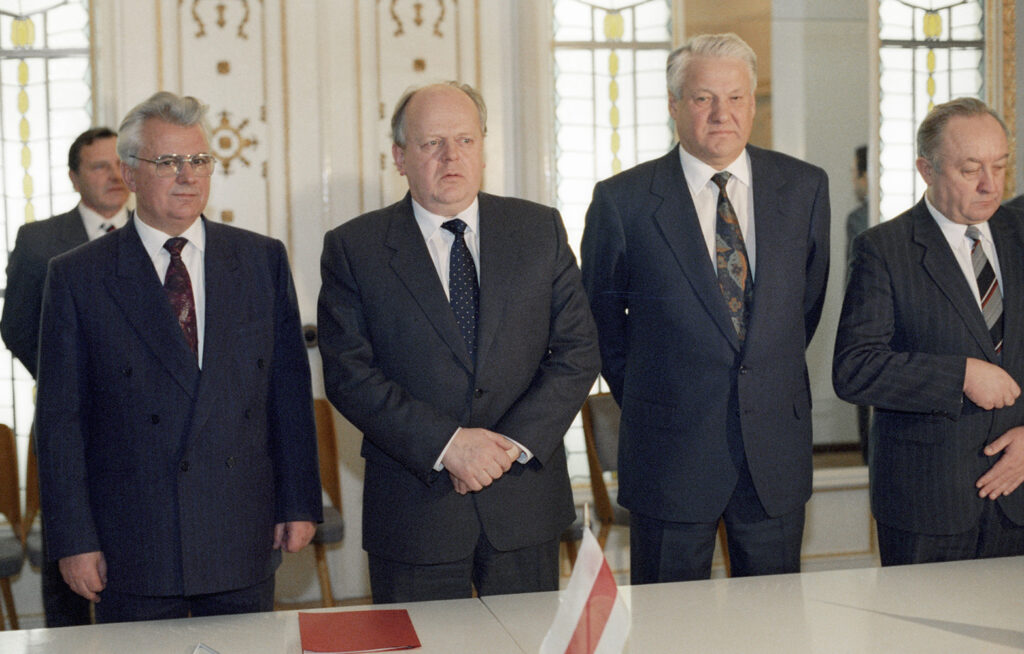
Leonid Kravchuk was elected in the presidential election held the same day. On December 8, an agreement signed by the leaders of Belarus, Russia, and Ukraine stated that “the USSR, as a subject of international law and a geopolitical reality, ceases to exist,” and, in Article 1, established the Commonwealth of Independent States. Only these three countries signed it, and the document itself records the place of signing as “the city of Minsk.”

In Crimea, a “referendum” was later held on March 16, 2014 in the Autonomous Republic of Crimea and the city of Sevastopol. The UN General Assembly, in Resolution 68/262, states that it was not authorized by Ukraine, and in operative paragraph 5 declares it “having no validity” and incapable of serving as a basis for changing the status of the Autonomous Republic of Crimea or the city of Sevastopol (see A Timeline of Independence and Aggression).
Giving Up Nuclear Weapons and the Budapest Memorandum
What remained on Ukrainian territory at independence, by the Arms Control Association’s estimate, was about 1,900 strategic nuclear warheads, 176 intercontinental ballistic missiles, and 44 strategic bombers. A figure of about 2,500 tactical nuclear weapons is also cited, but it is backed by only a single source. All of these are estimates.
The same association writes that “Kyiv never had operational control of these weapons.” At the same time, the Ukrainian government declared “administrative control” in June 1992, and asserted ownership of the warheads in 1993. Not having operational control is not the same as having no authority at all.
On December 5, 1994, Ukraine acceded to the Nuclear Non-Proliferation Treaty as a non-nuclear-weapon state. The Budapest Memorandum was signed the same day. It was signed by four countries—Ukraine, Russia, the United Kingdom, and the United States; France was not a signatory to the memorandum (it issued a separate unilateral declaration). The memorandum has six provisions: paragraph 1 confirms the obligation to respect Ukraine’s independence, sovereignty, and existing borders in accordance with the principles of the CSCE Final Act; paragraph 2, to refrain from the threat or use of force against Ukraine’s territorial integrity or political independence; paragraph 3, to refrain from economic coercion; paragraph 4, to seek immediate United Nations Security Council action if Ukraine becomes a victim of aggression involving nuclear weapons; and paragraph 6, to hold consultations if doubt arises regarding these commitments.
How much weight this memorandum carries is a matter of assessment. Steven Pifer, a former U.S. diplomat involved in the negotiations (Brookings Institution), writes: “What the Budapest Memorandum contains are security assurances, not security guarantees. Guarantees would imply the commitment of American military force, which is what NATO members have. U.S. officials made clear that this was not being offered.” This article does not assert in its own voice that it “is not a defense guarantee,” but presents this as Pifer’s assessment.
The 1990s: Prices, the Constitution, and the Currency
How prices rose can be stated two different ways, depending on the indicator. The State Statistics Service of Ukraine’s consumer price index, measured against the previous December, was 2,100.0 for 1992 and 10,256.0 for 1993 (about 102 times the previous December). The same agency’s annual average (year-on-year) figure for 1993 is 4,834.9. The World Bank’s published figure (4,734.9% for 1993) matches this annual-average series. Giving only one of these would be misleading, so both are shown here.
Production also fell. Calculated from the World Bank’s real GDP level figures, Ukraine’s real GDP in 1999 was 40.8% of its 1990 level (this is a calculation from the published figures, not a ratio the World Bank itself states). Ukraine returned to positive growth in 2000. On the connection between privatization and economic power, Freedom House’s annual report writes that national television was either state-owned or controlled by “economic oligarchs” close to the president and government. This is that organization’s assessment, not a statistical category.
On June 28, 1996, the Verkhovna Rada adopted the Constitution (No. 254к/96-ВР). Article 10 provides that “the state language of Ukraine is Ukrainian,” but the same article goes on to provide that “the free development, use, and protection of Russian and other languages of national minorities of Ukraine shall be guaranteed.” Giving only the first half would distort the article, so both are given here. Note that the term “semi-presidential system” does not appear in the text of the Constitution.
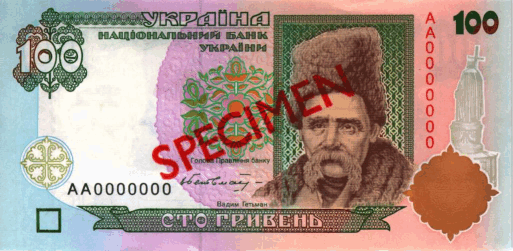
The currency reform began on September 2, based on Presidential Decree No. 762/96 of August 25, 1996. Cash circulation of the Ukrainian karbovanets ended at midnight on September 16, after which the hryvnia became the sole legal currency. The exchange rate was 1 hryvnia to 100,000 karbovantsi.


Elections, the Press, and the Gongadze Case
How to assess governance in the 1990s is given together with the name of the assessing body. The OSCE Office for Democratic Institutions and Human Rights (ODIHR) issued a final report on Ukraine’s presidential elections of October 31 and November 14, 1999, stating that they “failed to meet a significant number of OSCE election-related commitments.” The same report writes that “state administrative bodies and civil servants were observed campaigning for the incumbent president, and against his rival,” and that “the election observation mission uncovered clear evidence that this campaigning by state bodies was extensive, systematic, and coordinated nationwide.”
The journalist Heorhiy Gongadze disappeared on September 16, 2000, and a headless body was found near Tarashcha, Kyiv Oblast, on November 2. Confirming the identity took a long time: the Prosecutor General announced in December 2000 that it was someone else, then reversed course in February 2001 and confirmed it was Gongadze, with final DNA confirmation coming in March 2003. The European Court of Human Rights, in its judgment of November 8, 2005 (Application No. 34056/02), found that Ukraine had violated Article 2 of the European Convention on Human Rights (the right to life, in both its substantive and procedural aspects), Article 3, and Article 13, and ordered a payment of 100,000 euros. Three former police officers were found guilty of murder on March 15, 2008. Note that President Kuchma’s own involvement is not a finding of the Court; the judgment cites it only as a conclusion reached in a September 20, 2005 report by a special committee of the Ukrainian parliament.
This four-part series ends with the 1990s. The events from 2013 onward are covered separately in a sourced timeline.
Sources and article record
Sources and references
- Internet Encyclopedia of Ukraine “Famine of 1946–7”written by Andrij Makuch, Vasyl Markus. Confirms the drought and the unchanged procurement quotas, that the Soviet regime did not acknowledge the famine, and that death-toll estimates range from 100,000 to over one million
Published by Canadian Institute of Ukrainian Studies, University of Alberta · Checked: 2026-09-23 - Веселова О.М. “ГОЛОД 1946–1947 РОКІВ В УРСР” // Енциклопедія історії України, Т.2, 2004confirms the estimate of over one million, and the qualification that it is ‘according to extremely incomplete data’
Published by Інститут історії України НАН України · Checked: 2026-09-23 - Internet Encyclopedia of Ukraine “Ukrainian Insurgent Army”written by Petro Sodol. Confirms Shukhevych's September 3, 1949 order to dissolve the units, his death on March 5, 1950, and the continuation under Vasyl Kuk's leadership until 1954
Published by Canadian Institute of Ukrainian Studies, University of Alberta · Checked: 2026-09-23 - Бігун І.В., Кентій А.В. “УКРАЇНСЬКА ПОВСТАНСЬКА АРМІЯ (УПА)” // Енциклопедія історії України, 2019confirms the decline in activity after 1950 and the end of organized resistance with Kuk's 1954 arrest, and the encyclopedia's own warning that Soviet-side statistics overstate insurgent losses
Published by Інститут історії України НАН України · Checked: 2026-09-23 - Бажан О.Г. “ДЕПОРТАЦІЇ В РЕТРОСПЕКТИВІ УКРАЇНСЬКОЇ ІСТОРІЇ” // Енциклопедія історії України, Т.2, 2004confirms the figure of 203,662 people specially resettled from the western oblasts in 1944–52, of whom 182,543 were family members of OUN/UPA-linked people
Published by Інститут історії України НАН України · Checked: 2026-09-23 - Internet Encyclopedia of Ukraine “Crimea”confirms the transfer by the February 19, 1954 decision of the Presidium of the Supreme Soviet of the USSR, that the April 28, 1956 ban on return remained in effect until 1988, and the September 5, 1960 rehabilitation decision
Published by Canadian Institute of Ukrainian Studies, University of Alberta · Checked: 2026-09-23 - Mark Kramer “The Transfer of Crimea from Soviet Russia to Soviet Ukraine, 1954”confirms the January 25, 1954 Soviet Communist Party Presidium approval, the February 5, 13, and 19 documents and their GARF reference numbers, the verbatim text of the two published official reasons, the assessment that ‘neither of these ostensible justifications withstands scrutiny,’ and the analysis of the real motives. The author directs Harvard University's Cold War Studies Program
Published by Wilson Center · Checked: 2026-09-23 - J. Gordon Hylton “Understanding the Constitutional Situation in Crimea” March 16, 2014confirms the argument that approval of the residents concerned was required under the Soviet constitution but no referendum was held, and the calculation, on a share-of-eligible-voters basis, of about 37% for Crimea and about 40% for Sevastopol in the 1991 referendum. A law school faculty member's blog post, not a peer-reviewed paper
Published by Marquette University Law School Faculty Blog · Checked: 2026-09-23 - Договір між Українською Радянською Соціалістичною Республікою і Російською Радянською Федеративною Соціалістичною Республікоюsigned November 19, 1990. Confirms, from the original text, the mutual recognition of territorial integrity in Article 6, and the note that it was terminated by the 1997 treaty
Published by Верховна Рада України · Checked: 2026-09-23 - Договір про дружбу, співробітництво і партнерство між Україною і Російською Федерацієюsigned in Kyiv on May 31, 1997, ratified January 14, 1998. Confirms, from the original text, Article 2's territorial integrity and inviolability of borders, and the note on termination by Law No. 2643-VIII of December 6, 2018
Published by Верховна Рада України · Checked: 2026-09-23 - Internet Encyclopedia of Ukraine “Shistdesiatnyky”confirms the start in the late 1950s, the peak in the early 1960s, Lina Kostenko and Vasyl Symonenko, and the end through arrests in 1965–72
Published by Canadian Institute of Ukrainian Studies, University of Alberta · Checked: 2026-09-23 - Internet Encyclopedia of Ukraine “Dissident movement”confirms the two waves of arrests in 1965–66 and January–April 1972, the charge, the repression through dismissals/expulsions/evictions, and the 23 students expelled and 27 lecturers dismissed at Lviv University
Published by Canadian Institute of Ukrainian Studies, University of Alberta · Checked: 2026-09-23 - Internet Encyclopedia of Ukraine “Psychiatric hospitals, special”confirms that security took priority over medical judgment in the special psychiatric hospitals under the Ministry of Internal Affairs, the abuse of psychiatry for political ends, and that Ukraine had one such hospital, in Dnipropetrovsk
Published by Canadian Institute of Ukrainian Studies, University of Alberta · Checked: 2026-09-23 - Internet Encyclopedia of Ukraine “Ukrainian Helsinki Group”written by Osyp Zinkevych. Confirms the formation in Kyiv on November 9, 1976, the names of the 10 founders, and the arrests from February 1977 with sentences of 7 to 10 years
Published by Canadian Institute of Ukrainian Studies, University of Alberta · Checked: 2026-09-23 - Бажан О.Г. “УКРАЇНСЬКА ГРОМАДСЬКА ГРУПА СПРИЯННЯ ВИКОНАННЮ ГЕЛЬСІНСЬКИХ УГОД” // Енциклопедія історії Україниconfirms the formation in Kyiv on November 9, 1976 and the list of founders; the two sources fully agree
Published by Інститут історії України НАН України · Checked: 2026-09-23 - Internet Encyclopedia of Ukraine “Russification”written by Bohdan Kravtsiv, Volodymyr Kubijovyc. Confirms the share of Ukrainian-language schools falling from 85.3% (1955–6) to 81.1% (1967–8), the 1987 figure of 16% in the capital and oblast centers, higher-education textbook titles falling from 168 (1970) to 38 (1980), and the assessment of the advantage enjoyed by Russian speakers
Published by Canadian Institute of Ukrainian Studies, University of Alberta · Checked: 2026-09-23 - Chernobyl's Legacy: Health, Environmental and Socio-Economic ImpactsThe Chernobyl Forum: 2003–2005, 2nd revised version. Confirms Unit 4 on April 26, 1986, described as the most serious accident in the history of the nuclear power industry, the delayed and selective/restrictive provision of information, and the evacuation of about 50,000 Pripyat residents within 40 hours
Published by IAEA (IAEA, WHO, FAO, UNDP, UN-OCHA, UNSCEAR, the World Bank, and the governments of Belarus, Russia, and Ukraine) · Checked: 2026-09-23 - Convention on Early Notification of a Nuclear Accidentadopted September 26, 1986 in Vienna, entered into force October 27, 1986
Published by International Atomic Energy Agency · Checked: 2026-09-23 - Convention on Assistance in the Case of a Nuclear Accident or Radiological Emergencyadopted September 26, 1986, entered into force February 26, 1987. Confirms from the UN Treaty Series's registered original text that the Ukrainian Soviet Socialist Republic (January 26, 1987) was among the three states whose ratification brought it into force
Published by International Atomic Energy Agency / United Nations Treaty Series Vol.1457, No. I-24643 · Checked: 2026-09-23 - 1989 – відкрився Установчий з'їзд Народного руху України за перебудовуconfirms the founding congress at the Kyiv Polytechnic Institute, September 8–10, 1989
Published by Український інститут національної пам'яті · Checked: 2026-09-23 - 1990 – символічний «ланцюг злуки»confirms the human chain of January 21, 1990, officially called ‘Between Lviv and Kyiv’ but actually starting from the city of Stryi, branching toward Ivano-Frankivsk and Zakarpattia, a total length of about 700 km, and an estimated 400,000 to 3 million participants
Published by Український інститут національної пам'яті · Checked: 2026-09-23 - Internet Encyclopedia of Ukraine “Popular Movement of Ukraine”confirms the human chain of January 21, 1990, described as running from Kyiv to Lviv and on to Ivano-Frankivsk, a distance of 500 km; this distance disagrees with the above
Published by Canadian Institute of Ukrainian Studies, University of Alberta · Checked: 2026-09-23 - Декларація про державний суверенітет Україниadopted July 16, 1990, document No. 55-XII. Confirms the three nuclear-free principles in Section 9 from the original text
Published by Верховна Рада України · Checked: 2026-09-23 - Акт проголошення незалежності України / Постанова Верховної Ради Української РСРAugust 24, 1991, document No. 1427-XII. Confirms from the original text that the same resolution set the December 1 referendum
Published by Верховна Рада України · Checked: 2026-09-23 - Chrystyna Lapychak et al., The Ukrainian Weekly, Vol. LIX, No.49, December 8, 1991confirms, from a front-page map and its note that ‘these official results were received from the Central Election Commission on Wednesday, December 3,’ the 90.32% in favor / 84.16% turnout figures, and the by-unit figures for the 27 administrative units—Autonomous Republic of Crimea 54.19, city of Sevastopol 57.07, city of Kyiv 92.87
Published by Ukrainian National Association · Checked: 2026-09-23 - Internet Encyclopedia of Ukraine “Kravchuk, Leonid”confirms the election in the December 1, 1991 presidential election, and the referendum's 90.3% in favor
Published by Canadian Institute of Ukrainian Studies, University of Alberta · Checked: 2026-09-23 - Угода про створення Співдружності Незалежних Державsigned December 8, 1991. Confirms from the original text the wording that ‘the USSR ceases to exist as a subject of international law and a geopolitical reality,’ Article 1, the recorded place of signing as ‘the city of Minsk,’ and that there were three signatories
Published by Верховна Рада України · Checked: 2026-09-23 - Ukraine, Nuclear Weapons, and Security Assurances at a Glanceconfirms the estimate of about 1,900 strategic warheads, 176 ICBMs, and 44 strategic bombers, and Ukraine's December 5, 1994 accession to the NPT as a non-nuclear-weapon state
Published by Arms Control Association · Checked: 2026-09-23 - The Lisbon Protocol At a Glanceconfirms ‘never had operational control,’ and the June 1992 declaration of administrative control and the 1993 assertion of ownership
Published by Arms Control Association · Checked: 2026-09-23 - Меморандум про гарантії безпеки у зв'язку з приєднанням України до Договору про нерозповсюдження ядерної зброїBudapest, December 5, 1994. Confirms, from the authoritative Ukrainian text, that the four signatories were Ukraine, Russia, the UK, and the US, and the content of its six provisions
Published by Верховна Рада України · Checked: 2026-09-23 - Steven Pifer “Why care about Ukraine and the Budapest Memorandum” December 5, 2019confirms the distinction between security assurances and security guarantees, and the statement that no commitment of U.S. troops was offered
Published by Brookings Institution · Checked: 2026-09-23 - Індекси споживчих цін у 1992-2024 рокахDecember-on-previous-December: 2,100.0 for 1992, 10,256.0 for 1993. Annual average: 4,834.9 for 1993. Confirms all cells of the statistical file
Published by Державна служба статистики України · Checked: 2026-09-23 - World Development Indicatorsconfirms that the 1993 consumer price inflation rate of 4,734.914% matches the State Statistics Service's annual-average series, and that real GDP levels give a calculated figure of 40.8% for 1999 relative to 1990
Published by World Bank · Checked: 2026-09-23 - Freedom in the World 2004confirms the statement that national television was either state-owned or controlled by ‘economic oligarchs’ close to the president and government
Published by Freedom House · Checked: 2026-09-23 - Конституція України від 28.06.1996 № 254к/96-ВРconfirms, from the original text, the full text of Article 10—Ukrainian as the state language, and the guaranteed free development, use, and protection of Russian and other minority languages. Current consolidated text
Published by Верховна Рада України · Checked: 2026-09-23 - Указ Президента України «Про грошову реформу в Україні» від 25.08.1996 № 762/96confirms, from the original text, the start on September 2, the end of karbovanets cash circulation at midnight on September 16, and the 100,000-to-1 exchange rate
Published by Верховна Рада України (presidential decree) · Checked: 2026-09-23 - Ukraine Presidential Elections 31 October and 14 November 1999: Final ReportMarch 7, 2000, Amended Version. Confirms the statement that it ‘failed to meet a significant number of OSCE election-related commitments,’ and that campaigning by state administrative bodies was extensive, systematic, and coordinated nationwide
Published by OSCE Office for Democratic Institutions and Human Rights · Checked: 2026-09-23 - CASE OF GONGADZE v. UKRAINE (Application no. 34056/02), Judgment, 8 November 2005confirms, from the full judgment, the disappearance on September 16, 2000, the discovery of the body near Tarashcha on November 2, 2000, the course of identification, the finding of violations of Articles 2, 3, and 13 and the order to pay 100,000 euros, and that President Kuchma's involvement is cited only as a conclusion of the parliamentary special committee's September 20, 2005 report
Published by European Court of Human Rights · Checked: 2026-09-23 - Interim Resolution CM/ResDH(2008)35confirms that three former police officers were found guilty of murder on March 15, 2008
Published by Committee of Ministers, Council of Europe · Checked: 2026-09-23
If you find an error in this article, please tell us via Corrections. Once we have checked it, we will record in the article what was corrected and why.
More in this series
-
From Kyivan Rus’ to the 16th Century — Galicia-Volhynia and Two Unions
This article traces the history of the land that is now Ukraine before the Cossacks emerged as a political force: from the Trypillia culture of around 5000 BCE, through the Greek colonies on the Black Sea coast, Kyivan Rus', and the Grand Duchy of Lithuania, to the Union of Lublin in 1569 and the Union of Brest in 1596. The view of Kyivan Rus' as the state of a single "Old Rus' nationality" is the official framework put forward by a panel of historians commissioned by the Soviet Communist Party in the 1930s. Ukrainian historiography since Hrushevsky has regarded the Principality of Galicia-Volhynia as the successor to the Kyivan state.
-
From the End of Cossack Self-Rule to the Ban on Ukrainian-Language Publishing
This article traces the period from the Khmelnytsky Uprising of 1648, through the 1654 Pereiaslav Agreement (whose original document does not survive), the abolition of the office of hetman in 1764 and the destruction of the Sich in 1775, to the bans on Ukrainian-language publishing in 1863 and 1876, up to the eve of the First World War. The harm the Jewish community suffered during the uprising is presented through the divergence between different estimates, rather than a single figure.