
Ten of Fifteen Members Gone: How Ukraine’s Judicial Reform Began with a Council in Crisis
When the EU granted Ukraine candidate status, the first two conditions concerned the judiciary: remaking, with the involvement of international experts, the council that appoints judges, the commission that selects them, and the way Constitutional Court justices are chosen. This article follows the process from a 2021 law to the European Commission's 2025 report.

On June 17, 2022, the European Commission issued an opinion recommending that Ukraine be granted candidate status. It listed seven steps “on the understanding that the following will be undertaken,” and the first two concerned the judiciary.
- Enact and implement legislation setting out the selection procedure for judges of the Constitutional Court, including a pre-selection process based on an integrity and professional competence assessment, in line with Venice Commission (the Council of Europe’s legal advisory body) recommendations
- Complete the integrity vetting, by an Ethics Council, of candidates for the High Council of Justice, and complete the selection of candidates for establishing a High Qualification Commission of Judges
All seven steps, and the progress of accession negotiations overall, are covered in Four and a Half Years After Applying to Join the EU, How Far Has Ukraine’s Negotiation Come?.
The Body That Appoints Judges, and the Body That Selects Them
Two bodies are involved in judicial personnel matters in Ukraine.
The High Council of Justice (Vyshcha rada pravosuddia) is the central body that handles the appointment, dismissal and discipline of judges. Its statutory membership is 21: ten are elected by the Congress of Judges, and two each are elected by the President, the Verkhovna Rada, the Congress of Advocates, the All-Ukrainian Conference of Prosecutors, and the congress of legal higher-education and research institutions. The Chief Justice of the Supreme Court is also an ex officio member.
The High Qualification Commission of Judges handles the selection of judges and the assessment of sitting judges’ qualifications. Its membership is 16, of whom 8 are appointed from among sitting or retired judges.
The European Commission’s 2023 report gives, as reasons the reform was needed, that the judiciary lacked sufficient independence from the executive and legislature, that public trust in it was low, that corruption was widespread, and that certain interest groups exerted strong influence over court proceedings.
Two Laws in July 2021
The reform began in July 2021, with two laws: a law restarting the work of the High Qualification Commission of Judges (July 13, No. 1629-IX), and a law changing how High Council of Justice members are selected (July 14, No. 1635-IX).
At the core of the mechanism was bringing international-organization-nominated experts into the bodies that vet these members. The Ethics Council, which vets the integrity of High Council of Justice members and candidates, was initially set as “three judges and three people nominated by international or foreign bodies.” The selection commission that chooses High Qualification Commission members was likewise made up of three domestic experts and three international experts. The European Commission has assessed this as a mechanism giving international experts “a temporary but decisive role.”
A Council That Ground to a Halt, and a Commission Rebuilt
Once the vetting began, major upheaval hit the High Council of Justice. According to the European Commission’s 2023 report, the Council had 15 members when the reform began, but 10 of them left office, leaving only 5, including the Chief Justice. The Council lacked a quorum and could not function from February 2022 to January 2023.
In May 2022, the Ethics Council completed vetting of the four sitting members, finding one did not meet the standard. It then moved on to vetting new candidates, and by January 2023, 11 who passed vetting had been newly selected, bringing the Council up to its quorum of 15. By June 2023, membership had reached 17.
The High Qualification Commission of Judges had been inactive since autumn 2019. The selection commission vetted 301 candidates for integrity and professional competence, interviewed 64, and narrowed the field to 32. In June 2023, the now-rebuilt High Council of Justice appointed 16 of these as members, and the Commission resumed operating. The European Commission judged this second condition “fulfilled” in its 2023 report.
How Constitutional Court Justices Are Selected
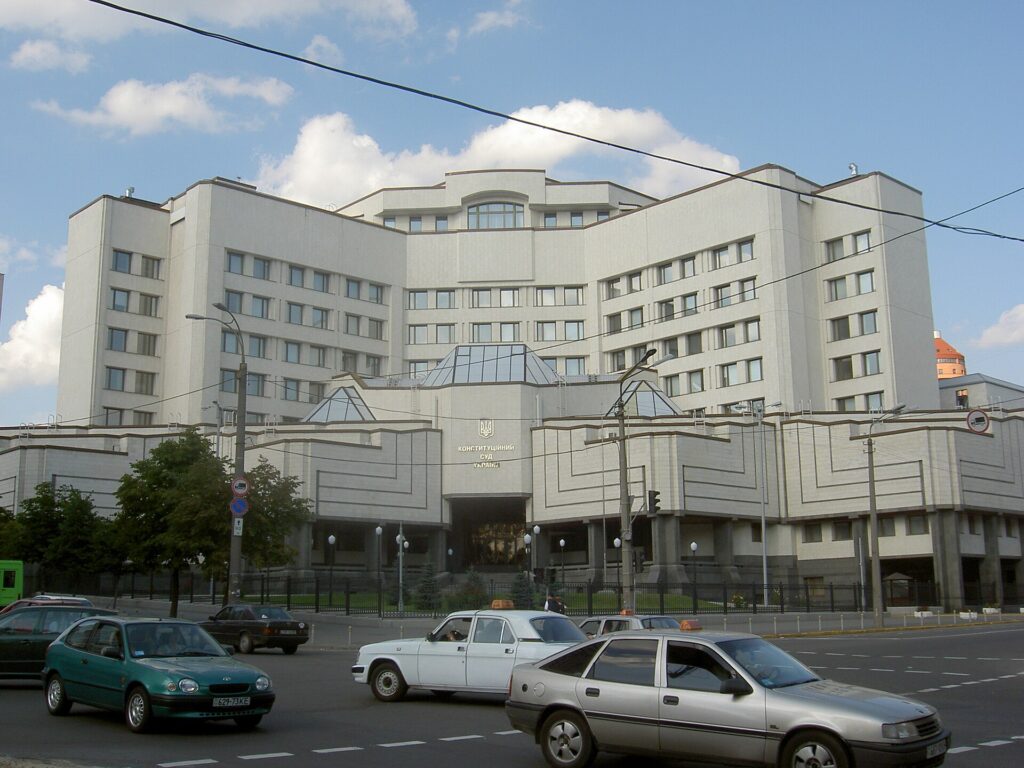
The Constitutional Court has 18 justices, six each appointed by the President, the Verkhovna Rada, and the Congress of Judges. Their term is nine years, non-renewable. The first condition was to introduce, before such appointments, a mechanism screening candidates’ moral qualities and legal competence.
On December 13, 2022, the Verkhovna Rada passed a law (No. 2846-IX) establishing an “Advisory Group of Experts” to conduct this screening. The Venice Commission issued an urgent opinion on November 23 of that year and adopted its opinion at its plenary session on December 16-17. Among its recommendations were setting a time limit on international experts’ involvement, and, as a way to resolve deadlocks, increasing the group to seven members for as long as international involvement continued, with the seventh seat reserved for the international slot.
The Verkhovna Rada then amended the law on July 27, 2023 (No. 3277-IX). In a further opinion of June 2023, the Venice Commission expressed “regret” that the seventh member had not been added, while assessing as a major improvement the fact that the international-slot member was given a decisive vote.
Under the current law, the Advisory Group of Experts has six members: one each appointed by the President, the Verkhovna Rada, and the Congress of Judges, one nominated by the Venice Commission, and two nominated by international organizations, all appointed by the Cabinet of Ministers. This arrangement is a transitional measure for six years from the law’s entry into force; during that period, decisions require at least four votes, of which at least two must come from international-slot members. If a vote is tied and a revote also fails to decide the matter, the votes of three members, including the two international-slot ones, become decisive. In October 2023, the Cabinet appointed the international-slot members and the Group began operating. The European Commission’s 2023 report judged this first condition “fulfilled” as well.
| Date | Event |
|---|---|
| July 2021 | Laws restarting the High Qualification Commission of Judges and changing how High Council of Justice members are selected |
| February 2022 to January 2023 | The High Council of Justice lacks a quorum |
| June 17, 2022 | European Commission opinion. Two judicial measures among the conditions for candidate status |
| December 13, 2022 | Law establishing pre-selection screening for Constitutional Court justices (No. 2846-IX) |
| June 2023 | The High Council of Justice appoints 16 members to the High Qualification Commission of Judges |
| July 27, 2023 | Amendment to the pre-selection law (No. 3277-IX) |
| October 2023 | The Advisory Group of Experts begins operating |
| June 15, 2026 | Opening of negotiations on the “Fundamentals” cluster (including the chapter on the judiciary and fundamental rights) |
What the 2025 Report Pointed Out
Though the conditions were judged “fulfilled,” the European Commission’s November 2025 report notes that the mechanisms are still not stable.
- In January 2025, several justices’ terms expired at once and the Constitutional Court fell below its quorum of 12. In February the Advisory Group of Experts recommended 10 candidates for 5 vacancies, and the President appointed a total of 2 in June and September, restoring the quorum. But in October the Verkhovna Rada was unable to appoint its own two
- Since spring 2025, the High Council of Justice has been operating with the bare minimum quorum of 15 out of 21. In October the President appointed two who had already been vetted. Citing martial law, the Congress of Advocates had not begun selecting its own two
- The term of the selection commission that chooses High Qualification Commission members, which includes international experts, expired in June 2025. The European Commission is calling for extending international experts’ involvement rather than forming the next selection commission solely from representatives of unreformed domestic bodies
- It expressed “serious concern” over growing pushback — including Constitutional Court challenges and draft bills — against the entire selection and vetting process involving international experts
- Qualification assessments of sitting judges had covered 2,549 by September 2025, with 1,413 remaining. Judicial vacancies stood at 2,198 as of August 2025
Negotiations Start with “Fundamentals”
On June 15, 2026, the EU and Ukraine opened the “Fundamentals” cluster as the first area of negotiation. Chapter 23, covering the judiciary and fundamental rights, is included here. According to the European Commission’s announcement, the rule-of-law chapter carries interim benchmarks, and without meeting them, negotiators cannot move to the stage of provisionally closing the chapter. This area is opened first and closed last, and is said to set the pace for the whole negotiation.
The judicial reform that was a condition for candidate status has, in the course of negotiations, entered a phase where it is being tested on whether the mechanisms actually keep running. On the events surrounding the independence of anti-corruption bodies, see also Ukraine’s Anti-Corruption Bodies, and the Nine Days in July 2025 When Their Independence Wavered.
Sources and article record
Sources and references
- Commission Opinion on Ukraine's application for membership of the European Union, COM(2022) 407 finalJune 17, 2022 — two of the seven measures underlying candidate status that concern the judiciary, the need to reform the Constitutional Court
Published by European Commission · Checked: 2026-09-24 - Ukraine 2023 Report, SWD(2023) 699 finalNovember 8, 2023 — assessment of the seven measures, reasons for reform, the High Council of Justice's 10 of 15 members leaving and the quorum, the Ethics Council's vetting, the High Qualification Commission's selection [301, 64, 32, 16], the launch of the Advisory Group of Experts
Published by European Commission · Checked: 2026-09-24 - Ukraine 2025 Report, SWD(2025) 759 finalNovember 4, 2025 — the Constitutional Court's quorum and appointments, the High Council of Justice's composition, the selection commission's term, opposition to international involvement, qualification assessments and vacancy numbers
Published by European Commission · Checked: 2026-09-24 - EU and Ukraine open first accession negotiations clusterJune 15, 2026 — the “Fundamentals” cluster, Chapter 23, interim benchmarks
Published by European Commission (DG Enlargement and Eastern Neighbourhood) · Checked: 2026-09-24 - Закон України «Про Вищу раду правосуддя» № 1798-VIIIArticle 5's composition, Article 9-1 and transitional provision 23-1 on the Ethics Council's composition, version as of September 23, 2026
Published by Verkhovna Rada of Ukraine (zakon.rada.gov.ua) · Checked: 2026-09-24 - Закон України «Про судоустрій і статус суддів» № 1402-VIIIthe High Qualification Commission of Judges' membership of 16, of whom 8 are judges
Published by Verkhovna Rada of Ukraine (zakon.rada.gov.ua) · Checked: 2026-09-24 - Закони України № 1629-IX (13 липня 2021 р.) та № 1635-IX (14 липня 2021 р.)titles and dates
Published by Verkhovna Rada of Ukraine (zakon.rada.gov.ua) · Checked: 2026-09-24 - Закон України «Про Конституційний Суд України» № 2136-VIIIArticle 9's membership and appointments, Article 10's quorum, Article 10-2, Article 16's nine-year term, transitional provisions 4, 5 and 20 on the Advisory Group of Experts
Published by Verkhovna Rada of Ukraine (zakon.rada.gov.ua) · Checked: 2026-09-24 - Закони України № 2846-IX (13 грудня 2022 р., законопроєкт № 7662) та № 3277-IX (27 липня 2023 р., законопроєкт № 9322)titles, dates and bill numbers
Published by Verkhovna Rada of Ukraine (zakon.rada.gov.ua) · Checked: 2026-09-24 - Opinion on the draft law on amending some legislative acts of Ukraine regarding improving procedure for selecting candidate judges of the Constitutional Court of Ukraine on a competitive basis, CDL-AD(2022)054adopted December 16-17, 2022, urgent opinion of November 23, paragraph 72 of the conclusions
Published by Venice Commission, Council of Europe · Checked: 2026-09-24 - Follow-up opinion (Draft Law No. 9322 of 25 May 2023), CDL-AD(2023)022adopted June 9-10, 2023, paragraph 40 of the conclusions
Published by Venice Commission, Council of Europe · Checked: 2026-09-24
If you find an error in this article, please tell us via Corrections. Once we have checked it, we will record in the article what was corrected and why.
Related articles
-
Crimean Tatars, Karaites, Krymchaks: Ukraine’s Law on Indigenous Peoples
In a 2021 law, Ukraine recognized three peoples formed on the Crimean Peninsula — Crimean Tatars, Karaites, and Krymchaks — as indigenous peoples. In April 2026, the Cabinet granted legal status to the Mejlis, the Crimean Tatars' representative body. This article also sums up what the International Court of Justice did and did not find regarding the Mejlis, which Russia has banned.
-
The Trojan Hero Becomes a Cossack ── Kotliarevsky’s Eneida
The Eneida rewrote Aeneas, the hero of Virgil's epic, as a Cossack youth who speaks Ukrainian vernacular. This article traces, through encyclopedias and the text itself, the feast scenes with halushky and borscht, the new ten-line stanza form, and what the work meant for turning Ukrainian into a literary language. In 2026, its first Japanese translation was published.
-
Ukraine’s National Cashback: Up to 15% Back on Ukrainian-Made Goods
Since September 2024, Ukraine has run a “National Cashback” program that returns part of the price when people buy Ukrainian-made goods. The refund rate has changed from a flat 10% to 5% or 15% depending on the share of imports in each product category, and in May 2026 the program entered its second stage. Based on the text of the Cabinet resolutions and announcements from the Ministry of Economy, this article sums up how the system works, what the money can be used for, and the scale of its use.