

Section
Culture & History
Food, music, literature and crafts: Ukrainian culture and the history behind it.
-
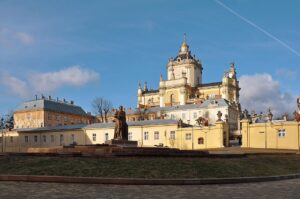
Erased in 1946, Back Aboveground 43 Years Later: The Greek Catholic Church
The Ukrainian Greek Catholic Church, which keeps the Eastern rite while being in communion with the Pope of Rome, began with the union of 1596. This article traces its path from being dissolved by the Soviet "sobor" of 1946, through continuing worship underground, to being recognized again in 1989, along with the spread of its faithful shown in a 2025 survey.
-

Floating Wreaths on the River, Leaping Over Fire: The Midsummer Festival of Ivan Kupala
Ukraine's midsummer festival Ivan Kupala survives as a pre-Christian ritual that came to overlap with the feast day of John the Baptist. Under the old calendar it fell in July, but the 2023 calendar reform moved the church feast to June 24. This article covers the wreath and fire customs, the songs, and the changes of the Soviet era as recorded in the encyclopedias.
-
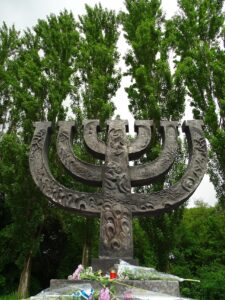
The Ravine Whose Monument Didn’t Say “Jews”: Kyiv’s Babyn Yar
On September 29 and 30, 1941, Nazi German forces shot Jews at Babyn Yar, a ravine in occupied Kyiv. The killing continued for two years, and the monument the postwar Soviet Union built in 1976 made no mention of Jews. This article traces where the death-toll figures come from, the reserve established after independence, and events up to Russia's missile strike of March 1, 2022.
-
The Odesa Film Studio Where Dovzhenko Began Making Films
The Odesa Film Studio was founded in 1919 and was the center of Ukrainian filmmaking in the 1920s. It was here that Dovzhenko made his first films. From the 1930s it went through a period of being used as a base for Moscow studios, and today it is a private joint-stock company that has also seen a court battle over the state's stake. This article traces its changes of name, its major works, and its current ownership.
-
The Healer Invited to Medzhybizh in 1740: the Baal Shem Tov and Hasidism
Hasidism, the Jewish religious movement, emerged in 18th-century Podillia around the healer known as the Baal Shem Tov. Drawing on two encyclopedias, this article traces the town of Medzhybizh where he lived from 1740, his teaching of joy rather than asceticism, the movement his disciples spread, and his great-grandson Nachman of Bratslav, who is buried in Uman.
-
The Tale of Ihor’s Campaign: an Epic Whose Original Was Lost to Fire in 1812
In 1185, Prince Ihor of Novhorod-Siverskyi was defeated and captured in battle against the Cuman-Polovtsian nomads. The Tale of Ihor's Campaign, an epic about this defeat, had its manuscript discovered in 1795 and published in 1800 — only for the original to be lost in a fire in 1812. This article sets out the content of the work, the long debate over whether it is authentic, how it has been read in Ukraine, and its Japanese translations.
-
Mavka of the Forest, Rusalka of the River, Domovyk of the Home: the Spirits of Ukrainian Folklore
Ukrainian folklore features many named spirits — the water spirit Rusalka, who lures young men by the riverbank, the forest spirit Mavka, the ghost of a young woman who lives in the woods, and Domovyk, who guards the household hearth, among others. Drawing on encyclopedia entries, this article sets out what each looks like, how these beliefs survived by overlapping with Christian holidays, the folklorists who recorded them, and the literary works that drew on them.
-
Masked Youths Go House to House on the Eve of Saint Melania’s Day: Ukraine’s “Malanka”
"Malanka" is a Ukrainian folk custom in which young people put on costumes and go from house to house on the eve of the new year, the evening of Saint Melania's Day. Encyclopedias describe a young man dressed as the female Malanka, and a goat character, visiting houses, playing pranks, and finishing with carols. Ukraine's national inventory of intangible cultural heritage lists three entries — the Bukovyna Malanka, the Malanka of the village of Bileluia, and a nationwide "Bountiful Evening" tradition. This article also explains why the date splits between December 31 and January 13.
-
Ninety Seconds of a Kharkiv Procession, September 1896: The Photographer Fedetsky
On September 30, 1896, Kharkiv photographer Alfred Fedetsky filmed a religious icon procession moving through the city, on about a minute and a half of film. On December 2 he screened his own footage at the opera house. This article traces just over a year in which a photographer already known for his portraits took up filmmaking, drawing on encyclopedias and a research monograph, and looks at what different claims of "the first film in Ukraine" actually count.
-
From 33 Student Films to a Kyiv Institution: The Molodist Film Festival
Kyiv's international film festival Molodist began in 1970 as a screening of 33 student films from a theater school's film department over two days. It was registered as an international film festival with the International Federation of Film Producers Associations (FIAPF) in 1993, and held its 54th edition in autumn 2025. Drawing on the organizers and encyclopedias, this article traces how it began, when it became "international," and its record from the 2020 postponement to the December 2022 edition.