
All articles
-
From 10% to 25%, Now 16%: The National Bank of Ukraine’s Key Policy Rate
In June 2022, under the full-scale invasion, the National Bank of Ukraine raised its key policy rate from 10% to 25%. It began cutting the rate from July 2023, raised it again from December 2024, and has held it at 16% since 18 September 2026. This article summarises the inflation figures and reasons the National Bank gave for each decision, and the mechanics of its 5% inflation target.
-
Nearly 30% of the EU’s Organic Grain Imports Come from Ukraine: Its Organic Laws and Certification
In 2025, 27.7% of the organic grain the EU imported came from Ukraine, the largest share of any single country. Ukraine has a 2018 law and a national “organic” logo, but most of its organic exports have been certified under EU or US standards. A new law adopted in 2026 will replace the old one in July 2029.
-
Ukrainian-Language Books Approach 90%: Ukraine’s Publishing Industry in Numbers
Ukraine published 15,069 books and pamphlets in 2025, with Ukrainian-language titles accounting for close to 90% of them. Drawing on statistics from the Book Chamber of Ukraine and the text of the relevant laws, this article covers the drop in the number of titles published to less than half in 2022, the ban on importing books from Russia and Belarus that took effect in 2023, and support measures such as the “єКнига” (yeKnyha) book-purchase grant for 18-year-olds and rent subsidies for bookshops.
-
The Procedures and Contact Points for Importing Ukrainian Food Into Japan
Importing food from Ukraine to Japan runs through the Food Sanitation Act, the Plant Protection Act, the Act on Domestic Animal Infectious Diseases Control, the Food Labeling Act, the Customs Act, and the Foreign Exchange and Foreign Trade Act, each at a different checkpoint. This article lays out, statute by statute and against public materials, how to file an import notification, what became of the provisional limit set after the Chornobyl accident, why an EPA tariff rate is not available, and whether exporting-country certificates can be obtained in wartime. Item-specific requirements must be confirmed with the competent authorities.
-
Mountain Spirits and a Summer of Shepherding: Kotsiubynsky’s Shadows of Forgotten Ancestors
Shadows of Forgotten Ancestors (1911), the novella by Mykhailo Kotsiubynsky that inspired the film of the same name (also known as Wild Horses of Fire), is set in a Hutsul village high in the Carpathians. This article traces the novella itself — Ivan and Marichka, born into feuding families, life at the summer mountain pastures, and mountain spirits and a sorcerer — while checking the writer's life and the years he stayed in the village against the encyclopedias.
-
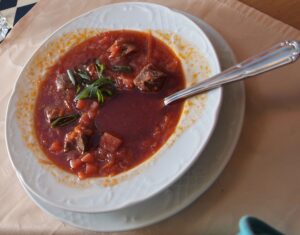
Ukraine’s Table — Borscht’s UNESCO Listing, and Cuisine That Changes by Region
Borscht's UNESCO listing is not on the Representative List but on the List of Intangible Cultural Heritage in Need of Urgent Safeguarding. This article covers grain porridges, the eastern and western forms of paska bread, regional groupings of cuisine, and drinks and pork products. Claims of origin that could not be verified are gathered at the end of the article.
-
55 of 400 Tales Feature the Fox: Ukraine’s Animal Folktales, Published in 1916
In Ukrainian, folk tales with animals as the main characters are called “baika,” distinct from “kazka,” tales in which people are the main characters. In 1916 the folklorist Volodymyr Hnatiuk collected 400 of these tales and organised them by animal into a two-volume book. Drawing on the book's preface and table of contents, this article traces who recorded the tales and where, how tales of the fox and the wolf were classified, and how the war delayed publication.
-
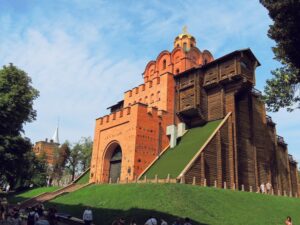
From Kyivan Rus’ to the 16th Century — Galicia-Volhynia and Two Unions
This article traces the history of the land that is now Ukraine before the Cossacks emerged as a political force: from the Trypillia culture of around 5000 BCE, through the Greek colonies on the Black Sea coast, Kyivan Rus', and the Grand Duchy of Lithuania, to the Union of Lublin in 1569 and the Union of Brest in 1596. The view of Kyivan Rus' as the state of a single "Old Rus' nationality" is the official framework put forward by a panel of historians commissioned by the Soviet Communist Party in the 1930s. Ukrainian historiography since Hrushevsky has regarded the Principality of Galicia-Volhynia as the successor to the Kyivan state.
-
How to Arrange 14,000 Proverbs: The Collections of Nomys and Franko
Ukrainian proverbs were compiled into numbered books in the 19th century. Nomys's 1864 collection arranges tens of thousands of proverbs by theme, while Franko's collection of 1901–10 arranges them alphabetically by keyword. This article introduces the man behind the pen name, the difference in how they were arranged, and seven proverbs with their original numbers and page references.
-
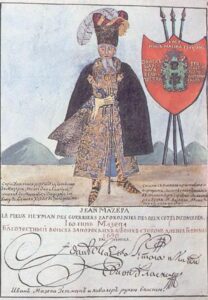
From the End of Cossack Self-Rule to the Ban on Ukrainian-Language Publishing
This article traces the period from the Khmelnytsky Uprising of 1648, through the 1654 Pereiaslav Agreement (whose original document does not survive), the abolition of the office of hetman in 1764 and the destruction of the Sich in 1775, to the bans on Ukrainian-language publishing in 1863 and 1876, up to the eve of the First World War. The harm the Jewish community suffered during the uprising is presented through the divergence between different estimates, rather than a single figure.