
The Advisory Body Recommended “Deferral” ── The Residence of the Metropolitans of Chernivtsi
The main building of Chernivtsi University was built between 1864 and 1882 as the residence of the Orthodox metropolitans of Bukovina and Dalmatia. In 2011, UNESCO's advisory body recommended deferring its World Heritage listing, but the World Heritage Committee decided to inscribe it anyway. This article covers the architect Hlávka, how the residence became a university, and where the assessments diverged.
The main building of Yuriy Fedkovych Chernivtsi National University was not originally built for the university at all. Between 1864 and 1882 it was built as the residence of the Orthodox metropolitans who governed Bukovina and Dalmatia. In 2011, this cluster of red-brick buildings was inscribed on UNESCO’s World Heritage List as the “Residence of Bukovinian and Dalmatian Metropolitans.”
Before the inscription, UNESCO’s advisory body ICOMOS (International Council on Monuments and Sites) had recommended deferring the listing of this building complex. The World Heritage Committee reached a different judgment from that recommendation. Let’s follow this story from how the building came to be, through to where the assessments diverged.
Three Buildings on a Hill Overlooking the Prut River
According to ICOMOS’s evaluation, the World Heritage property covers 8 hectares, with a 244.85-hectare buffer zone around it that also includes the old town. The building complex stands on the slope of a hill flanked by the Prut River and its tributary. Behind a walled front courtyard measuring 100 by 70 meters stands the main building — the metropolitan’s former residence — at the front; to the left, the seminary wing and the “Church of the Three Hierarchs” (dedicated to Saint Basil the Great, Saint John Chrysostom, and Saint Gregory the Theologian); to the right, the monastic wing with its clock tower; and behind it all, a garden and an English-style park.
The World Heritage Committee’s decision describes this building complex as an outstanding example of 19th-century historicist architecture expressing the cultural distinctiveness of the Orthodox Church within the Austro-Hungarian Empire. It states that the dome-topped, cross-shaped church draws on Byzantine forms, and that the patterns picked out on the roof in differently glazed tiles represent the folk culture of the local people. ICOMOS’s evaluation notes that the dome of the clock tower on the monastic wing bears a Star of David ornament, a token of gratitude to the town’s Jewish community, which helped fund the construction. Ukraine’s national encyclopedia, the Great Ukrainian Encyclopedia (ВУЕ), likewise writes that the town’s German and Polish Catholic communities and its Jewish community all contributed to the construction.
Josef Hlávka, the Architect from Bohemia
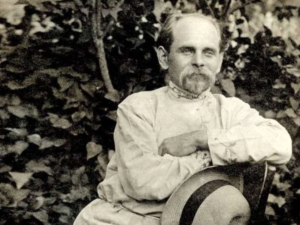
The design and construction were carried out by Josef Hlávka. According to ВУЕ, he was born on February 15, 1831, in what is now Přeštice in the Czech Republic, and died on March 11, 1908, in Prague. He studied at the Prague Polytechnic and the Vienna Academy of Fine Arts, and led a construction firm in Vienna; in 1890–91 he provided the financial backing for the founding of what is now the Czech Academy of Sciences and became its first president.
The state commissioned the residence’s design in 1861 (ВУЕ notes that “other sources say late 1860”), and Emperor Franz Joseph I approved the design in 1863. ВУЕ regards this residence as the finest of the works Hlávka designed and built, and states that the design won second prize at the 1867 Paris World’s Fair. According to ВУЕ, construction cost 1.75 million Austrian gulden, funded by the Bukovinian Orthodox Church’s religious fund. A bust of Hlávka was placed in the garden behind the residence in 1937.
The Habsburg Empire’s Bukovina and the Orthodox Church
According to the Internet Encyclopedia of Ukraine (IEU, published by the Canadian Institute of Ukrainian Studies, or CIUS, at the University of Alberta), Austria annexed the northern part of Moldavia, including Chernivtsi, taking advantage of the Russo-Turkish War (1768–74), and this region was named “Bukovina.” It became a crown land with its own administration in 1849. The same encyclopedia gives the ethnic makeup of Bukovina’s population, according to Austria’s 1910 census, as 40% Ukrainian, 34% Romanian, 11% Jewish, 9% German, and 3% Polish. The Jewish, German, and Polish populations lived mainly in towns, especially Chernivtsi.
According to ICOMOS’s evaluation, the diocese of Bukovina was later merged with that of Dalmatia, and in 1873 Bishop Yevhen Hakman was designated by imperial decree Archbishop of Chernivtsi and Metropolitan of Bukovina. It was he who proposed building the new residence. The metropolitan see had dioceses in what are now Zadar in Croatia, Kotor in Montenegro, as well as Trieste, Vienna, and Prague. ICOMOS writes that this residence, built with the fund’s money and with the permission of the Austrian Ministry of Religion, was a political declaration of imperial tolerance toward the most influential religious group among Bukovina’s residents — while adding that it could also be seen not so much as genuine tolerance as a skillful form of rule that granted each denomination its freedom.
From Metropolitan’s Residence to University
The university itself began separately from the residence. According to the university’s official website, it was founded by an imperial decree of Emperor Franz Joseph on March 31, 1875, and opened on October 4 of the same year as “Franz Joseph University.” The language of instruction was German. According to IEU, in the Austrian period it had three faculties — theology (Orthodox), law, and philosophy — and the philosophy faculty also housed a chair in Ukrainian language and literature. Many students came not only from Bukovina but from Galicia as well, including the writer Ivan Franko. According to ВУЕ, the university’s theology faculty moved into the seminary wing of the residence starting in 1875.
After the First World War, Bukovina became part of the Kingdom of Romania, and the university became a Romanian-language institution. When the northern part of Bukovina was annexed by the Soviet Union in 1940, the language of instruction switched to Ukrainian. According to ICOMOS’s evaluation, the residence was designated a state protected area in 1945 (rendered as a “national park” in the English text of the World Heritage Committee’s decision), and transferred in 1955 to what became Chernivtsi National University. The university’s official website states it was transferred by a 1955 decision of the Council of Ministers of the Ukrainian Soviet Socialist Republic. ВУЕ and IEU’s entry on “Chernivtsi,” on the other hand, both give the year as 1956.
The building was damaged by war. ВУЕ writes that in 1944, as the metropolitan withdrew along with Romanian forces, a fire was set in the main building, destroying the interior decoration of the great hall in the east wing. ICOMOS’s evaluation states that the wooden ceiling of the Assembly Hall (the Marble Hall) was lost in a fire in 1942 and, in the 1950s, replaced with a ceiling painted in the Stalinist style. The discrepancy in the year has not been resolved between the sources. According to ICOMOS’s evaluation, once the Soviet era ended, the Church of the Three Hierarchs resumed functioning as a church.
A Recommendation to “Defer,” and the World Heritage Committee’s Inscription
According to ICOMOS’s evaluation, Ukraine added this building complex to its Tentative List on June 11, 2007 (ВУЕ says 2009), and submitted the nomination on January 29, 2010. Ukraine argued that it met four criteria, (i) through (iv), but in its March 2011 evaluation, ICOMOS judged that none of the criteria had been “demonstrated at this time.” The main reasons were as follows.
- Insufficient comparative analysis: Hlávka produced around 150 works, yet the claim that this residence is his masterpiece was not backed up by comparison with his other works
- No discussion of why this style was chosen within the broader context of 19th-century European historicist architecture
- Insufficient description and photographs of the interiors, and insufficient detail on restoration work, making authenticity hard to judge
On this basis, ICOMOS recommended deferring the inscription, so that the nomination could be re-examined after deepening the comparative analysis and adding a tourism management plan and disaster-preparedness measures to the management plan.
At its 35th session, held at UNESCO headquarters in Paris in June 2011, the World Heritage Committee inscribed the building complex under criteria (ii), (iii), and (iv) — departing from the recommendation (Decision 35 COM 8B.38). As its explanation for criterion (iii), the decision states that the Metropolitan See of Bukovina, which had once extended as far as Trieste on the Adriatic, ceased to exist in 1940, and that its name survives only in historical documents. Alongside this, the committee also recommended creating a tourism management plan, a conservation plan for the garden and park behind the residence, and submitting details of the interior restoration work to UNESCO. According to ВУЕ, a center to manage this World Heritage site was set up within the university in 2012.
Ukraine’s list of World Heritage sites is set out in “Ukrainian Cities and World Heritage,” and the wooden churches of western Ukraine, older than the Habsburg era, in the article on the wooden churches of the Carpathians.
Sources and article record
Sources and references
- Decisions adopted by the World Heritage Committee at its 35th session (UNESCO, 2011), WHC-11/35.COM/20, Decision 35 COM 8B.38the inscription decision, criteria (ii)(iii)(iv), the retrospective statement of outstanding universal value, 1945 and 1955, the three-point recommendation
Published by UNESCO World Heritage Committee · Checked: 2026-09-24 - Advisory Body Evaluation No 1330: Residence of Bukovinian and Dalmatian Metropolitansapproved March 2011. Area 8 ha, buffer zone 244.85 ha; the composition and construction sequence of the buildings; the Star of David; the 1873 metropolitan; 1945 and 1955; the 1942 fire; June 11, 2007 tentative listing; comments on each criterion; the recommendation to defer inscription
Published by ICOMOS (as posted by UNESCO) · Checked: 2026-09-24 - Резиденція митрополитів Буковини і Далмації в Чернівцяхwritten by V. V. Vecherskyi, published November 29, 2022. Design approval in 1863, construction costs and funding, the religious communities that contributed, construction years for each building, the 1944 fire, the 1956 transfer, the 2012 management center
Published by Велика українська енциклопедія · Checked: 2026-09-24 - Главка, Йозефwritten by V. V. Vecherskyi, published May 2, 2024. Dates and places of birth and death, education, the 1861 commission, second prize at the 1867 Paris World's Fair, the founding of the Czech Academy of Sciences
Published by Велика українська енциклопедія · Checked: 2026-09-24 - Chernivtsi National Universityrevised 2021. The 1875 founding, a German-language university, Romanianization and the Soviet period, the main building from 1955, Franko and other students
Published by Internet Encyclopedia of Ukraine (CIUS) · Checked: 2026-09-24 - Chernivtsithe design and construction of the residence 1864–82, the 1956 incorporation into the university, the metropolitan see from 1873
Published by Internet Encyclopedia of Ukraine (CIUS) · Checked: 2026-09-24 - BukovynaAustria's 1774 annexation, the 1849 crown land, the ethnic makeup per Austria's 1910 census, the 1940 partition
Published by Internet Encyclopedia of Ukraine (CIUS) · Checked: 2026-09-24 - Про університетthe imperial decree of March 31, 1875 and the October 4 opening, changes to the university's name, the transfer under a 1955 decision of the Council of Ministers of the Ukrainian Soviet Socialist Republic
Published by Chernivtsi National University named after Yuriy Fedkovych · Checked: 2026-09-24
If you find an error in this article, please tell us via Corrections. Once we have checked it, we will record in the article what was corrected and why.
Related articles
-
From ‘Shchedryk’ to ‘Carol of the Bells’: How One Melody Became Two Songs
The melody of the Christmas standard "Carol of the Bells" comes from the Ukrainian New Year's song "Shchedryk." It crossed to North America at a Carnegie Hall concert on October 5, 1922, and gained its English lyrics in 1936 — lyrics that are not a translation of the original. Drawing on primary sources, this article traces where one melody split into two songs.
-
Does One in Ten Speak Surzhyk, or One in Five? A Mixed Speech That Changes with How You Count
Surzhyk is a form of speech mixing Ukrainian and Russian. Its name comes from mixed grain flour. Depending on the survey, the share of speakers who use it comes out at 11–18% when interviewers judge by ear, and close to one in five say they speak "both about equally" when asked directly. This article lays out how dictionaries and encyclopedias describe it, why survey figures diverge, how it is evaluated, and how it appears in literature and on stage.
-
The EJU Is Held in June and November; Overseas Venues Are 17 Cities in Asia
The Examination for Japanese University Admission (EJU), required by many schools of international students entering a Japanese university, is held every year in June and November. Subjects are Japanese, science, general subjects, and mathematics, chosen to match what your target school specifies. Overseas venues are limited to 17 Asian cities, with none in Ukraine or nearby countries. 950 schools use it (as of September 2026).