
The Year After Ukrainian-Language Publishing Was Banned in the Russian Empire, the University of Tokyo Opened in Japan
The Ems Ukase of 1876 banned the printing of Ukrainian-language books within the Russian Empire. The following April, in 1877, the University of Tokyo opened in Japan. Starting from Eneida (1798) and Kobzar (1840), published before the ban, this article lines up events from Perry's arrival to 1919, taking care over the difference between the two countries' calendars.


The Internet Encyclopedia of Ukraine’s (published by the Canadian Institute of Ukrainian Studies, CIUS, at the University of Alberta) entry on the Ems Ukase states that, as a result of the decree, not a single Ukrainian-language book was printed in 1877. The same encyclopedia’s entry on Book publishing states that the number of Ukrainian-language books in Russian-ruled Ukraine fell from 30 in 1875 to 2 in 1877. In Austrian-ruled Galicia, more Ukrainian-language books were published in 1875 than in Russian-ruled Ukraine (same entry). In April of the same 1877, the University of Tokyo opened in Japan (National Archives of Japan, “The Course of Japan” chronology).
After Being Divided Between Two Empires, Before the Ban
Before that, control of the land had already changed hands, through the three partitions of Poland in 1772, 1793, and 1795. IEU’s entry on Poland states that, through these partitions, Russia gained most of the Ukrainian lands that had belonged to Poland, while Galicia was annexed to the Austrian Empire. According to the entry on Galicia, Galicia came under Austrian rule in the First Partition of 1772, and that rule continued until 1918. The entry on Podilia states that the western part of Podilia passed to Austria in 1772, and the eastern part to Russia in the Second Partition of 1793. The “Austrian-ruled Galicia” that appears later in this article begins with this First Partition.
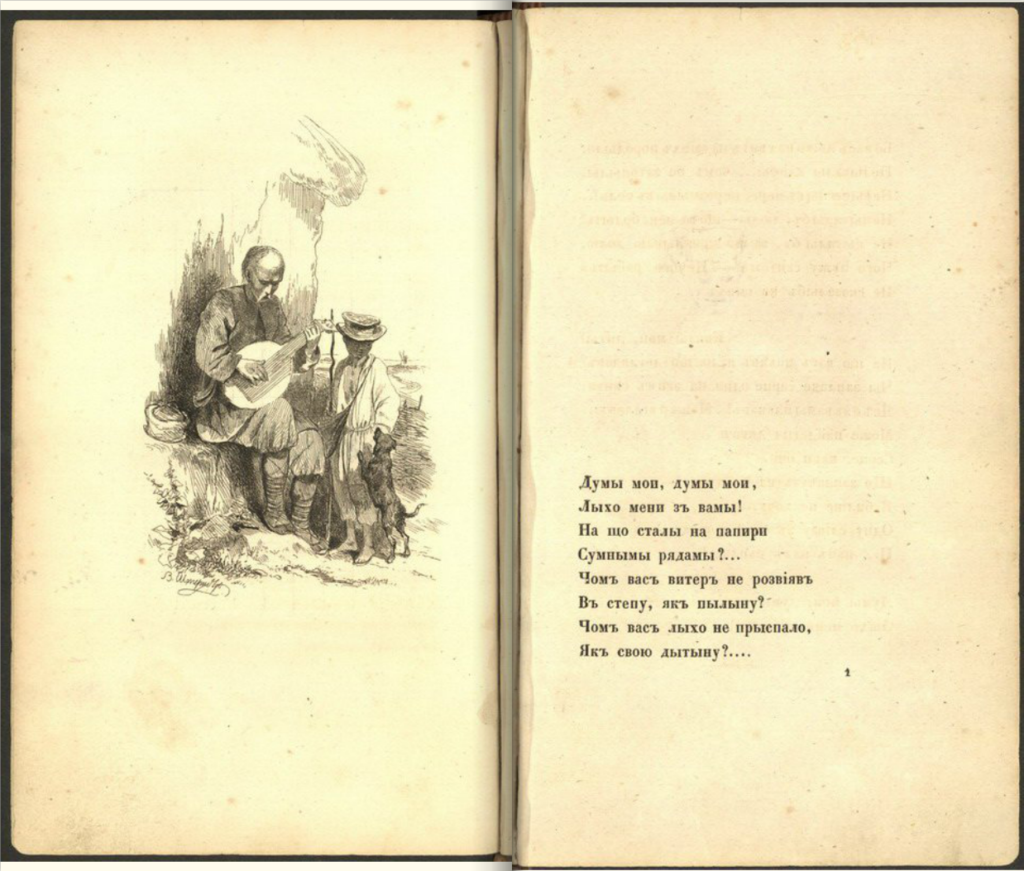
Before printing was stopped, Ukrainian-language literature had already appeared in book form. According to IEU’s entry on Ivan Kotliarevsky, Kotliarevsky began writing Eneida, a burlesque reworking of Virgil’s epic Aeneid, in 1794, and its first three parts were published in Saint Petersburg in 1798. The cost of publication was borne by Maksym Parpura. Part four appeared in 1809. Parts five and six were completed around 1820, but the first edition containing all six parts was not published until after the author’s death, in Kharkiv in 1842.
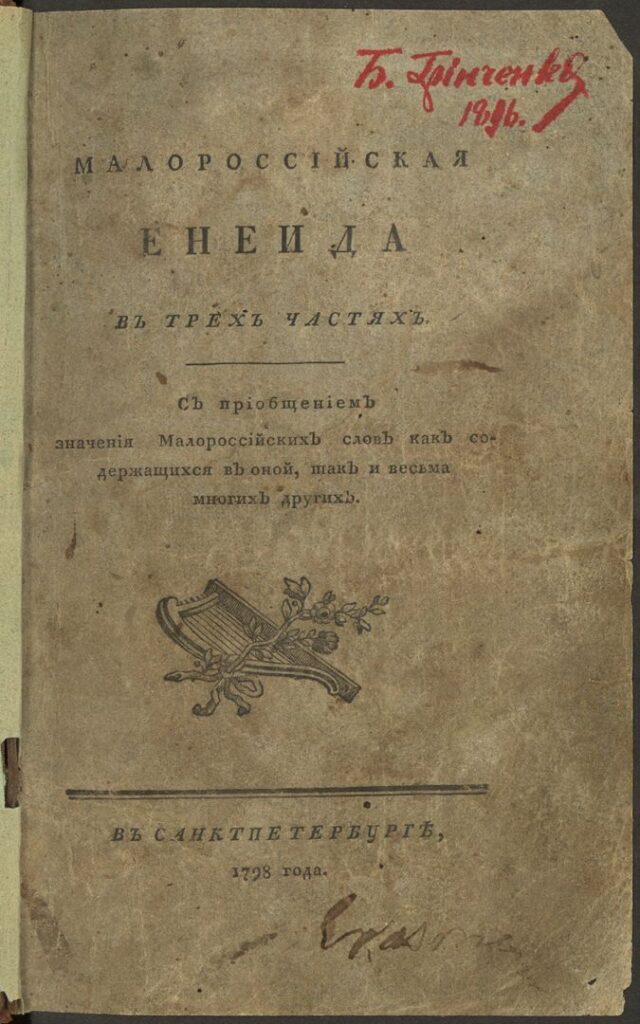


According to IEU’s entry on Taras Shevchenko, he was bought out of serfdom and freed on 5 May 1838, and entered the Imperial Academy of Arts in Saint Petersburg. In 1840, his first collection of poems, Kobzar, was published in the same city — a book containing eight poems. The same entry positions this collection as marking the beginning of a new era for Ukrainian literature and the development of the modern Ukrainian language.
The same entry on Book publishing counts 3 Ukrainian-language books published in Russian-ruled Ukraine in 1848 and 41 in 1862. After the Valuev Circular of 1863, the number fell to 5 in both 1865 and 1870.
A Secret Decree Stops the Presses
According to IEU, the Ems Ukase was a secret decree issued on 30 May 1876 by Tsar Alexander II of Russia at the German spa town of Bad Ems, aimed at stopping the printing and distribution of Ukrainian-language publications within the Russian Empire. It extended the circular that Interior Minister Pyotr Valuev had issued in 1863. Even within IEU itself, the date of that circular is inconsistent: the Ems Ukase entry gives 20 June, while the Petr Valuev entry gives 30 July.
According to the same entry, the decree banned the printing of original Ukrainian-language works and translations; historical documents could be printed in their original orthography, but literary works could only be printed using Russian orthography. It also banned importing Ukrainian-language publications from abroad, staging Ukrainian-language plays and public readings, and printing Ukrainian-language lyrics for musical works, and required all permitted manuscripts to undergo prior censorship.
IEU further records that the decree was issued bypassing the normal legislative process — it was never submitted to the State Council or the Council of Ministers, and it was never formally repealed. Around the same time, the Southwestern Branch of the Imperial Russian Geographical Society in Kyiv and the Russian-language newspaper Kievskii telegraf (the paper’s name in the Russian spelling used at the time) were shut down, and several professors, including Mykhailo Drahomanov, were expelled from Kyiv University.
Around the Same Time, Japan’s Chronology Carried Two Dates
The National Diet Library’s chronology, “Japan in the Modern Era as Seen in Historical Records,” gives two dates side by side for events before the Meiji era: on the 3rd day of the 6th month of Kaei 6 (8 July), the US East India Squadron under Commodore Perry arrives at Uraga; on the 3rd day of the 3rd month of Kaei 7 (31 March), the Treaty of Kanagawa is signed; on the 19th day of the 6th month of Ansei 5 (29 July), the Treaty of Amity and Commerce is signed; and on the 14th day of the 10th month of Keiō 3 (9 November), Tokugawa Yoshinobu submits his petition to return power to the emperor (taisei hōkan).
The date outside the parentheses is the lunisolar calendar; the one inside is the Gregorian calendar. According to the National Archives of Japan’s chronology, Japan adopted the solar calendar in November of Meiji 5 (1872). Any Gregorian-calendar date given for a time before that necessarily involves conversion.
The Russian Empire’s calendar also differed from Western Europe’s. According to IEU’s entry on the Calendar, the civil calendar in Ukraine switched to the Gregorian calendar in 1918, under the Central Rada. IEU, however, does not specify which calendar underlies individual dates, including 30 May 1876 for the Ems Ukase. When lining up the chronologies of two countries, dates that look alike in form are not necessarily measured against the same yardstick.
In 1853, the year Perry arrived at Uraga, the Crimean War had already begun on the Black Sea side. According to IEU’s entry on the Crimean War (print edition first appeared in Volume 1, 1984), Russia occupied Moldavia and Wallachia in June 1853; the following September, in 1854, an allied force including Britain and France landed in Crimea, and Sevastopol fell on 2 September 1855. The war ended with the Treaty of Paris on 30 March 1856. The same entry states that Ukraine served as a rear area while parts of it also became a battlefield, and suffered great economic damage. Serfdom was abolished in the Russian Empire five years later, on 19 February 1861 (IEU’s entry on Serfdom).
Japan from 1868 to 1890
According to the National Archives of Japan’s chronology, the Battle of Toba-Fushimi took place in January 1868, and the Charter Oath was issued in March. The Education System Order was promulgated in August 1872, and the solar calendar was adopted that November. The Satsuma Rebellion came in January 1877, and the University of Tokyo opened in April.
According to the National Diet Library’s chronology, the Constitution of the Empire of Japan was promulgated on 11 February 1889; the first general election for the House of Representatives was held on 1 July 1890, and the opening ceremony of the first Imperial Diet took place on 29 November.
The Years of War, and Beyond
According to the National Archives of Japan’s chronology, the First Sino-Japanese War began in August 1894 (with the imperial declaration of war), and the Treaty of Shimonoseki was concluded in April 1895. The Russo-Japanese War began in February 1904, followed by the Treaty of Portsmouth in September 1905. The Japan-Korea Annexation Treaty was concluded in August 1910. Japan declared war on Germany in August 1914 and presented the Twenty-One Demands to China in January 1915.
In January 1905, in the midst of the Russo-Japanese War, revolution began in the Russian Empire. According to IEU’s entry on the Revolution of 1905 (print edition first appeared in Volume 4, 1993), by mid-April about 810,000 workers across the empire had gone on strike, of whom 170,000 were in Ukraine. In March of the same year, the Academy of Sciences in Saint Petersburg, stating that Ukrainian was not a dialect of Russian but an independent Slavic language, recommended lifting the restrictions imposed by the Valuev Circular and the Ems Ukase. After the tsar’s manifesto of 30 October, Ukrainian-language newspapers and magazines began to appear in Kharkiv, Kyiv, Poltava, Odesa, and elsewhere, reaching 18 periodicals by 1906. The same entry also records that, from late 1906, official interference again sharply restricted Ukrainian-language publishing.
On contact between Japan and Ukraine, IEU’s entry on Japan (print edition first appeared in Volume 2, 1988) treats the relationship as beginning in the 20th century, placing the first contact in the period of the Russo-Japanese War. M. Sudzilovsky, a former medical student at Kyiv University, traveled from Hawaii to Japan and organized relief for prisoners of war of the Russian imperial army (many of whom, according to the same entry, were Ukrainian). In 1916, Kostiantyn Karmeliuk-Kamensky’s theater troupe performed in Tokyo, Kobe, Yokohama, and Kamakura. In early July 1917, staff of the Japanese embassy in Petrograd visited the Central Rada in Kyiv, and in November Japan stationed a military mission in Kyiv.
17 March 1917, Kyiv
According to IEU’s entry on the Central Rada (written by Arkadii Zhukovsky; print edition first appeared in Volume 1, 1984), the Central Rada was established in Kyiv on 17 March 1917, on the initiative of the Society of Ukrainian Progressives, joined by other parties. Mykhailo Hrushevsky was elected chairman in absentia. After the All-Ukrainian National Congress of 17–21 April that year, the Rada came to consist of 150 members selected from parties, professional bodies, cultural organizations, and provincial representatives, with Hrushevsky as chairman and Serhii Yefremov and Volodymyr Vynnychenko as vice-chairmen.

The same entry states that the Rada led Ukraine from autonomy to independence through four Universals (proclamations), and that the Fourth Universal declared the Ukrainian People’s Republic an independent, sovereign state. According to IEU’s entry on the Universals of the Central Rada, this proclamation was dated 22 January, but it was actually adopted by the Little Rada on 25 January.
In Japan, according to the National Archives of Japan’s chronology, the Siberian Intervention was declared in August 1918, the rice riots spread nationwide that same month, and the Hara Takashi cabinet was formed in September. The Treaty of Versailles was signed in June 1919.
Events Lined Up by Year
| Year | Ukrainian lands and the Russian Empire | Japan |
|---|---|---|
| 1853 | The Crimean War begins (until the Treaty of Paris, March 1856) | Perry arrives at Uraga, 3rd day of the 6th month (8 July) |
| 1861 | Serfdom abolished, 19 February | — |
| 1863 | Valuev Circular | — |
| 1867 | — | Taisei hōkan (return of power) submitted, 14th day of the 10th month (9 November) |
| 1868 | — | Battle of Toba-Fushimi in January; Charter Oath in March |
| 1872 | — | Education System Order promulgated in August; solar calendar adopted in November |
| 1876 | Ems Ukase, 30 May | — |
| 1877 | Number of Ukrainian-language books given as zero or two, depending on the IEU entry | Satsuma Rebellion in January; University of Tokyo opens in April |
| 1889 | — | Constitution of the Empire of Japan promulgated, 11 February |
| 1890 | — | First general election for the House of Representatives, 1 July; opening of the first Imperial Diet, 29 November |
| 1894–95 | — | First Sino-Japanese War begins in August; Treaty of Shimonoseki the following April |
| 1904–05 | Revolution begins in the Russian Empire, January 1905; tsar’s manifesto, 30 October | Russo-Japanese War begins in February; Treaty of Portsmouth the following September |
| 1910 | — | Japan-Korea Annexation Treaty, August |
| 1914 | — | Declares war on Germany, August |
| 1916 | — | Karmeliuk-Kamensky’s theater troupe performs in Tokyo, Kobe, Yokohama, and Kamakura |
| 1917 | Central Rada established in Kyiv, 17 March; All-Ukrainian National Congress, 17–21 April | Staff of the Japanese embassy in Petrograd visit the Central Rada in early July; Japan stations a military mission in Kyiv in November |
| 1918 | Independence declared in the Fourth Universal (dated 22 January; adopted 25 January) | Siberian Intervention declared and rice riots in August; Hara Takashi cabinet formed in September |
| 1919 | — | Treaty of Versailles signed, June |
What Simply Lining Things Up Cannot Tell You
The table in this article has many dashes. This is because these are years covered in only one of the two sources. A blank cell does not mean nothing happened in that place that year.
Sources and article record
Sources and references
- Ems Ukase
Published by Internet Encyclopedia of Ukraine (Canadian Institute of Ukrainian Studies, University of Alberta = CIUS) · Checked: 2026-09-23 - Book publishingprint edition first appeared in Volume 1, 1984; written by Bohdan Kravtsiv, Andrew Turchyn
Published by Internet Encyclopedia of Ukraine (CIUS) · Checked: 2026-09-23 - Valuev, Petrprint edition first appeared in Volume 5, 1993; written by Roman Senkus
Published by Internet Encyclopedia of Ukraine (CIUS) · Checked: 2026-09-23 - Calendarprint edition first appeared in Volume 1, 1984; written by Viktor Pavlovsky
Published by Internet Encyclopedia of Ukraine (CIUS) · Checked: 2026-09-23 - Central Radaprint edition first appeared in Volume 1, 1984; written by Arkadii Zhukovsky
Published by Internet Encyclopedia of Ukraine (CIUS) · Checked: 2026-09-23 - Universals of the Central Radaprint edition first appeared in Volume 5, 1993; written by Arkadii Zhukovsky
Published by Internet Encyclopedia of Ukraine (CIUS) · Checked: 2026-09-23 - 年表/日本のあゆみ
Published by 国立公文書館 · Checked: 2026-09-23 - 年表史料にみる日本の近代
Published by 国立国会図書館 · Checked: 2026-09-23 - Kotliarevsky, Ivanprint edition first appeared in Volume 2, 1988; written by Pavlo Petrenko
Published by Internet Encyclopedia of Ukraine (CIUS) · Checked: 2026-09-23 - Shevchenko, Tarasrevised 2004; written by Myroslav Antokhii, Daria Darewych, Marko Robert Stech, Danylo Husar Struk
Published by Internet Encyclopedia of Ukraine (CIUS) · Checked: 2026-09-23 - Polandprint edition first appeared in Volume 4, 1993; written by B. Kravtsiv, V. Kubijovyč, O. Ohloblyn, I. Lysiak Rudnytsky, M. Zhdan
Published by Internet Encyclopedia of Ukraine (CIUS) · Checked: 2026-09-23 - Galiciarevised 2014; written by Volodymyr Kubijovyč, Yaroslav Pasternak, Illia Vytanovych, Arkadii Zhukovsky
Published by Internet Encyclopedia of Ukraine (CIUS) · Checked: 2026-09-23 - Podiliaprint edition first appeared in Volume 4, 1993, partially revised 2020; written by Volodymyr Kubijovyč, Ihor Stebelsky, Mykhailo Zhdan
Published by Internet Encyclopedia of Ukraine (CIUS) · Checked: 2026-09-23 - Crimean Warprint edition first appeared in Volume 1, 1984; written by Lubomyr Wynar
Published by Internet Encyclopedia of Ukraine (CIUS) · Checked: 2026-09-23 - Serfdomprint edition first appeared in Volume 4, 1993; written by Illia Vytanovych
Published by Internet Encyclopedia of Ukraine (CIUS) · Checked: 2026-09-23 - Revolution of 1905print edition first appeared in Volume 4, 1993; written by John-Paul Himka
Published by Internet Encyclopedia of Ukraine (CIUS) · Checked: 2026-09-23 - Japanprint edition first appeared in Volume 2, 1988; written by Arkadii Zhukovsky
Published by Internet Encyclopedia of Ukraine (CIUS) · Checked: 2026-09-23
Corrections and updates
- Added statements on the publication of Eneida (1798) and Kobzar (1840), and on the number of Ukrainian-language books published before that.
- Added statements on the partitions of Poland (1772, 1793, 1795) and the resulting change in control of Galicia and Podilia.
- Added statements on the Crimean War (1853–56), the abolition of serfdom (1861), the 1905 Revolution, and points of contact between Japan and Ukraine from the Russo-Japanese War period to 1917. Revised the table's 1877 entry to show that the figures are inconsistent between IEU entries.
If you find an error in this article, please tell us via Corrections. Once we have checked it, we will record in the article what was corrected and why.
More in this series
-
From the Founding of Heian-kyō to the Ōnin War: What Was Happening in Kyiv
From the move of the capital to Heian-kyō in 794 to the end of the Ōnin War in 1477, this article lines up what was happening in and around Kyiv during the same years. The year 882, taken as the beginning of Kyivan Rus', comes from a chronicle compiled more than two hundred years after the events it describes. The periodization of Japanese history also varies by source in when each era is said to begin.
-

220 Years from the Founding to the Destruction of the Sich: Japan from Sengoku to Edo
This article lines up the roughly 220 years from around 1552, when a Sich was founded on the Dnipro River, to 1775, when the last Sich was destroyed, against Japan during the same period. The Sich was not a single site; there were eight of them. No original document of the Pereiaslav agreement survives. The Battle of Poltava has two dates.
-

Seventy Years as a Soviet Republic, and Japan During Those Years
This article lines up the period when Ukraine was a Soviet republic — from the 1932 famine to independence in 1991 — against Japan during the same years. It notes who counted the figures of 3.9 million, 33,771, and about 200,000, and how.
Related articles
-
The Tale of Ihor’s Campaign: an Epic Whose Original Was Lost to Fire in 1812
In 1185, Prince Ihor of Novhorod-Siverskyi was defeated and captured in battle against the Cuman-Polovtsian nomads. The Tale of Ihor's Campaign, an epic about this defeat, had its manuscript discovered in 1795 and published in 1800 — only for the original to be lost in a fire in 1812. This article sets out the content of the work, the long debate over whether it is authentic, how it has been read in Ukraine, and its Japanese translations.
-
Ride a Bicycle With Your Phone in Hand and Pay a ¥12,000 Fine: the “Blue Ticket” System From April 2026
From April 1, 2026, if a person aged 16 or older runs a red light or uses a smartphone while cycling, they can be issued a “blue ticket” and required to pay a fine, under a new system. The fines include ¥12,000 for using a phone and ¥6,000 for running a red light. Wearing a helmet is only an effort obligation. The National Police Agency’s materials are not available in Ukrainian.
-
Ten of Fifteen Members Gone: How Ukraine’s Judicial Reform Began with a Council in Crisis
When the EU granted Ukraine candidate status, the first two conditions concerned the judiciary: remaking, with the involvement of international experts, the council that appoints judges, the commission that selects them, and the way Constitutional Court justices are chosen. This article follows the process from a 2021 law to the European Commission's 2025 report.