
Where Green and Yellow Run Like “Tears”: Kosiv’s Painted Ceramics
In the town of Kosiv, in Ukraine's western Hutsul region, potters have made ceramics by coating vessels in white slip, scratching lines into them with a metal tool, and coloring them in green, yellow and brown. This article covers how this tradition, inscribed on UNESCO's Intangible Cultural Heritage Representative List in 2019, is made, the motifs it has depicted, the potters whose names survive, and its practitioners today.
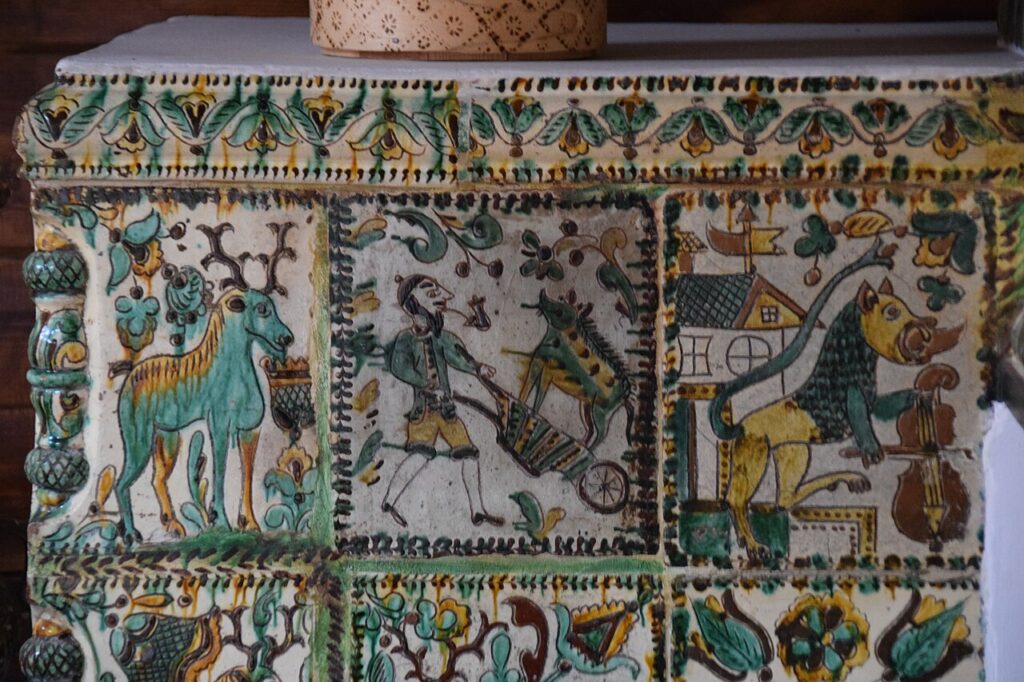

During firing, the green paint bleeds and runs like a watercolor. In the ceramics made in the western Ukrainian town of Kosiv, this running is called a “tear.” When UNESCO’s Intergovernmental Committee inscribed the “Tradition of Kosiv painted ceramics” on the Intangible Cultural Heritage Representative List in December 2019, its decision mentioned this “tear” too.
Kosiv, a Town in the Hutsul Region
Kosiv (Косів) is a town in Ivano-Frankivsk oblast. According to the Internet Encyclopedia of Ukraine (Canadian Institute of Ukrainian Studies at the University of Alberta; this entry was first published in 1988), it first appears in written sources in 1424. From 1869 to 1939 it was the seat of a county, and served as the administrative and commercial center of the Hutsul region, home to the Hutsul people of the Carpathian Mountains. Its population is 8,627 (2017). Alongside wood carving, woven kilims and embroidery, it has long been known for its pottery as well.
The nomination file Ukraine submitted to UNESCO in 2018 names the current centers as the town of Kosiv and the nearby villages of Pistyn, Verbovets, Staryi Kosiv and Kuty. It states that, from the late 18th century to the mid-20th century, the largest concentration of craftspeople was in the village of Pistyn, and that Kosiv later became the center once a local branch of the artists’ union, an art school and workshops were established there. The nomination file also lists “Hutsul ceramics” and “Pokuttia ceramics” as alternative names.
Scratch, Fire, Paint, Fire Again
The process described in the nomination file is as follows.
- The piece is shaped from local gray clay, and coated with a white slip (engobe, a cream-textured white clay)
- Once dry, the outline is drawn by scratching the surface with a thin metal rod (a technique called “rytuvannia” in Ukrainian). Some of the areas enclosed by the lines are filled in with brown slip
- It is dried further and fired at 950°C, then painted with metal-oxide pigments and fired a second time
During the second firing, the pigments turn the traditional green and yellow. The nomination file calls coloring in these three colors — green, yellow and brown — an “indispensable feature,” stating that this color scheme is what makes the pottery recognizable as “Hutsul” or “Kosiv.” Some potters add a touch of cobalt blue, but the file notes that this is kept to a degree that does not lose the traditional coloring. The “tears” mentioned at the top are the green bleeding and spreading during firing.
The entry “Kosiv ceramics” in the Great Ukrainian Encyclopedia (VUE), Ukraine’s national encyclopedia (written by H. M. Ivashkiv), likewise places at the center of Kosiv ceramics the technique of scratching grooves into the white-slipped, unfired body with a nail or wire, and painting in the “three colors” of brown, green and yellow. The nomination file states that both wood-fired kilns and electric kilns are used.
What Has Been Depicted
UNESCO’s decision places the greatest distinguishing feature of Kosiv ceramics in the representational nature of the motifs, which it states express “the history, life, folklore, beliefs, customs, and surrounding flora and fauna of the Hutsul people.”
VUE divides examples from the 19th to early 20th century as follows. The most common are plant motifs — rosettes, tulips, leaves, grapes, potted plants, the “Tree of Life,” and others. Geometric motifs are less common. Animal motifs include small birds, roosters, peacocks, goats, cattle, lions, horses, fish and crayfish. Figures include religious images of the Virgin Mary or Saint Nicholas; scenes of everyday work by trade — potters, millers, musicians, farmers plowing, and weavers; genre scenes such as “at the tavern” or “leading a bear”; and images of churches with three or five domes.
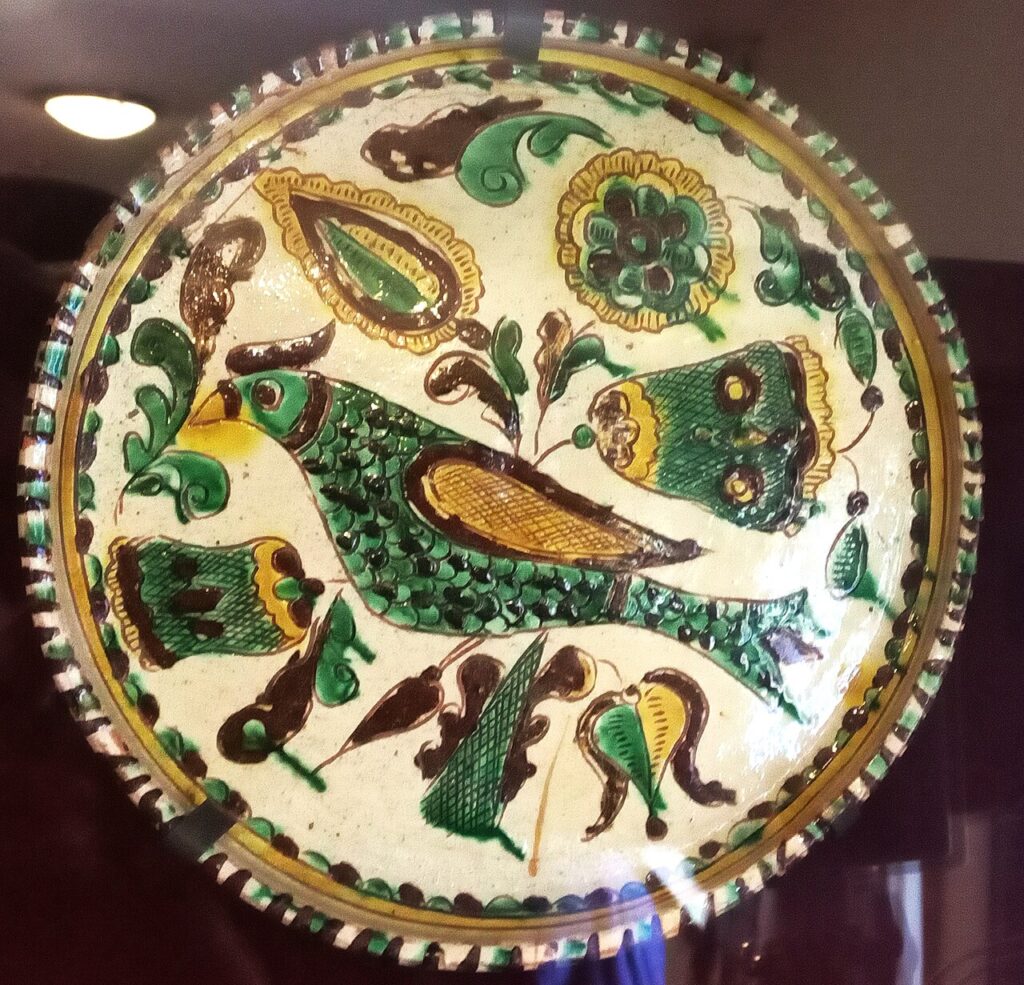

Vessels are not the only thing made. Besides tableware, the decision lists ritual objects, toys and tiles. According to IEU’s entry “Ceramics” (first published 1984), Kosiv is also known for distinctively shaped tiled stoves with painted tiles; potters in Kosiv made more than 400 such stoves in the 19th century, most of which are now in museums. VUE likewise states that tiled stoves are the most numerous surviving examples from the 19th to early 20th century.
The Potters Whose Names Survive
According to VUE, the potter P. Havryshchiv first introduced, in the 1830s–40s, the technique of scratching lines with a pointed tool into a white-slipped, dried vessel, later moving fully over to this technique. In the 1840s–50s, the potter I. Baraniuk worked in this technique, followed from the 1860s by his student Oleksa Bakhmatiuk. Bakhmatiuk exhibited at ethnographic exhibitions in Vienna (1873), Lviv (1877), and Kolomyia (1880). IEU also names Bakhmatiuk as one of the finest Hutsul potters of the late 19th century.
VUE states that Kosiv had 20 potters in the 1880s and 23 by the end of the 19th century. UNESCO’s decision states that this tradition arose in the 18th century and reached its golden age in the mid-19th century.
Passed Down by School and Family
According to the nomination file, a ceramics department was established at the Kosiv School of Applied Arts in 1959. This school is now the Kosiv Institute of Applied and Decorative Arts of the Lviv National Academy of Arts (VUE). The decision states that the ceramics department at the Kosiv school bears a special responsibility for bridging generations, and maintains the full traditional process — the wheel, clay, tools and kiln.
As to the number of practitioners, the nomination file states “about 70.” Most are craftspeople who graduated from the Kosiv school and work in their own studios, and about 20 of them produce work at the studio of the Kosiv branch of the National Union of Artists of Ukraine. Tile makers form a separate group. In family workshops, the file explains, men often handle heavy work such as preparing and shaping the clay, making tiles, and firing the kiln, while women often handle the painting.
Consent for the nomination was shown in a document signed by 34 people (19 women, 15 men) at a gathering held during the local festival “Malovanyi Dzhbanyk” (painted pitcher) in 2014. In 2017, 9 tile makers separately sent a letter of consent. The nomination file lists avoiding imitations that depart from the traditional technique and excessive commercialization as challenges, and set out plans to support makers who preserve the traditional process through festivals and awards.
From a National List to UNESCO’s List
According to the nomination file, the Tradition of Kosiv painted ceramics was one of the first elements listed when Ukraine’s national inventory of intangible cultural heritage was created by Ministry of Culture Order No. 1521 of December 14, 2012, and holds entry number 1 on the list.
UNESCO’s inscription was decided at the 14th session of the Intergovernmental Committee, held in Bogotá, Colombia, in December 2019. Ukraine’s Ministry of Foreign Affairs announced that the decision was made on December 12. This was the second Ukrainian element to be inscribed on the Representative List, following Petrykivka decorative painting in 2013.
All of Ukraine’s intangible cultural heritage elements on UNESCO’s list are covered in our article “Ukraine’s Cities and World Heritage”, eggs decorated with beeswax patterns in our article on pysanky, and embroidered shirts whose techniques vary by region in our article on vyshyvanka.
Sources and article record
Sources and references
- Tradition of Kosiv painted ceramicsthe introduction of the element; 2019, 14.COM, the Representative List
Published by UNESCO Intangible Cultural Heritage · Checked: 2026-09-24 - Decision of the Intergovernmental Committee: 14.COM 10.B.40the decision text; the 18th-century origin; the mid-19th-century golden age; the slip, scratched lines, green and yellow, and "tears"; the content of the motifs; the ceramics department at the Kosiv school; the national inventory
Published by UNESCO Intangible Cultural Heritage · Checked: 2026-09-24 - Nomination file No. 01456 for inscription in 2019 on the Representative Listthe file itself; the central town and villages; alternative names; "about 70" and "about 20" practitioners; the process and 950°C; the three colors; the division between men and women; the 1959 ceramics department; the 2014 consent of 34 people and the 2017 consent of 9 tile makers; National Inventory Ministry of Culture Order No. 1521 of December 14, 2012, entry no. 1; signed February 28, 2018
Published by Ukraine (published by UNESCO) · Checked: 2026-09-24 - Український елемент «Традиція Косівської мальованої кераміки» включено до Репрезентативного списку… [The Ukrainian Element "The Tradition of Kosiv Painted Ceramics" Has Been Included in the Representative List…]December 12, 2019; the 14th session of the Intergovernmental Committee, Bogotá
Published by Ministry of Foreign Affairs of Ukraine · Checked: 2026-09-24 - Косівська кераміка [Kosiv Ceramics]H. M. Ivashkiv; the technique and the three colors; the potters Havryshchiv, Baraniuk and Bakhmatiuk and their exhibition years; 20 potters in the 1880s, 23 by the end of the 19th century; the classification of motifs; tiles; the school's history
Published by Great Ukrainian Encyclopedia (State Scientific Institution "Encyclopedic Publishing House") · Checked: 2026-09-24 - Kosivfirst published 1988; the first written mention in 1424; the county seat 1869–1939; a population of 8,627 [2017]; crafts
Published by Internet Encyclopedia of Ukraine (CIUS) · Checked: 2026-09-24 - Ceramicsfirst published 1984; 18th-century vessels and tiles from Kosiv and Pistyn; more than 400 19th-century stoves; potters at the end of the 19th century
Published by Internet Encyclopedia of Ukraine (CIUS) · Checked: 2026-09-24
If you find an error in this article, please tell us via Corrections. Once we have checked it, we will record in the article what was corrected and why.
Related articles
-
Taras Shevchenko: The Poet the Tsar Forbade to Write or Paint
Born a serf, Shevchenko had his freedom bought with the proceeds of a portrait raffle and was also a painter trained at the Academy of Arts. After his arrest in 1847, he spent 10 years under the Tsar's order forbidding him to write or paint — and still wrote poems and made pictures. This is the life of the poet who made Ukrainian the language of modern literature.
-

Ukraine’s Rivers Flow to Three Seas — Water Systems, Climate, and Chernozem
Ukraine's river water heads not only to the Black Sea but also to the Sea of Azov and the Baltic Sea. This article sets out the basins of Ukraine's major rivers as recorded in the National Water Cadastre, its natural zones and climate, and the extent and degradation of its chernozem, attaching the issuing body and date to every figure. Even Japan's own public bodies do not agree on the country's area.
-

What Happened in Kakhovka the Day the Russian-Controlled Dam Broke
In the early hours of June 6, 2023, the dam of the Kakhovka Hydroelectric Power Plant on the Dnipro River—under Russian military control since February 2022—collapsed in an explosion. Downstream, at least 80 settlements were flooded; upstream, the reservoir that was the drinking-water source for more than 700,000 people began to dry up. The United Nations and the Ukrainian government estimate the damage and losses at nearly $14 billion.